9 October 2026, 06:22
Loading...
Czech Karviná waste plasma gasification project fails to secure billion-crown subsidy
Ekonews.cz
2 November 2024, 12:13
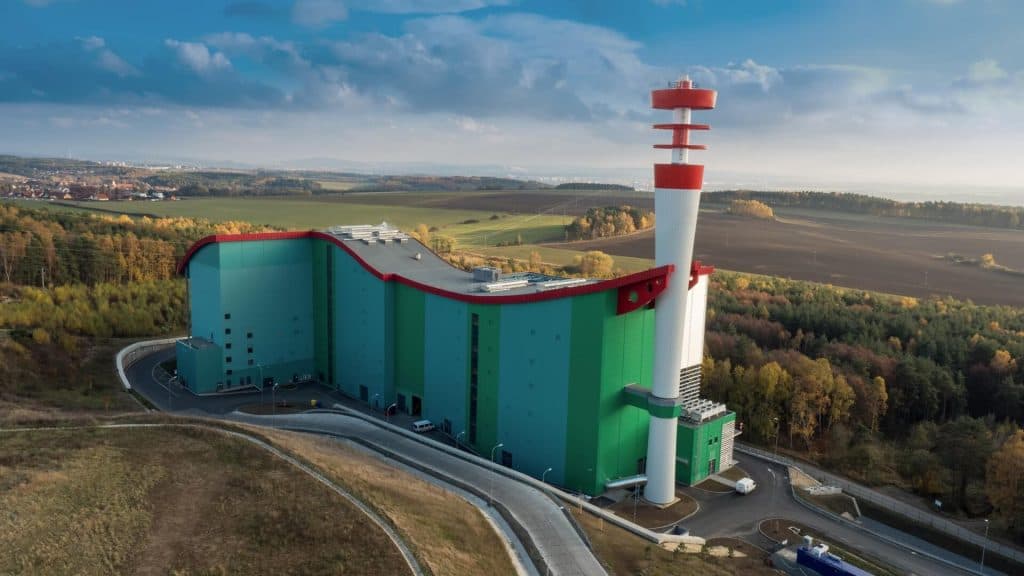
A project involving waste plasma gasification technology at the site of a former mine in the Karviná region was also seeking a billion-crown subsidy from the fund for transforming coal regions. It has now emerged that Pavel Telička, a former ANO MEP, is a co-owner of the applicant for the funding.
The Podolupark project, described by its authors as a “modern industrial park with a key innovative feature” in the form of plasma gasification technology, was to be built on the grounds of the former 9 May Mine near Stonava in the Karviná region, which belonged to the bankrupt company OKD. Pavel Telička represented the interests of then-shareholder Zdeněk Bakala on the board of directors of its parent company, New World Resources, years ago.
He has now “returned” to the Moravian-Silesian Region. The former diplomat, ANO MEP and professional lobbyist is a minority shareholder in Podolupark Holding, which applied for the billion-crown subsidy through Podolupark LandCo. This follows from documents filed with the commercial register this year.
The Podolupark project, based on the energy-intensive plasma gasification technology that Ekonews previously described in detail, ultimately failed to secure the subsidy.
“I have been intensively involved in the circular economy from a regulatory perspective for many years, and I therefore support innovative technologies. At the same time, I work in strategic advisory services. My role was therefore primarily on the strategic side, also because I did not see the plasma dimension as the main one, as you write,” Telička told Ekonews in response to questions. According to him, his role “certainly was not related to European funds, although I would be pleased if the innovative park contributed to the transformation of the region”.
Last-minute change
The original applicant for the technology subsidy was PDI, a joint-stock company. Twenty billion crowns had been earmarked for major projects under the Just Transition Operational Programme (OPST), with Podolupark originally applying for one billion crowns, according to the documents. Under the initial proposal, total project costs were to reach seven billion crowns, including the restoration of the former 9 May Mine near Stonava and a “modern waste management solution” using a plasma incinerator.
PDI is backed by German-born businessman Grischa Kahlen, who has unsuccessfully attempted to launch plasma gasification projects in Czechia and Europe several times over the past twenty years. He has also received several subsidies for the technology in the past.
However, PDI ultimately did not apply for public funding for the Podolupark project. Instead, the subsidy was sought by affiliated company Podolupark LandCo, which owns the land at the former mine site, having bought it three years ago from then state-controlled mining company OKD for 83 million crowns.
Podolupark Holding in the background
Kahlen is one of four managing directors at Podolupark LandCo, which is owned by Podolupark Holding, whose shareholders were not publicly known until last year. A three-fifths majority in Podolupark Holding is owned by Stonava Invest, controlled by three Prague-based property developers: Thomas Samii, Martin Žižka and Alexander Adámek.
One fifth of the holding is held by Michal Teuer, an Ostrava businessman who was previously involved in the case of Moravian-Silesian lobbyist Martin Dědic, who was convicted in a non-final ruling of manipulating public procurement contracts at Ostrava City Hall. Teuer was not accused of any wrongdoing in the case.
An 11% stake in Podolupark Holding is held by PDI, which was the original subsidy applicant and whose two-thirds shareholder, according to the register of beneficial owners, is Kahlen. He is a member of Podolupark Holding’s board of directors.
The remaining 9% of Podolupark Holding is held by Pavel Telička. Telička said he acquired his stake in the company “as part of standard business activities and in cooperation with the main shareholder [Stonava Invest, editor’s note], with whom he not only works but also has a friendly relationship”.
Plasma gasification technology initially interested him as a means of processing waste. “Over time, however, it became apparent that the ideas and promises of some shareholders were not necessarily realistic in the near term. This is my personal view; some other shareholders may not share it,” he said. He added that he deliberately speaks of his role in Podolupark Holding in the past tense.
“I am still a shareholder at this point, but I expect that to change fairly soon,” he added.
Project without potential
According to the evaluators, changing the subsidy applicant from PDI to Podolupark LandCo was one reason why they issued a negative opinion on the public funding application. “Based on the opinion of both the Regional Standing Conference and the selection committee, Podolupark in its current form is excluded from funding under the call intended for strategic projects,” confirmed Veronika Krejčí, a spokeswoman for the Ministry of the Environment.
However, this was not the main reason why the Podolupark project did not receive public support. According to Hana Truncová, a representative of the State Environmental Fund, speaking at a meeting of the Moravian-Silesian Region’s Regional Standing Conference, the proposal was sparse and the project lacked transformation potential for the region.
Moreover, the plasma gasification technology failed to meet the requirement that it should not be an investment focused on the energy recovery of waste. In other words, a condition for receiving the subsidy was that waste material should be turned into something reusable, rather than merely energy.
Kahlen previously claimed that PDI had prepared two options. It intended to use lower-energy municipal waste to generate electricity and heat for the site and beyond. It also planned to produce usable materials and chemicals from non-recyclable waste plastics.
Members of the interministerial expert group also raised a number of other objections that led them not to recommend the project (the Ministry of the Environment’s committee had the final say on approving the subsidy, editor’s note). Evaluators noted, for example, that the fund could not reimburse land reclamation and remediation either, as these should by law have been paid for by the mine’s original owner. The minutes also show that the company requested reimbursement of costs for photovoltaics, for which it had received a 43 million-crown subsidy from another source, the Modernisation Fund, in spring last year.
“Based on the above comments and conflicts with OPST rules, the interministerial expert group does not expect that the applicant’s response could affect the final decision not to recommend the project,” Truncová said at the meeting of the Moravian-Silesian Region’s Regional Standing Conference.
More than a quarter of subsidies allocated
Grischa Kahlen did not respond to questions on whether the plasma gasification project would continue despite the subsidy not being approved. When Ekonews described the technology, which operates nowhere at commercial scale, last year, Kahlen claimed that he would launch the project regardless of whether it received state support.
At the aforementioned regional conference, officials advised the new subsidy applicant, Podolupark LandCo, to shift its focus to another form of support. “We recommend changing the status of the Podolupark Karviná strategic project to a strategic brownfield and financing it through a loan instrument and calls intended for this type of project, provided that the project meets all evaluation criteria and the conditions of the calls,” they said.
“It will also have the opportunity to apply for funding from the so-called MSK Brownfield Fund, a loan instrument that we are preparing under the OPST and expect to launch in 2025,” added Krejčí, the Environment Ministry spokeswoman.
Podolupark is not the only strategic project that will not receive an OPST subsidy. According to the ministry spokeswoman, the Education District project in the Moravian-Silesian Region and the Vl:Aštovka project in the Karlovy Vary Region were also rejected.
By contrast, 16 projects are already certain to receive subsidies, although the benefits of many of them are questionable, as Ekonews previously reported. So far, projects worth 7.6 billion crowns have been approved in the Moravian-Silesian Region, three billion crowns in the Ústí Region and 2.3 billion crowns in the Karlovy Vary Region. In total, 41 billion crowns is to go towards supporting the transformation of coal regions.
Republished from the online portal EkoNews.cz, a website covering business and sustainability.
Translation disclaimer
This article is a machine translation of the Czech original and has not yet been fully reviewed. In case of any doubt, please refer to the Czech version.
Sdílejte článek prostřednictvím:
You might also like

8 October 2026, 10:05