3 October 2026, 13:01
Loading...
EU seeks tighter oversight of fossil fuel support, Czech Republic holds surprising lead

Martin Voříšek
1 February 2022, 18:20
The European Commission is planning stricter oversight of member states’ efforts to reduce support for fossil fuels. The EU’s aim is for member states to gradually phase out fossil fuel support and for support for renewable sources to match the European Union’s increased climate targets.
The European Union is planning further measures to make it harder for fossil fuels to compete economically. This time, it is focusing on their direct and indirect support schemes and subsidies.
According to a recent report by the European Court of Auditors, these subsidies totalled EUR 52 billion in 2020, EUR 4 billion less than in the previous year. However, the decline was also due to an overall fall in energy consumption in the European Union, making further reductions uncertain.
One positive conclusion of the report from the European Commission’s perspective is certainly that, on average, renewable sources receive more support than fossil fuels. However, in a total of fifteen member states, support for fossil sources is higher than support for renewable sources.
The statistics bring very positive news for the Czech Republic. In a comparison of member states based on the ratio of fossil fuel subsidies to subsidies for renewable sources, the Czech Republic ranks first, followed by Germany and Spain.
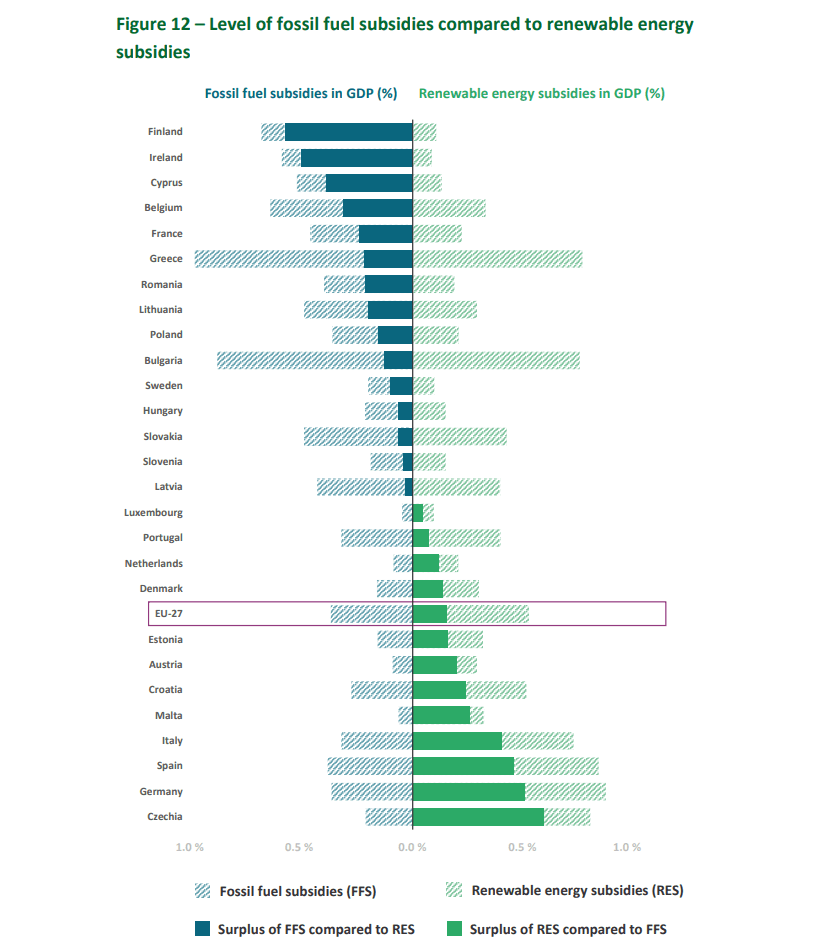
Ratio of support for fossil and renewable sources in relation to gross domestic product
To give the European Union greater oversight of the level of support for fossil sources, it is preparing the necessary legislation. Under it, member states would be required to report on reducing support for fossil fuels. The rules should apply from 2023.
Fossil fuel subsidies can take many forms, from support for the construction of gas infrastructure and reduced tax burdens to the free allocation of emissions allowances to district heating plants burning fossil fuels. As the cited report states, in some cases tax advantages for fossil fuels may even be greater than those for some cleaner alternatives.
Approval of the rules will be difficult, with the impact on households posing a risk
Last year, as part of the Fit for 55 package, the EU published an amendment to the directive changing the structure of the framework rules on the taxation of energy products and electricity. Its main objective is to level the tax playing field in favour of renewable energy sources.
However, the approval process requires changes to be adopted unanimously. Each member state can therefore block the adoption of the new rules.
Given high energy commodity prices, the impact of the new regulation on households will also be important. If the new tax structure proposed by the Commission were to place an even greater burden on households, reaching agreement on the measure would be complicated.
If the rules on the new taxation are ultimately approved, it will likely be the result of a broader compromise on the shape of European energy regulation through to 2030 and beyond.
Translation disclaimer
This article is a machine translation of the Czech original and has not yet been fully reviewed. In case of any doubt, please refer to the Czech version.
Sdílejte článek prostřednictvím:
You might also like
3 October 2026, 07:43

2 October 2026, 21:55
2 October 2026, 15:14