23 October 2026, 14:38
Loading...
Germans still pay Europe’s highest electricity prices; Czech businesses pay the EU’s fourth lowest

David Vobořil
12 January 2019, 13:35
On Wednesday, the European Commission published statistics on electricity prices in individual European Union member states for 2017. Germany has traditionally remained at the top. Czech households are significantly below the EU average, while Czech industry pays the fourth-lowest electricity price in the EU. Current household electricity prices and the cheapest offers can be found HERE.
Households
Final household electricity prices in the EU fell in 2017 for the first time since 2008, due to a halt in the rising trend in network charges, renewable energy support levies and other taxes and charges included in the final electricity price. Excluding network charges, these account for an average of 40 % of the average final electricity price in the EU.
German households traditionally pay the most for electricity, with an average of 0,305 EUR/kWh (7,8 CZK/kWh), closely followed by households in Denmark and Belgium. At 0,144 EUR/kWh (3,7 CZK/kWh), the Czech Republic remains significantly below the EU28 average of 0,204 EUR/kWh (5,2 CZK/kWh).
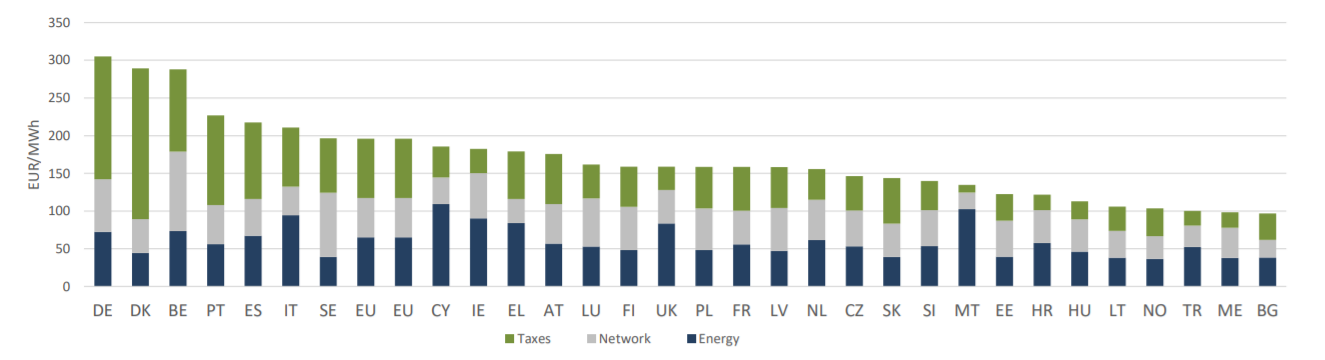
For example, a Czech household consuming 3,5 MWh will pay approximately CZK 12 800 for its annual electricity bill, CZK 5 400 less than the average European household and CZK 14 400 less than a household in Germany.
When calculated as a share of average annual household income, the above expenditure accounts for 6,1 % of total income in the Czech Republic, compared with 4,2 % for an average EU household and 4,9 % for a German household.
Businesses
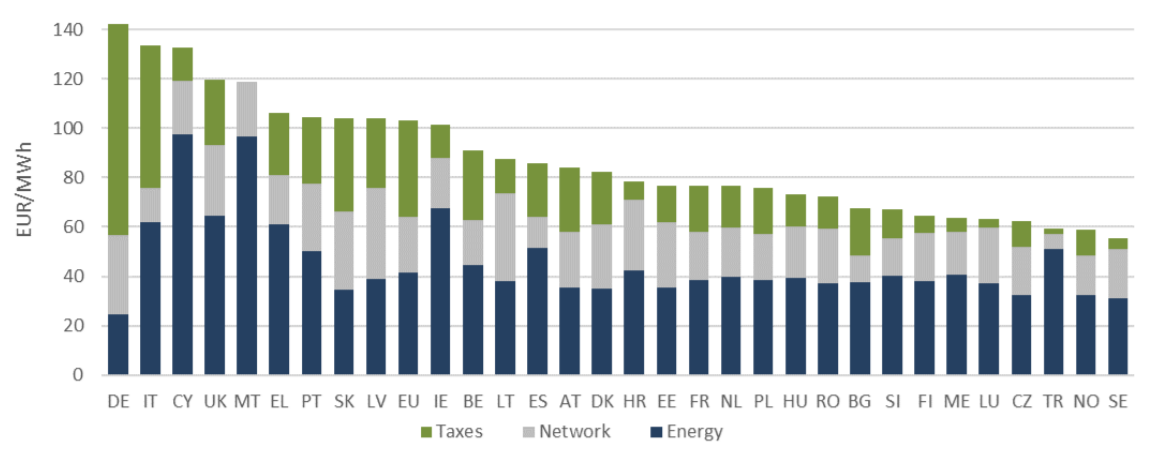
German companies also pay the most for electricity. While the price of energy-only electricity in Germany is the lowest in the entire EU, network charges and other fees and taxes—which account for more than 80 % of the final electricity price for an average business—propel Germany into the unenviable top spot.
However, it should be noted that the most energy-intensive industrial sectors in Germany, as well as in some other countries, are granted tax and levy exemptions in order to preserve their competitiveness.
Prices for businesses fell between 2015 and 2017, mainly thanks to the declining price of energy-only electricity. However, this trend has reversed, and particularly last year, energy-only electricity prices recorded a very significant increase, mainly due to rising emissions allowance prices. At the end of 2018, the price of electricity on the Leipzig exchange for delivery in the following year was 180 % higher than its 2016 low, reaching a 10-year high.
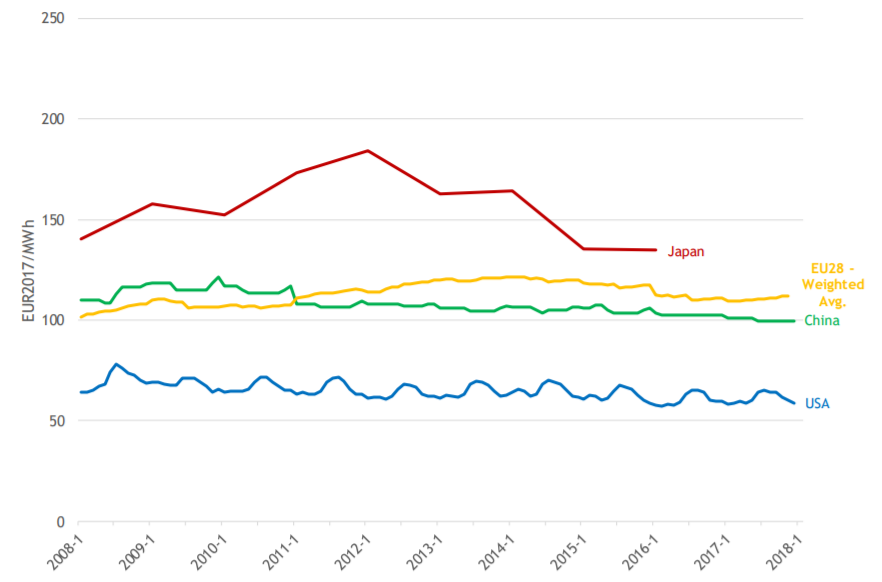
When comparing the average price for businesses with other major global economies, the historical trend remains unchanged. Retail electricity prices in the EU are higher than in the US, Canada, Russia, China and Turkey, but lower than in Japan and Brazil. Retail prices are generally less volatile than wholesale markets, as suppliers mostly offer fixed-price contracts and only a small share of contractual arrangements consist of dynamic-price tariffs dependent on price developments in wholesale markets.
Translation disclaimer
This article is a machine translation of the Czech original and has not yet been fully reviewed. In case of any doubt, please refer to the Czech version.
Sdílejte článek prostřednictvím:
You might also like
23 October 2026, 11:01
23 October 2026, 06:34