
23 October 2026, 14:38
Loading...
Energy prices and energy policy prompt more German companies to consider relocating production

David Vobořil
6 August 2024, 06:53
Four in ten industrial companies in Germany are considering scaling back production in the country or moving some of their production capacity abroad due to uncertainty about energy policy and high energy prices. This is according to a survey by the Association of German Chambers of Industry and Commerce (DIHK).
Around 37% of the 3,000 companies surveyed said they were considering scaling back production or moving some of their production capacity abroad. The figure was 32% in 2023 and 21% in 2022. Among energy-intensive companies, 45% are considering these steps. Of large companies with more than 500 employees, 51% said this could be one option.
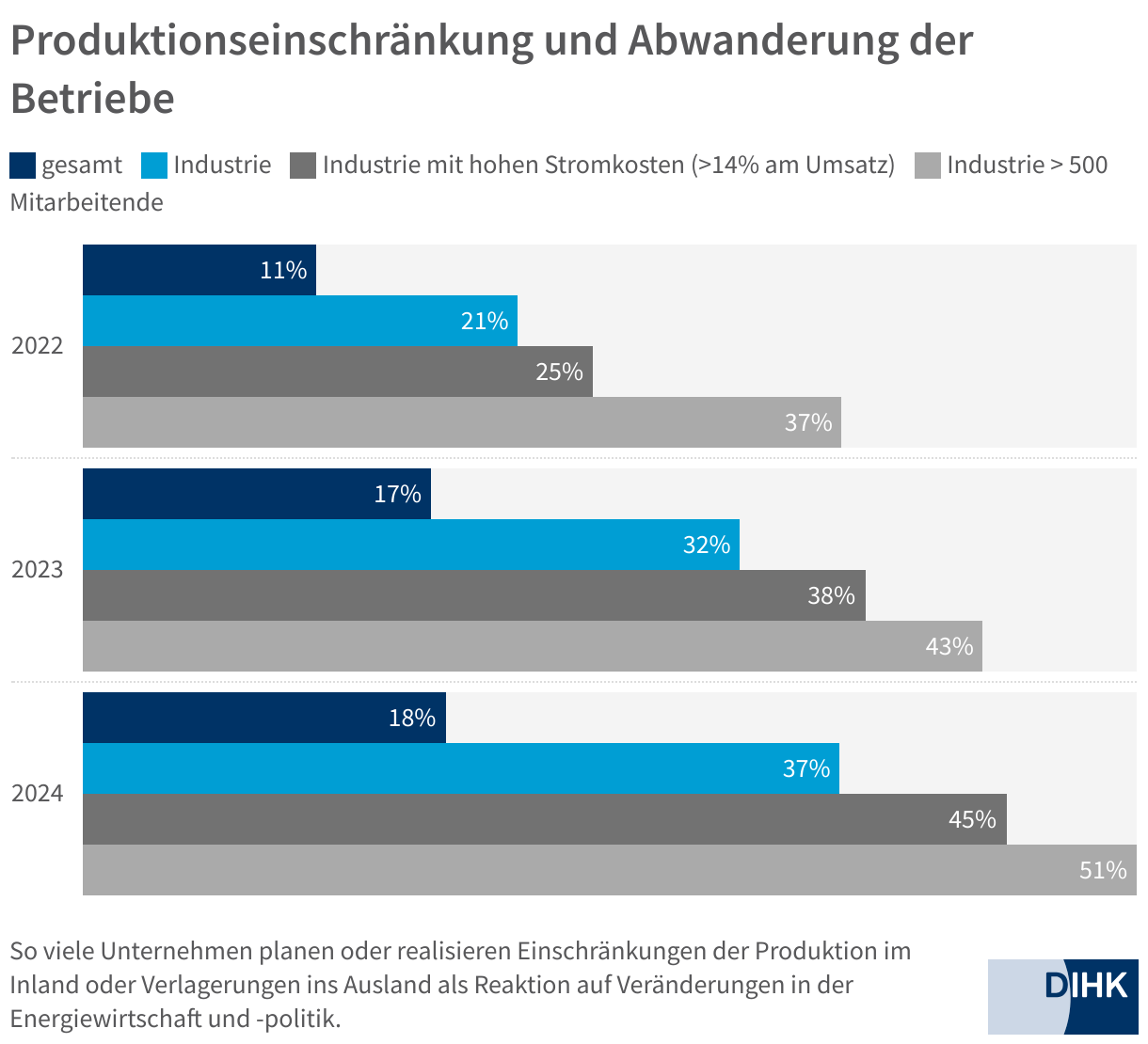
Share of German companies planning or implementing production cuts in Germany or relocating production abroad. Source: DIHK
"German businesses’ confidence in energy policy has been seriously damaged," said Achim Dercks, deputy chief executive of the DIHK.
The German government has so far failed to give businesses a clear outlook for reliable and affordable energy supplies in the future, Dercks said, adding that more and more businesses now see the energy transition as a threat rather than an opportunity.
Asked how they viewed the impact of the energy transition on their competitiveness, respondents gave a negative assessment on average, with energy-intensive businesses expressing more negative views.
"Businesses continue to see far more risks than opportunities," Dercks said, arguing that the government had so far failed to adequately address concerns that have risen sharply since the energy crisis in 2022.
Dercks warned that if no countermeasures are taken, Germany could be on the brink of lasting deindustrialization. Many of the businesses surveyed said high energy prices were preventing investment in climate measures, research and other areas. According to the survey, bureaucracy and a lack of planning certainty were cited as the main factors negatively affecting business sentiment.
The survey also found, for example, that improving their own energy supply and securing long-term power purchase agreements (known in English as Power Purchase Agreements, or PPAs) are becoming increasingly important not only for industry but for all companies.
As for supply reliability, four out of five companies see bottlenecks in transmission and distribution grids as a growing problem for stable energy supplies. Reliable access to hydrogen is also becoming increasingly important for businesses. Nearly two-thirds of companies are therefore calling for greater planning certainty in this area.
Impact of the energy crisis
The energy crisis in 2022, which saw an unprecedented rise in prices across Europe, particularly for natural gas, hit the German economy hard as the country was recovering from the coronavirus pandemic.
Although wholesale gas prices have fallen significantly from their peak in the summer of 2022, they remain above the long-term average and continue to hamper a full recovery of German industry and the economy. Chancellor Olaf Scholz’s government has adopted a range of measures to lower prices, reduce bureaucracy and accelerate the recovery of industry.
Industry representatives, however, say these measures still fail to address the underlying problems and are taking too long to implement to pull Europe’s largest economy out of its current downturn.
Translation disclaimer
This article is a machine translation of the Czech original and has not yet been fully reviewed. In case of any doubt, please refer to the Czech version.
Sdílejte článek prostřednictvím:
You might also like


23 October 2026, 11:01


23 October 2026, 06:34