1 October 2026, 18:46
Loading...
Germany reverses course on gas, orders state importer to replenish unusually low stocks
Adam Sosna
1 October 2026, 16:01
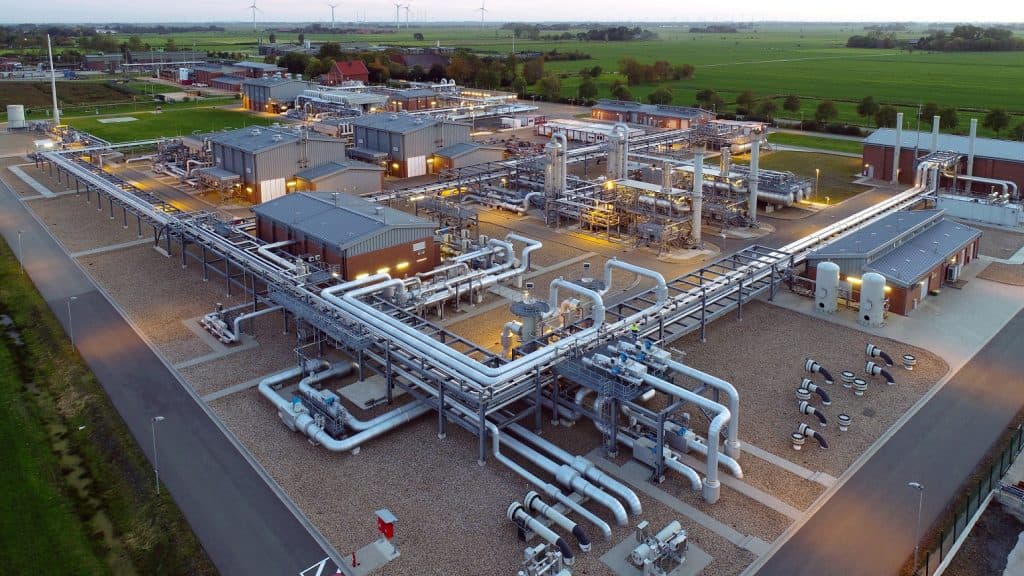
The German government has ordered state-owned gas importer SEFE to speed up the filling of unusually low gas storage levels and buy and store an additional 8 TWh of natural gas by mid-December. Merz’s cabinet has thus intervened directly in the market, something it had so far sought to avoid over concerns that it could drive prices up further. Storage facilities across the EU are 71 percent full, while Germany’s are only 58 percent full. Although European institutions still consider supplies stable, low reserves make the market more vulnerable to winter weather and disruptions to LNG imports.
Chancellor Friedrich Merz’s cabinet is instructing its company Securing Energy for Europe (SEFE) to buy and store an additional 8 TWh of natural gas by 15 December. SEFE’s chief commercial officer, Hamead Ahrary, confirmed the report by Handelsblatt. The Federal Ministry for Economic Affairs and Energy said Minister Katherina Reiche had agreed on the approach with the chancellor in response to persistent geopolitical risks.
This is not a blanket order to all importers, but a directive from the state in its capacity as the company’s owner. While Reiche merely urged the company to accelerate filling in mid-September, the purchases are now mandatory. The ministry also expects other market participants to continue securing winter supplies. It describes the decision as a signal to them as well.
Germany consumed 864 TWh of gas last year, according to regulator Bundesnetzagentur, so the mandated purchases represent just under one percent of annual consumption. Relative to Germany’s total storage capacity of approximately 247.5 TWh, the additional volume amounts to about 3.2 percentage points of capacity. The measure will therefore bolster reserves. Low storage levels are not just a German problem, however.
Europe has a smaller cushion. Germany is among the laggards
According to the AGSI platform of the Gas Infrastructure Europe association, EU storage facilities were 71.54 percent full as of 29 September, equivalent to approximately 809 TWh of stored gas. On the same day last year, they were approximately 82.5 percent full, while the average for 2021 to 2025 was 86.9 percent. This year’s level is therefore about 15.5 percentage points below the five-year average.
German storage facilities were only 58 percent full on the same date. The Netherlands, also one of the EU countries with the largest gas storage capacity, is in a very similar position. Italy currently has the largest volume of natural gas in storage, while France also reports high fill levels. Czech storage facilities are 76.5% full, above the European average. In absolute terms, that amounts to 34.6 TWh.
Despite the low fill level, German storage facilities currently hold 143 TWh of natural gas. Supply security must therefore be assessed based on a combination of stocks, available imports, infrastructure and demand, rather than a single indicator. Nevertheless, weaker reserves leave Germany with less room to cope with another supply disruption without significant price effects.
Summer gas was too expensive to store
This year’s situation is the result of a combination of adverse circumstances. After a colder winter, the EU entered April with storage facilities only 28 percent full. Over the summer, LNG outages in the Persian Gulf related to the war in Iran and disruption to shipping through the Strait of Hormuz hampered efforts to replenish reserves.
For traders, however, the key factor was not only the high price of gas itself, but also the spread between the spot purchase price and the price for future winter sales. This year, the usual model of buying cheaper summer gas and storing it for the more expensive winter was undermined by a low or even negative summer-winter price spread.
With this price structure, the incentive to build additional stocks beyond what is needed to secure contracted customer supplies weakens, even when storage capacity is available. European heatwaves further worsened the situation, increasing gas consumption for power generation and reducing the amount available for injection into storage. Berlin is thus grappling with the conflict between the need for a larger security buffer and market conditions that make building one economically unattractive.
There should be enough gas. But the weather will also matter
Low stocks do not in themselves mean that Europe is facing a gas shortage. Following a September meeting of the coordination group, the European Commission and member states once again confirmed that supplies remain stable. Compared with the crisis at the turn of 2021 and 2022, suppliers are more diversified, LNG import capacity has increased and European consumption has also fallen.
The weather remains a major uncertainty, however. According to models by the German storage operators’ association INES, if storage facilities were 77 percent full on 1 November, a normal winter would allow demand to be fully met and leave storage approximately 38 percent full at the beginning of April. But in the event of exceptionally low temperatures, the same initial stock would not be enough, and on some days in January the model suggests the shortfall in meeting demand could exceed 25 percent.
Reaching the initial target of 77 percent by 1 November cannot be taken for granted, either. Storage operators warned as early as the beginning of September that it would require a substantial acceleration in gas injections.
If Europe and Asia experience a cold winter at the same time, European countries would also have to compete more intensely for limited LNG supplies. German State Secretary at the Federal Ministry for the Environment Jochen Flasbarth therefore warns that even if the country has enough gas in volume terms to get through the winter, price volatility and rising gas prices could place a significant burden on its economy.
Translation disclaimer
This article is a machine translation of the Czech original and has not yet been fully reviewed. In case of any doubt, please refer to the Czech version.
Sdílejte článek prostřednictvím:
You might also like
1 October 2026, 17:03
1 October 2026, 12:05