
23 October 2026, 14:38
Loading...
Construction begins on Czech waste-to-energy plant near Most, with annual capacity of 150,000 tonnes

oEnergetice.cz, ČTK
28 August 2024, 17:46
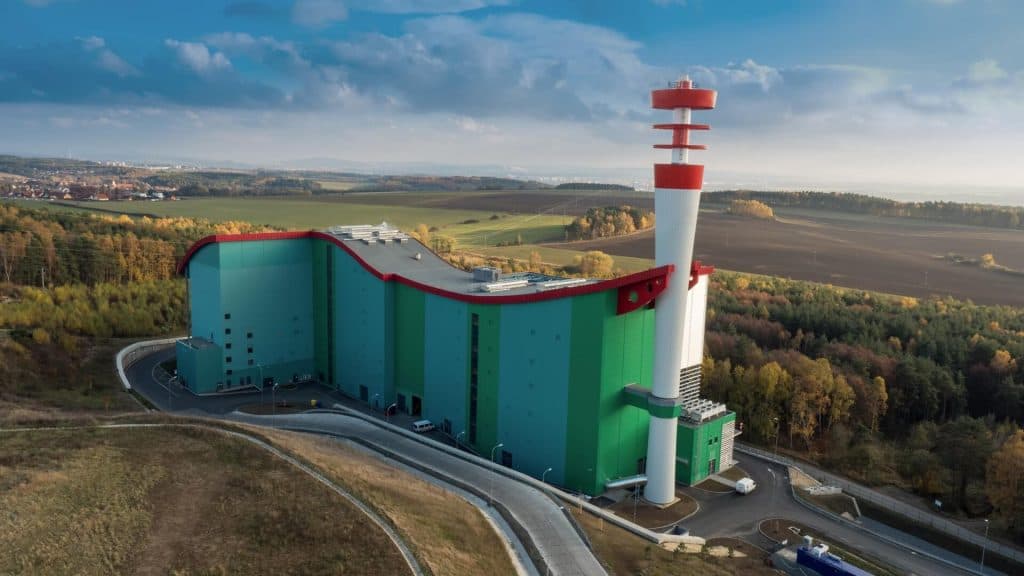
Construction has begun on a waste incinerator in Komořany near Most. The waste-to-energy facility (ZEVO) has an annual capacity of 150.000 tonnes. Construction costs exceed five billion koruna. United Energy CEO Milan Boháček said this today at the laying of the foundation stone. Half of the costs will be covered by the company, which belongs to Daniel Křetínský’s holding, from the Modernisation Fund. The facility is expected to start operating in spring 2027.
The company has signed memorandums on deliveries of unsorted waste with all the largest cities in the Ústí nad Labem Region and a number of municipalities across the region. Deliveries have also been pledged from Cheb, for example. „The incinerator is designed to process half of the waste generated in the Ústí nad Labem Region. The advantage is that it will be a relatively cheap source of heat for Most and Litvínov,“ Boháček said.
According to the CEO, operating conditions for incinerators are very strict. „The new incinerator’s emissions will be at a fraction of the limits for the existing heating plant,“ Boháček said. Using waste will save the heating plant around 120.000 tonnes of brown coal a year. „In 2027, we will use only waste, gas and existing biomass to produce heat,“ the CEO said.

Boháček said the incinerator would not mean a greater burden on transport. „Waste transport will be diverted from landfills to us; we are located in an industrial area away from public roads. For more distant locations, we are considering transport by rail,“ he said. The ZEVO facility in Komořany will not process waste from Germany. „We have committed to burning waste from the Czech Republic only,“ he said.
A waste-to-energy facility is also planned in nearby Chomutov. „The volume of waste is not falling, so we are not worried about running short of it; this may even be an advantage for municipalities,“ Boháček said. Processing the waste will produce slag, which can be used in construction. Hazardous waste will be generated only during the chemical cleaning of flue gases. The facility will burn unsorted waste—that is, the waste people put in black bins.
Municipalities in the Ústí nad Labem Region welcome construction of the incinerator, as a ban on landfilling will take effect in 2030. „The Ústí nad Labem Region should now coordinate municipalities and towns and help them negotiate the best possible terms with the incinerator,“ said regional governor Jan Schiller (ANO). „The end of landfilling is approaching, and we cannot wait for something to happen. I would like to help municipalities in the Děčín District. We are looking for a solution; a transfer station near Děčín could be an option, where municipalities would take their waste, and the City of Děčín would then be a partner for ZEVO Komořany,“ Anna Lehká (Volba pro Děčín), deputy mayor of Děčín, told ČTK. „I hope the fee will be affordable. I welcome the region’s initiative to help us reach an agreement and secure the best prices for our residents,“ Lehká said.
Translation disclaimer
This article is a machine translation of the Czech original and has not yet been fully reviewed. In case of any doubt, please refer to the Czech version.
Sdílejte článek prostřednictvím:
You might also like


23 October 2026, 11:01


23 October 2026, 06:34