23 October 2026, 14:38
Loading...
Combined heat and power (cogeneration) in Czechia

Jan Budín
26 August 2017, 13:25
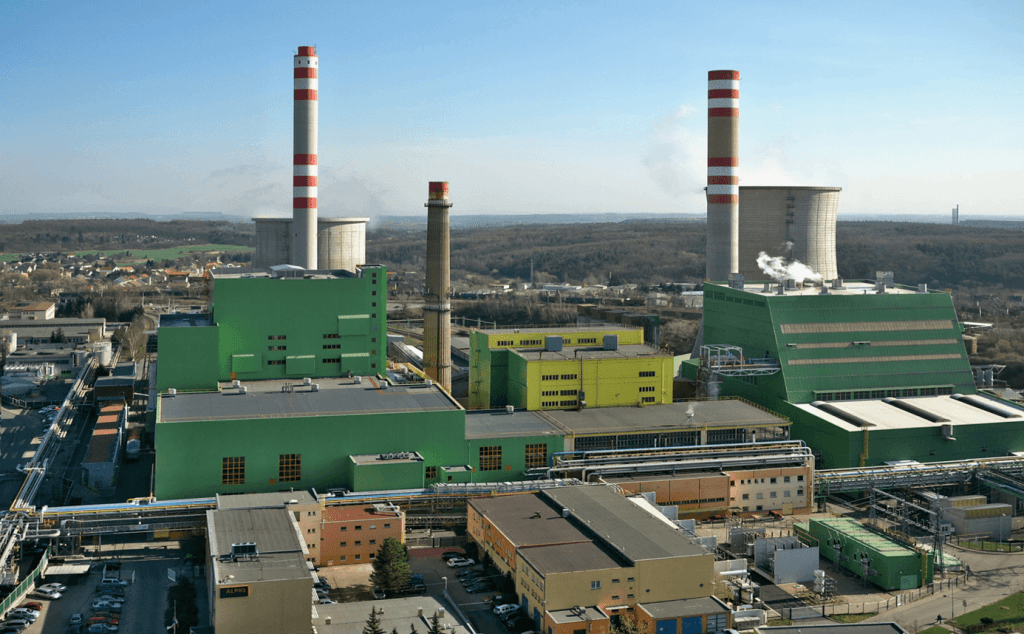
Combined heat and power (CHP), or cogeneration, is an efficient, reliable and, above all, environmentally friendly method of electricity generation, in which heat is supplied simultaneously.
By using the heat that is released into the surrounding environment without being utilised during electricity generation in conventional power plants, the overall efficiency of the energy contained in fuel is significantly increased. For comparison, conventional electricity sources (condensing power plants) achieve an electricity generation efficiency of around 30-40 %, while the overall energy generation efficiency of modern CHP plants often exceeds 90 % thanks to heat supply.
The previous article on cogeneration explained the principle of combined heat and power generation in greater detail and introduced the most commonly used CHP technologies, including their advantages and shortcomings. This article focuses on high-efficiency CHP in Czechia, particularly on trends in generation from these sources. It also outlines the legislative framework for supporting cogeneration in Czechia. Finally, it examines trends in operating support for the individual CHP categories in the Czech Republic, as well as the volume of operating support paid out.
Electricity generation from high-efficiency CHP in the Czech Republic
Cogeneration is nothing new in Czechia. It has been operated for decades in heating plants that supply heat through district heating systems serving areas ranging from groups of buildings and housing estates to entire cities. According to the Czech Republic District Heating Association, CHP accounts for nearly 2/3 of heat supplies in these systems.
According to the regularly published Annual Reports on the Operation of the Czech Electricity System, prepared by the Energy Regulatory Office, electricity generated by CHP covers more than 15 % of net electricity consumption in the Czech Republic.
The following table shows the development of electricity generation from high-efficiency CHP between 2007 – 2013 (electricity supported by a green bonus – see below).
| Installed capacity of generating plants | 2007 | 2008 | 2009 | 2010 | 2011 | 2012 | 2013 |
|---|---|---|---|---|---|---|---|
| Above 5 MWe [MWh] | 7 479 543 | 6 561 082 | 6 874 299 | 8 353 131 | 7 826 844 | 7 564 846 | 7 400 625 |
| Below 5 MWe [MWh] | 335 804 | 322 454 | 298 120 | 567 057 | 717 158 | 805 945 | 986 441 |
Electricity generation from high-efficiency CHP in the Czech Republic. Data source: Czech Republic District Heating Association
The table shows a growing trend in supported generation from small CHP units and, since 2010, a declining trend in supported generation from large sources.
CHP units with installed electrical capacity of up to 5 MWe, which are used primarily for so-called decentralised electricity and heat generation, meaning generation close to or directly at the centre of energy consumption, benefit from operating support paid for the electricity generated due to the advantages associated with the high efficiency of converting energy stored in fuel and the benefits of reducing electricity transmission and distribution losses. Sources with installed capacity above 5 MWe are also supported, but as stated below, the support for these sources is noticeably lower.
Legislative framework for supporting electricity from high-efficiency CHP
As stated above, electricity generating plants using high-efficiency CHP are among the supported energy sources. The support is enshrined in Act No. 165/2012 Coll., on supported sources and amendments to certain acts, and in the related Ministry of Industry and Trade Decree No. 37/2016 Coll., on electricity from high-efficiency combined heat and power generation and electricity from secondary sources.
At European Union level, support for high-efficiency cogeneration is based on Directive 2012/27/EU of the European Parliament and of the Council on energy efficiency (EED – Energy Efficiency Directive) and related regulations.
Operating support in the Czech Republic is implemented through so-called green bonuses added to the price of electricity generated by high-efficiency CHP. Green bonuses are set as fixed prices for individual types of CHP sources, and their annual level is determined in the relevant price decision of the Energy Regulatory Office.
Development of operating support for electricity from high-efficiency CHP
Support for electricity in the form of green bonuses for generated electricity is significantly higher for sources with installed electrical capacity of up to 5 MWe. This reflects the above-mentioned benefits of small decentralised sources. The development of the average value of green bonuses paid for the monitored categories of generating plants is shown in the table below.
| Installed capacity of generating plants | 2007 | 2008 | 2009 | 2010 | 2011 | 2012 | 2013 |
|---|---|---|---|---|---|---|---|
| Above 5 MWe [Kč/MWh] | 45 | 45 | 45 | 45 | 45 | 45 | 176 |
| Below 5 MWe [Kč/MWh] | 699 | 645 | 615 | 695 | 683 | 603 | 679 |
Average level of support for electricity from CHP. Data source: Czech Republic District Heating Association
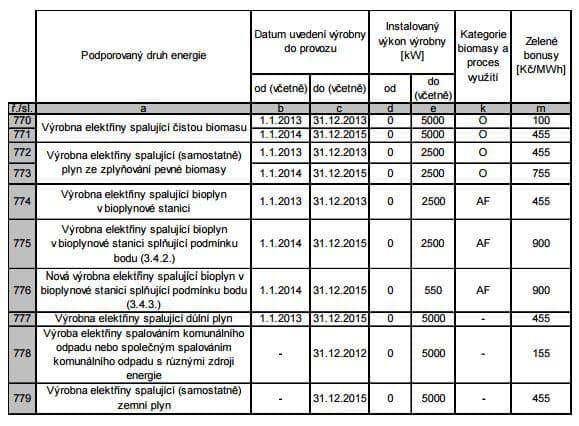
Green bonuses consist of two rates – a basic rate and a supplementary rate. Generating plants eligible for the supplementary rate are listed in the table below, while the specific formulas for calculating total support can be found in the relevant price decision of the Energy Regulatory Office.
The following tables show the basic green bonus rates for 2016. They demonstrate the substantial difference between the bonus for electricity from small CHP units and that from large CHP sources.
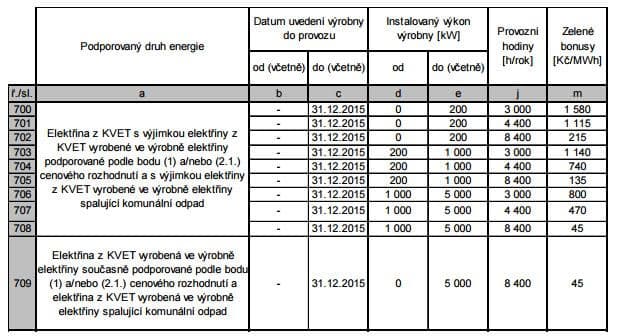
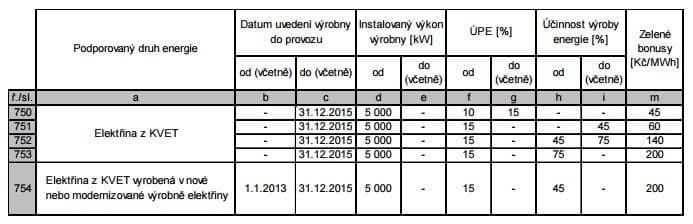
As noted above, in addition to the basic green bonus rate, some sources are also eligible for a supplementary rate. Depending on the type of generating plant, this stood at the following levels in 2016.
The following table also shows the development of total support paid in the form of green bonuses for CHP sources in the Czech Republic, broken down into sources with installed electrical capacity below 5 MWe and above 5 MWe.
| Installed capacity of generating plants | 2007 | 2008 | 2009 | 2010 | 2011 | 2012 | 2013 |
|---|---|---|---|---|---|---|---|
| Above 5 MWe [million Kč/year] | 336,6 | 295,2 | 309,3 | 374,5 | 353,6 | 340,6 | 1 300,5 |
| Below 5 MWe [million Kč/year] | 234,6 | 208,1 | 183,3 | 394,3 | 490,1 | 485,6 | 669,6 |
Support paid for electricity from CHP. Data source: Czech Republic District Heating Association
The table below shows the total support provided for electricity generating plants using high-efficiency CHP and the volume of supported electricity from 2013 to 2016.
| 2013 | 2014 | 2015 | 2016 | |
|---|---|---|---|---|
| Support paid (million Kč) | 1 970 | 1 664 | 1 899 | 1 933 |
| Volume of supported electricity (GWh) | 8 387 | 6 802 | 7 099 | 7 530 |
Operating support provided to electricity generating plants using high-efficiency CHP from 2013 to 2016 and the volume of supported electricity. Source: OTE
Current status of operating support for CHP in the Czech Republic
Although support for electricity from high-efficiency CHP is enshrined in Czech and European legislation, the Energy Regulatory Office declined to set support for these generating plants for 2016 and subsequently for 2017. The reason was the absence of European Commission notification decisions for this support scheme.
Support for high-efficiency CHP for 2016 was set only at the end of 2015 on the basis of a government regulation, and only for existing sources commissioned by the end of 2015. In 2017, support was set only for generating plants commissioned by the end of 2012 and for plants commissioned after 1 January 2016.
As of the end of August 2017, electricity generating plants using high-efficiency CHP commissioned between 2013 and 2015 were still awaiting a European Commission notification decision. In the explanatory memorandum to its draft price decision on 23 August, the Energy Regulatory Office stated that if these generating plants did not obtain the necessary notification decision by 30 September 2017, when the authority was required to publish its price decision for supported energy sources for 2018, support would not be set for these plants.
However, the Energy Regulatory Office added that should new notification decisions be issued after this deadline, the price decision would be supplemented by a further price decision.
Reference: www.kombinovana-vyroba.cz
Source of featured image: www.tzb-info.cz
Translation disclaimer
This article is a machine translation of the Czech original and has not yet been fully reviewed. In case of any doubt, please refer to the Czech version.
Sdílejte článek prostřednictvím:
You might also like
23 October 2026, 11:01
23 October 2026, 06:34