
23 October 2026, 14:38
Loading...
Global warming and reclamation of Czech mining-affected areas – Part 1
Stanislav Štýs
18 November 2015, 22:36
Rising global temperatures and the concurrent increase in the atmospheric concentration of carbon dioxide (CO2) as a greenhouse gas led to the formulation of the greenhouse hypothesis. The history of planet Earth makes it clear that climate fluctuations occur predominantly for natural reasons. New findings obtained from ice-core drilling demonstrate a relationship between temperatures and CO2 concentrations, but temperature has always been the cause, rather than the consequence, of rising CO2 concentrations. The greenhouse effect is incorrectly equated with the greenhouse hypothesis. Methods of model-based long-term projections of climate, extremely high temperatures and CO2 concentrations are objectively criticised by independent scientists. Efforts to combat climate change as thus formulated are irrationally focused, at global, European and national levels, primarily on decarbonisation. They should instead primarily target adaptation measures. The reclamation of areas following lignite mining in north-western Czechia, strongly focused on enhancing the landscape’s water-retention and storage function, is an example of adaptation measures. Lakes with volumes of up to 2.5 m3 * 10-9 will be created here, representing 45 % of the current volume of all water reservoirs and ponds in the Czech Republic, with potential for energy use in pumped-storage power plants as well, corresponding to the energy-intensive alternatives of both warming and cooling.
External context of the topic
After the Second World War came a period of social recovery, stimulated by the rapid and often extensive development of an energy-intensive economy based predominantly on readily available coal. The result was extreme pollution of the air, soil, water and forests. At first, people tolerated the principle that you cannot make an omelette without breaking eggs.
However, environmental devastation escalated into a socially intolerable situation, and the era of environmental darkness became ripe with the need to fight for a healthy environment. At that time, people also realised that global temperatures had risen substantially during the industrial period. This was linked to the growth in greenhouse gas emissions resulting from the combustion of the main energy source, coal.
Global warming therefore also became one of the protected components of the environment. At a time when combustion processes were being made cleaner and conventional emissions were being reduced, thereby improving the environment, the issue of fighting for a healthy environment began worldwide to focus predominantly on fighting carbon, or more precisely CO2 – carbon dioxide.
The climate is subject to constant change. The current climatic trend, traced from the mid-19th century, is one of warming. IPCC (Intergovernmental Panel on Climate Change) materials state that global temperature has risen by 0.74 °C over the past 100 years (at our latitudes, this is 0.35 to 0.56 °C more). Over the past 150 years, atmospheric CO2 concentration has risen from 280 ppm to the current 400 ppm. And because CO2 is a greenhouse gas, the hypothesis of a dominant influence of CO2 on rising temperature (the greenhouse hypothesis) was adopted. During the period assessed, the burning of fossil fuels, especially coal, increased significantly. Nevertheless, the prevailing view was adopted that humans are the dominant cause of warming.
The greenhouse hypothesis is based on the relationship between CO2 and temperatures. However, calculations of model forecasts are highly simplified. They are the result of linear extrapolation of CO2 concentrations, to which higher temperatures are then assigned. In forecasting terms, this is regarded as a surrogate correlation. According to the globally recognised forecasting authority Professor J. Scott Armstrong, founder of the Journal of Forecasting, climatological models are practically worthless.(9) In the article “Let’s Deal in Science and Facts” (2010), he writes: “We published a study (Green 2009), which shows that the forecasting procedures used by the UN climate panel violate 72 of 89 relevant forecasting principles…”(1)
Among independent scientists, who generally respect the upward trend in global temperatures, prevailing views hold that global temperature is primarily a function of the interaction of natural factors beyond human influence: chiefly the relative positions of the Sun and Earth (Milankovitch cycles), oscillations in solar activity, Earth’s magnetic field, plate tectonics, thermohaline circulation of ocean currents, which act as the global heat exchanger, volcanic activity, impacts of celestial bodies and cloud cover. Anthropogenic factors include aerosols, the level of albedo and literally life-giving greenhouse gases – without whose effect Earth would be frozen.
At a time when nation states had lost the power to effectively protect their citizens, the global United Nations (UN) was founded in 1945. Dozens of agencies and organisations subsequently emerged within its framework, including UNEP – the UN Environment Programme. Yet problems continued. To address them, the Club of Rome was founded by global elites in 1968. Its proclaimed idea is the need to create a New World Order with more effective approaches to democracy, the market, human freedoms and natural resources. At the initiative and under the auspices of this non-governmental association, a series of publications was gradually issued (1972 Limits to Growth, 1974 Mankind at the Turning Point, 1976 The Population Bomb and The First Global Revolution (King and Schneider 1991).
On page 70 of this last-cited publication, we learn that “democracy is no longer sufficient to solve the tasks …”, followed on page 71 by: “When you do not know what to do about domestic policy, divert attention to threats from outside. Let us unite nations against an external enemy, either a real one or one invented for that purpose.” And on page 75 it openly recommends: “In searching for a new enemy to unite us, we came up with the idea that pollution, the threat of global warming, water shortages, famine and the like could be used for this purpose. …”(in the 1991 original, on page 115 “In searching for a new enemy to unite us, we came up with the idea that pollution, the threat of global warming, water shortages, famine and the like would fit the bill.”).(7)
Fighting climate warming became part of the tendencies striving for a New World Order. In this context, the activities of the IPCC – the UN Intergovernmental Panel on Climate Change, which continually escalates the threat of anthropogenic global warming, can also be understood. This is despite the fact that the conclusions and recommendations of the IPCC are increasingly refuted each year by scientific arguments as knowledge grows, and criticised by the global scientific community.
As an opposition to the IPCC, whose members are the governments of UN member states, the International Non-governmental Panel on Climate Change (NIPCC) was established, sponsored by non-profit organisations. In April 2014, it issued an extensive scientific analysis entitled “Climate Change Reconsidered II: Biological Impacts.”(2) Its conclusions are unequivocal: human CO2 does not significantly affect the climate and is not a pollutant. On the contrary, carbon dioxide substantially benefits terrestrial and aquatic vegetation and, subsequently, animals, as is also evident from charts No. 1 and No. 2(10):
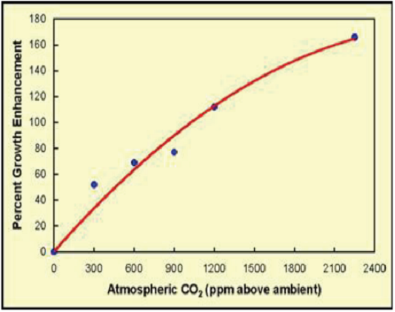
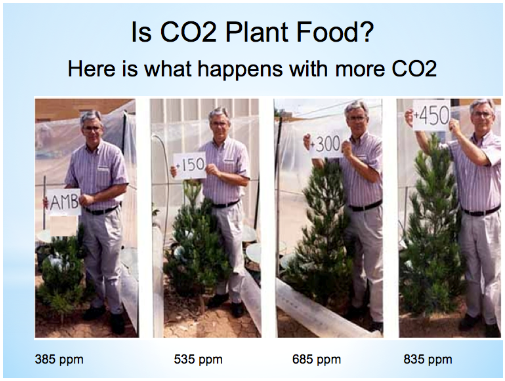
Note: Evidence of the very high productivity of prehistoric tropical systems in the dinosaur era, 250 million years ago, when the average annual temperature was 25 °C and the average atmospheric CO2 concentration was 2,000 ppm, can be found in araucaria conifers (Norfolk Island pine), which reached heights of up to 100 metres, and dinosaurs, whose weight approached 100 tonnes.
Long-term development tells us that CO2 concentration has been continuously declining for the last 500 million years. It peaked in the Cambrian period (540 to 488 million years ago), at 4,500 to 7,000 ppm. During the Cretaceous, a decline to 1,000 ppm was recorded, and in the Tertiary to just 400 ppm.
If life on Earth disappears, it will not be due to rising CO2 concentrations but to their further decline. Based on the long-term fall in CO2, Lovelock and Whitfield formulated a hypothesis in 1982 that the critical CO2 level of 150 ppm would be reached in 100 million years.
Geoclimatic calendar
Absolutely crucial information on long-term climate development is provided by analyses of ice samples from core drilling in the Greenland ice sheet and Antarctic ice sheets. CO2 concentrations and temperatures are determined from undisturbed ice samples, layers corresponding to chronological data.
During interglacial periods, atmospheric CO2 concentration regularly increased with rising temperature, which is logical, since greenhouse gases were always released from Earth’s surface as a result of higher temperatures accompanied by increased precipitation and thus greater ecosystem productivity. Rising atmospheric CO2 concentrations were therefore always not the cause, but the consequence, of higher global temperatures. A number of graphical documents based on ice-core drilling have already been prepared and published that unequivocally demonstrate this.
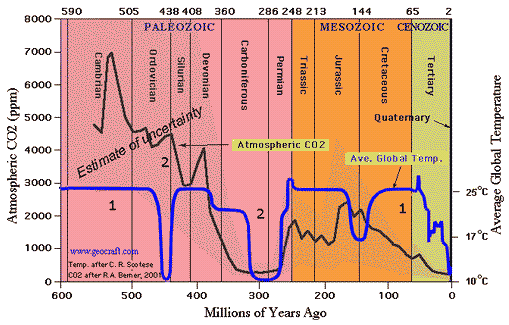
From chart No. 4 (Berner and Kothaval 2001), it is evident that in case No. (1), 550 million and 200 million years ago, temperatures were practically the same, but the CO2 level was 7,000 ppm in the first case and 1,550 ppm in the second. In the second case (2), the situation 450 million and 300 million years ago is documented. In both cases, the temperature was again the same, while CO2 concentrations differed substantially (4,500 ppm – around 400 ppm).
The following chart No. 5 (Humlum et al. 2012), in which ocean temperatures are marked in blue, land surface temperatures in red and CO2 increments in green, demonstrates that growth in CO2 concentration always subsequently responds to rising temperatures.

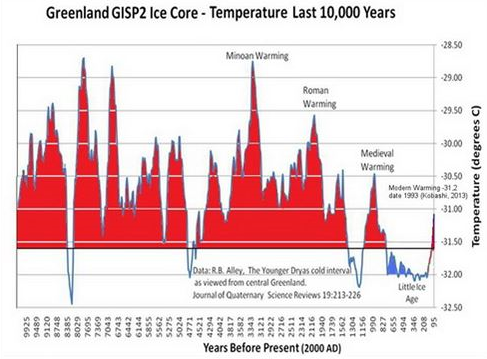
The aforementioned chart No. 5, prepared by a team of scientists during research on the Greenland ice sheet, best serves to orient us in the current situation of global warming. This overview demonstrates that temperatures continually alternated during the Holocene, while temperatures in the current period, which have not yet even approached the Medieval Warm Period, may be considered a recovery from the Little Ice Age, with temperatures returning to the Holocene average.
Let us hope that the current period of temperature stagnation is merely an episode and that we are heading towards another climatic optimum. Warm periods, characterised by high solar energy input and usually sufficient precipitation, have throughout history been associated with civilisational progress. Cold periods can generally be considered synonymous with crop failures, famines, plague epidemics, but also military campaigns to conquer and occupy more fertile areas.
A moderately favourable alternative is the forecast of the director of the Pulkovo Observatory, Ch. Abdusamatov, who assumes that the onset of global cooling will begin by 2015. In 2040, solar activity should reach its lowest intensity, and the greatest cooling, comparable to the “Little Ice Age”, should occur between 2055 and 2060.
What would happen in our landscape if the atmosphere contained one-third more CO2, with warming to values the same as during the so-called Boreal period (the 7th and 6th millennia BC), when temperatures rose relatively rapidly by 2 to 3 °C to around 10 °C? According to M. Kutílek (2008)(11) this warming stimulated the rapid development of deciduous forests dominated by oak, lime, ash and elm. The temperature increase stimulated suitable growing conditions. This is logical, since organic compounds are created in plants through photosynthesis in chloroplasts under the influence of sunlight, CO2 and water. When atmospheric CO2 concentration rises, CO2 uptake also increases. The result is greater production of organic matter: growth increments in woody plants and yields in agricultural crops.
Rising CO2 concentrations are therefore beneficial for plants. This is demonstrated by greenhouse yields when CO2 concentrations are artificially increased. Under our conditions, this would in no way jeopardise the cultivation of common crops. It would also create an opportunity for a greater share of thermophilic species. It has been demonstrated that higher CO2 concentrations, given sufficient light and water, significantly increase crop yields as well.
As a result of a long-term media campaign, people are becoming unaccustomed to viewing carbon dioxide as a friend. Yet without CO2, photosynthesis, through which life-giving organic substances are formed, would not take place. It is stated that photosynthesising organisms can absorb around 17.4 * 1010 tonnes of atmospheric carbon in a single year. Higher CO2 concentrations in the air therefore stimulate the development of vegetation. J. Patočka (2013) states that satellite studies by Australian scientists showed that “… between 1982 and 2010, in four monitored areas (desert margins in Australia, southern and northern Africa, the south-western United States, the Middle East and Central Asia), vegetation cover increased by 11 %, correlating with the rise in CO2 concentration. …”.(16)
In conclusion to this part, it can be stated that the greenhouse effect is a scientifically proven finding. However, it cannot be equated with the greenhouse hypothesis, which has not yet been experimentally demonstrated and which is based on the belief that current global warming is caused predominantly by humans, especially by CO2 emissions.
Analyses of ice-core drilling have demonstrated a correlation between global temperatures and CO2 concentrations, but temperatures have never risen in the geological era as a result of elevated CO2 concentrations. It has always been the other way round. The current temperature trend is apparently a recovery from the Little Ice Age. Changes predicted by the climate panel by 2010 could reach the temperatures of the Medieval Climate Optimum, characterised by favourable conditions for both nature and humans. The greatest positive effect would occur in northern parts of Canada, Russia and Scandinavia, whose fertility and habitability would increase significantly.
Climatic oscillations have occurred throughout Earth’s geological history, and there is no reason to assume that they will cease in our period, since they are the dominant consequence of the cyclical development of natural factors.
The article will continue in Part 2…
References:
- Armstrong J. S., (2010) : Let’s Deal in Science and Facts – Online http://www.klimaskeptik.cz/osobnosti/armstrong/
- Climate Change Reconsidered II: Biological Impacts http://www.nipccreport.org/reports/ccr2b/ccr2biologicalimpacts.html
- Dvořák M., (2014) : Climate: the EU saves the climate and destroys Europe, Neviditelný Pes, 7. 4. 2014 – Online: http://neviditelnypes.lidovky.cz/klima-eu-zachranuje-klima-ale-nici-evropu-fp4-/p_klima.aspx?c=A140406_161002_p_klima_wag
- Flanery T., (2007) : We are changing the climate. Dokořán, Prague, p. 270
- Humlum O., Stordahl K., Jan-Erik Solheim J.-E. (2013): The phase relation between atmospheric carbon dioxide and global temperature Global and Planetary Change, Vol. 100, pp. 51-69.
- IPCC – Assessment Reports of the Intergovernmental Panel on Climate Change (I to V) – Online http://cs.wikipedia.org/wiki/Glob%C3%A1ln%C3%AD_zm%C4%9Bny_klimatu
- King A., Schneider B., (1991) : The First Global Revolution: A Report by the Council of The Club of Rome. – Pantheon Books, 286
- Klaus V., (2007) : Blue Planet in Green Shackles, Dokořán, Prague, p. 164
- Kremlík V., (2014) : Climatologists do not yet understand the climate – Online http://kremlik.blog.idnes.cz/c/415338/Klimatologove-klimatu-jeste-nerozumeji.html
- Kremlík V., (2014) : Professor Tol left the IPCC in protest against climate alarmism. 2. 4. 2014 – Online http://kremlik.blog.idnes.cz/c/403580/Profesor-Tol-vystoupil-z-IPCC-na-protest-proti-klima-alarmismu.html
- Kutílek M., (2008) : A rational view of global warming. Dokořán, Prague, p. 185
- Kutílek M., (2012) : The Holocene climate versus the greenhouse hypothesis, Vesmír, 2012/May, pp. 298-300
- Lomborg B., (2006) : The Skeptical Environmentalist. Dokořán – Liberal Institute Prague, p. 587
- Lovelock J., (2012) : The Vanishing Face of Gaia: A Final Warning, Academia
- Ložek V., (2007) : Mirror of the past – The Czech and Slovak landscape in the Quaternary. Dokořán, Prague
- Patočka J., (2013) : Carbon dioxide emissions help green the Earth, Vesmír, Vol. 92, p. 597
- Štýs S. et al., (1981) : Reclamation of areas affected by mineral extraction, SNTL Prague
- Štýs S. et al., (2014) : Transformations of the North-West, Czech Statistical Office Prague
- Štýs S., (2013) : Hydrological reclamation as a subsystem of the reclamation transformation of the landscape, Vodní hospodářství, 2013/4, pp. 121-124
- Štýs S., (2014) : Landscape of hope. Publisher St. Srnka, pp. 222-230
Translation disclaimer
This article is a machine translation of the Czech original and has not yet been fully reviewed. In case of any doubt, please refer to the Czech version.
Sdílejte článek prostřednictvím:
Topics:Opinion
You might also like


23 October 2026, 11:01
23 October 2026, 06:34