
1 November 2026, 07:59
Loading...
Key parameters for choosing a heat pump in Czechia
oEnergetice.cz
29 November 2023, 00:36
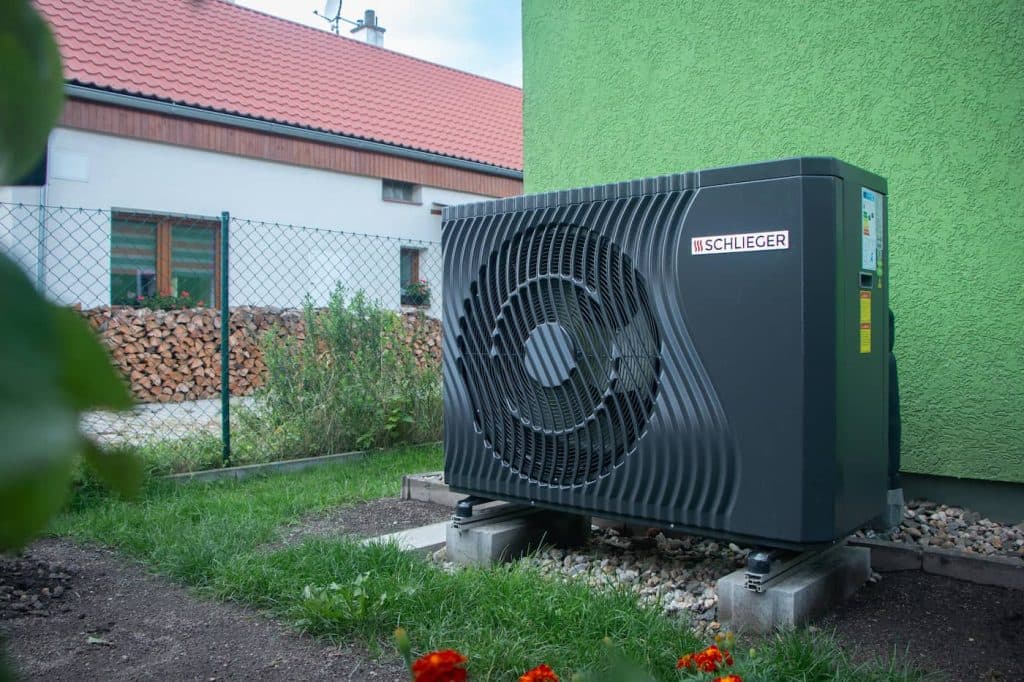
In recent years, heat pumps have been replacing other heat sources, such as those that burn fossil fuels. More and more customers are opting for a more economical and environmentally friendly way to heat their homes and water. According to Ministry of Industry and Trade statistics, air-to-water heat pumps account for 97% of all installations in the Czech Republic.
If you decide on this modern, environmentally friendly and cost-effective way to heat your home and water, you should pay attention to important parameters that reveal a great deal about the product you are considering. They can help you choose a product that best meets your needs and works reliably in all weather conditions.
Heat pump output
The most important parameter when choosing a heat pump is undoubtedly its output. Simply put, a home with a floor area of 120 m² will need an output of approximately 11 kW; a floor area of 160 m² will require 15 kW, while buildings with a floor area of around 250 m² are recommended to have a heat pump with an output of 21 kW. In practice, however, these indicative values are significantly affected by the specific characteristics of your property, above all the building’s heat loss. A home’s heat loss is the amount of thermal energy escaping outdoors through the entire building envelope at any given moment—that is, through the roof, walls, windows, doors and other structural elements. A home’s heat loss is therefore the most important figure when choosing a heat pump. You can find it, for example, on the building’s energy performance certificate. If one is not available, you can calculate it yourself or contact a specialist who will inspect the property and use a thermal imaging camera to identify critical areas of heat loss. Comparing the heat pump’s output with the home’s heat loss will tell you whether the model you have chosen is suitable. Its output should be 30–40% higher than the home’s heat loss. This “margin” ensures that your property is heated adequately even at the lowest operating temperature. It is therefore essential to invest in a heat pump with an adequate output margin.
An output of 9 kW at A7/W35 means that the heat pump generates 9 kW of output at an outdoor temperature of +7 °C, with the heating water temperature at 35 °C. The heat pump’s output decreases as the heating water temperature rises and the air temperature falls.
Bivalence point
The bivalence point is the temperature below which a backup (bivalent) energy source must be used. This source is provided by an electric heating element, which supplies the missing energy needed to reach the required output and cover the home’s heat loss, as well as to heat water. A heat pump with a bivalence point of 0 °C is cheaper, but its backup source starts drawing electricity too early (as soon as the outdoor temperature reaches “zero”), making it uneconomical to operate. More expensive heat pumps can operate without switching on the backup source even in considerably colder weather.
Heat pumps can operate at outdoor temperatures as low as –25 °C, and their output temperature can reach 62 °C. At extremely low temperatures, they use an electric boiler as a bivalent source, with a total output of 3–6–9 kW and staged switching.
“These heat pumps are automatically controlled by a smart thermostat, offering customers both high output and high energy efficiency,” adds Pavel Matějovič, Chief Operating Officer of Schlieger.
Heat pump efficiency and coefficient of performance
A heat pump’s efficiency determines how effectively it converts energy into heat for heating. The key measure of energy efficiency is the seasonal coefficient of performance (SCOP), measured according to the ČS EN 14825 standard.
Heat pumps are divided into efficiency classes and labelled with an energy label. The highest efficiency is represented by heat pump class A+++, while class G is the lowest.
The coefficient of performance (COP) is a measure of a heat pump’s efficiency. It expresses the ratio between the heat produced and the energy consumed. The higher the COP, the more efficiently and cheaply heat is produced. For example, a COP of 3 means that for every 1 kW of energy consumed, you get 3 kW of heat.
For air-to-water heat pumps, the COP most often ranges from 2 to 4; for ground-to-water systems, it is usually between 3 and 5.
If the only thing that catches your eye when choosing a heat pump is a very attractive purchase price, you should take a closer look. Review all the important parameters, and only make your decision once you are sure you are not throwing money away. If you have any doubts, it is best to consult specialists who can help you choose, supply and connect a heat pump.
Translation disclaimer
This article is a machine translation of the Czech original and has not yet been fully reviewed. In case of any doubt, please refer to the Czech version.
Sdílejte článek prostřednictvím:
You might also like

31 October 2026, 12:55

31 October 2026, 08:21

30 October 2026, 20:16