23 October 2026, 14:38
Loading...
Expected growth failed to materialise. What needs to be done to kick-start the hydrogen revolution

Jan Budín
25 February 2026, 10:41
The sharp growth in hydrogen use that a number of analysts, including the International Energy Agency (IEA), had expected on the basis of government and corporate targets announced after 2020 did not materialise. The reasons most commonly cited are uncertain demand and the high cost of producing low-emissions hydrogen. However, as the IEA states in its recent analysis, the development of the hydrogen economy is nevertheless progressing relatively quickly and is comparable with the historical rollout of other low-carbon technologies. The necessary acceleration will, however, require a number of measures.
Global demand for hydrogen reached 100 million tonnes in 2024. Most of it came from refineries and the chemical and steel industries. Compared with 2023, demand rose by 2%, roughly in line with the growth rate of overall energy demand.
This demand was met almost entirely with hydrogen produced from fossil fuels without CO2 emissions capture. Production of low-emissions hydrogen amounted to just under 0.8 million tonnes in 2024 and subsequently rose to just under 1 million tonnes last year. According to the IEA's current outlook, it should increase further to around 4 million tonnes by 2030.
"This is very little compared with the ambitions announced in the early 2020s. Nevertheless, it represents strong growth for an emerging sector, with the share of low-emissions hydrogen in total production rising from less than 1% currently to around 4% by 2030. If achieved, this would be a growth rate similar to that observed during the rapid development of other low-emissions technologies in recent years," the agency said.
According to the IEA, growth by 2030 could be even higher, as the 4 million tonnes figure includes only projects that are operational, under construction or have already received a final investment decision. Other projects with potential annual production of around 6 million tonnes have, according to the agency, "high potential to be realised by 2030". In total, the IEA tracks projects with potential total production of around 37 million tonnes per year.
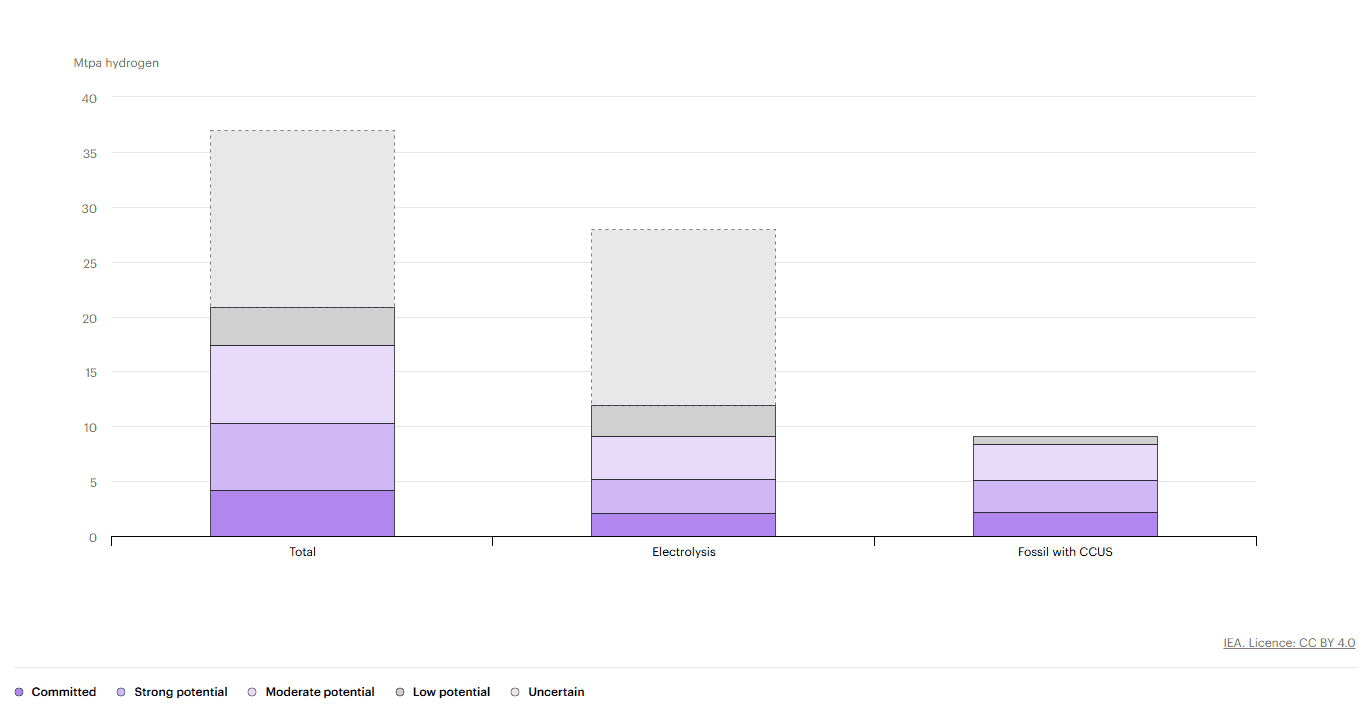
Potential global production of low-emissions hydrogen, broken down into hydrogen produced through water electrolysis and hydrogen produced from fossil fuels using CO2 capture technologies. Source: IEA
High costs, limited infrastructure, uncertain demand
According to the agency, several factors are holding back the faster development of the hydrogen economy, led by high production costs, complex regulation, inadequate transport infrastructure and uncertain demand.
"Demand for low-emissions hydrogen has grown in recent years and a number of offtake agreements have been signed. These long-term contracts have enabled the approval of projects focused on its production. However, progress in this area is slow, and most signed contracts are 'preliminary'; contracts containing binding terms for both producers and offtakers amount to just under 2 million tonnes per year, which is less than the 4 million tonnes of production expected from operational or approved projects," the agency added.
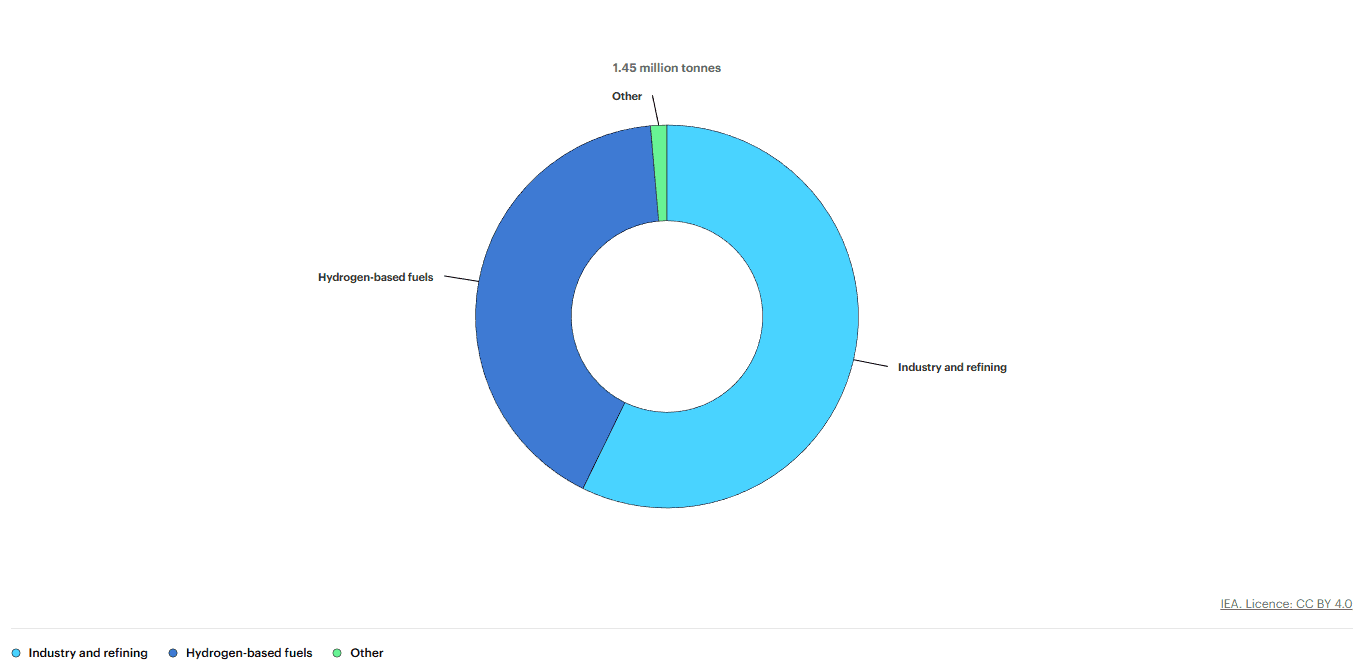
Volume of signed low-emissions hydrogen contracts over the past 5 years. Source: IEA
According to the IEA, increasing the volume of contracts with binding terms will require action by governments. However, the agency warns against excessive regulation, which could slow development rather than kick-start it.
Instead, measures should target reducing the cost gap between "fossil" hydrogen and low-emissions hydrogen. On the consumption side, governments should first focus on sectors that already make extensive use of hydrogen.
The development of the hydrogen economy should also be supported by the creation of so-called hydrogen hubs, bringing together both consumers and producers of this commodity.
"For most of these measures to be effective, it is essential that producers and consumers are able to identify low-emissions hydrogen by its carbon footprint across the value chain," the agency added, noting that a number of countries have already introduced or are introducing certification schemes used for these purposes.
Translation disclaimer
This article is a machine translation of the Czech original and has not yet been fully reviewed. In case of any doubt, please refer to the Czech version.
Sdílejte článek prostřednictvím:
You might also like

23 October 2026, 11:01

23 October 2026, 06:34