
28 October 2026, 15:10
Loading...
Hydrogen Days 2024: Is regulation complicating hydrogen use in Czechia?
Klára Čeperová
23 March 2024, 12:16
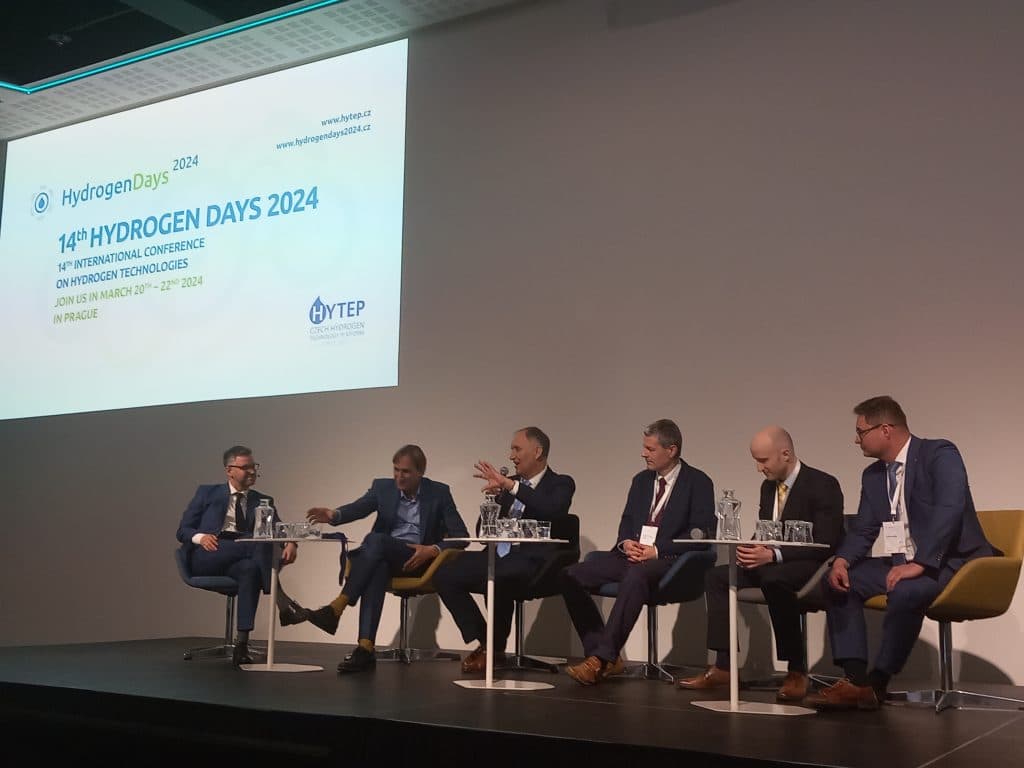
The international Hydrogen Days conference brought representatives of government, industry and academia to Prague. They discussed the future of hydrogen in the energy sector and the obstacles it faces on the way to wider adoption.
Is the introduction of hydrogen into the energy system being held back by sector regulation? This was the question the latest edition of the international Hydrogen Days conference set out to answer. Representatives of public administration, industry and academia had the opportunity to present their experience and the results of their projects and products to an international audience, and to build partnerships with other organisations.
Regulation
Regulation is one of the main factors shaping the direction of the hydrogen economy. According to some of the speakers at the event, it can also accelerate the deployment of hydrogen technologies—a development that Karel Bouzek, chair of the conference’s Scientific Committee, said would be welcome.
“Is the deployment progressing as quickly as we hope? In my view, it is not. Various factors are contributing to this slowdown, but we decided to highlight one of them in particular as the theme of this year’s conference,” he writes in his opening remarks on the Hydrogen Days 2024 website.
The conference was divided into three thematic tracks. The first focused on education, legislation and safety, renewable hydrogen certification, and the integration of electricity and gas networks.
As part of this track, representatives of Germany, Czechia, Hungary and Slovakia discussed hydrogen regulation and approaches to developing the hydrogen market. They all agreed that regulation should focus on supporting development, while also stressing that it is necessary.
Blending or pure hydrogen?
One example of the regulation needed is an approved amendment to the Energy Act, which allows not only natural gas but also hydrogen or a mixture of the two to be fed into the transmission and distribution networks.
“Our gas pipelines and gas facilities are already ready to distribute a blend containing up to 20% hydrogen in natural gas. At the same time, we are working to ensure our network will also be able to distribute 100% pure hydrogen in the future. That is why we have been investing in the development of our infrastructure for the long term,” explains Tomáš Pernis, spokesperson for GasNet, the largest gas distributor in Czechia.
When the discussion turned to blending hydrogen with natural gas (so-called blending), the representatives split into two camps. Petr Mervart, the Ministry of Industry and Trade’s hydrogen envoy, and Viktor Horváth, a representative of Hungary’s Ministry of Energy, favoured building a market for pure hydrogen. Michael Sterner, a representative of Germany’s National Hydrogen Council, and Ján Weiterschütz, a representative of the Slovak National Hydrogen Association, instead tended to defend the use of blends as a step towards using pure hydrogen.
“We are prepared for any scenario for the development of the Czech energy sector. In the medium term, this could mean a further strengthening of natural gas’s role as a transition fuel as we move away from coal, alongside a gradual increase in the share of new low-emission gases such as hydrogen or biomethane. Hydrogen is clean, renewable energy. Above all, it is a gas that is an excellent medium for storing and transmitting energy. Like electricity from solar or wind power, gas also has a renewable future through the use of biomethane and, especially, hydrogen,” explained Tomáš Pernis, outlining GasNet’s position.
Automotive and hydrogen
The second thematic track focused on the development and deployment of hydrogen in transport. Presentations included fuel cells for power generation, hydrogen combustion powertrains and hybrid systems. BMW presented its hydrogen-powered vehicle, while Isotta Cerri of Toyota Europe discussed the outlook for hydrogen mobility.
“It is very difficult to predict what the market for hydrogen passenger cars will look like. We originally expected Japan, for example, to be the main market, but today we see Europe as a potentially interesting market too,” Cerri said.
The third track focused on the development and deployment of hydrogen in the energy sector, with speakers discussing hydrogen production and storage, related infrastructure, and combined heat and power systems or fuel cells using hydrogen.
The conference took place at the Cubex multifunctional centre in Prague from 20 to 22 March.
Translation disclaimer
This article is a machine translation of the Czech original and has not yet been fully reviewed. In case of any doubt, please refer to the Czech version.
Sdílejte článek prostřednictvím:
You might also like

28 October 2026, 13:08

28 October 2026, 11:10

28 October 2026, 09:08
