
2 October 2026, 21:55
Loading...
Danube rises, Paks NPP raises output again: Hungary’s Dukovany equivalent recovers from record drought
Barbora Zimová
14 August 2026, 11:04
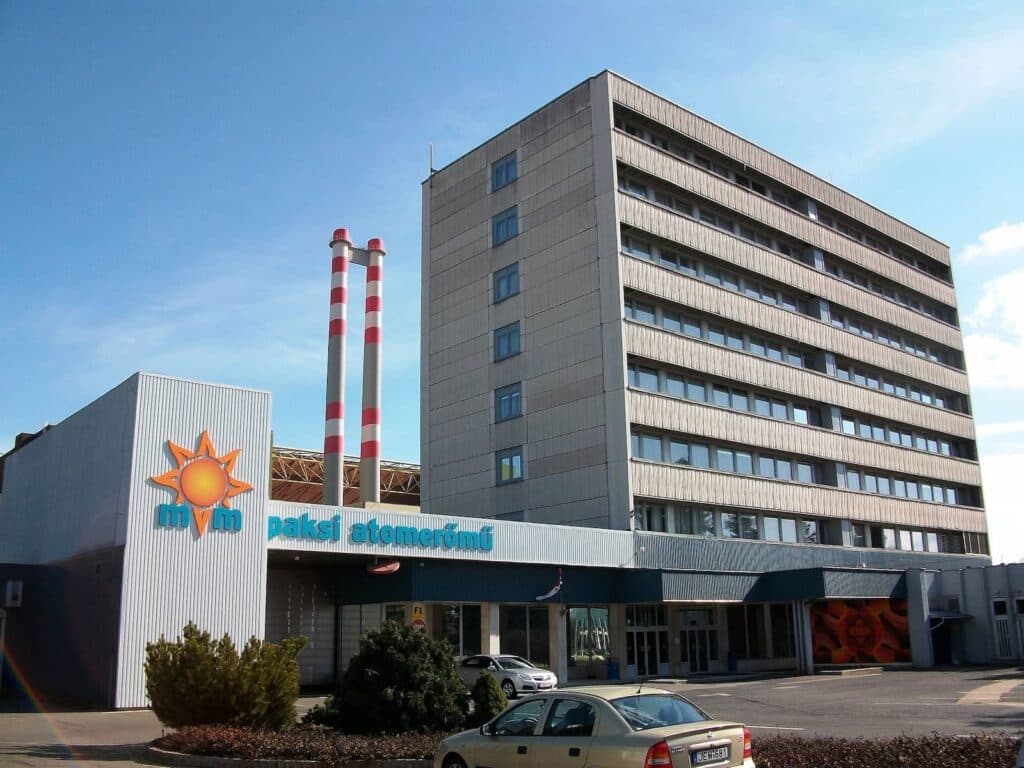
The record-low Danube pushed Hungary’s Paks to the brink of a complete shutdown at the end of July. The nuclear power plant is now gradually raising output again. Czech nuclear power plants are not threatened by drought.
Hungary has been grappling with extremely high temperatures since June, like a number of other countries. According to the European Union’s Copernicus Climate Service, the summer months so far have been exceptionally hot and dry in Western and Central Europe. Western Europe experienced the hottest June and July on record, while river flows fell far below normal levels. Alongside France’s Seine and the Rhine, the Danube was among the worst affected rivers. According to Copernicus, low water levels affected water supplies and energy generation in several countries, in some cases driving electricity prices on exchanges up by as much as 100 %.
The record-low level of the Danube, whose water the nuclear power plant uses for cooling, initially led to reductions in Paks NPP’s total output. The plant’s operator, MVM Paksi Atomerőmű,announced a complete shutdown at the end of July. Statements by Prime Minister Péter Magyar indicated that a return to production was not expected in the coming weeks.
The four VVER-440 pressurised water reactors, equivalent to the four units at Dukovany, provided the country with 45 to 50 % of its electricity generation. In the week following the shutdown, their share of total generation fell to 6 %, as one turbine at Unit 2 remained in operation.
On 10 August, Hungarian Prime Minister Magyar reported a major breakthrough.
“The Danube’s water level was 19 centimetres higher this morning than the minimum recorded a week ago. The process of reconnecting one of the turbines at Paks has begun. From this evening, turbine No. 3 of Unit 2 will also generate electricity,”he posted on his profile on X.
The Hungarian Atomic Energy Authority (Országos Atomenergia Hivatal), which monitors the facility’s installed capacity, reported 228 megawatts electric (MWe) at noon that day. A day later, it was reporting more than double that amount, and by noon on 12 August, 481 MWe. Nuclear power’s share of electricity generation thus rose to 13.6 %.
There is enough water, but...
According to a press release from the plant operator, the issue was not a lack of water in the Danube, as might appear at first glance. Although the volume of water would be sufficient to cool the units even at exceptionally low water levels and flow rates, the level of the pump intake is above the (previously falling) water level.
In this context, the operator stated that upgrades over the past 40 years have made it possible to maintain the plant’s safe operation even at a water level 120 centimetres lower than envisaged by the original design. The anticipated future decline in water levels requires further modifications, work on which it said had already begun.

Comparison of the same stretch of the Danube north of Budapest: 9 August 2025 on the left, and 4 August 2026 on the right, with record-low water levels. Source: Creative Commons / CC BY-SA 3.0 IGO / ESA
It attributes the gradual decline in water levels to two causes. The first is global climate change. While so-called high-water events used to be common several times a year, this spring again saw no increase in flow caused by glacier melt. The second reason is said to be the long-term deepening of the riverbed, resulting from both natural processes and human activity.
Dukovany and Temelín are safe from water shortages
The situation in Hungary should not pose a direct threat to Czech nuclear power plants. According to a statement to the Czech News Agency from ČEZ spokesperson Ladislav Kříž, both Dukovany and Temelín are fortunate. He attributes this to their different method of condenser cooling, namely a cooling-tower system, as opposed to the once-through cooling used, among others, at Paks NPP. The Czech State Office for Nuclear Safety confirms the same.
This means only minor reductions in electrical output due to higher cooling-water temperatures, without affecting safety. For the new nuclear units at Dukovany, ČEZ is reportedly planning a combination of water cooling and so-called dry air cooling.
Translation disclaimer
This article is a machine translation of the Czech original and has not yet been fully reviewed. In case of any doubt, please refer to the Czech version.
Sdílejte článek prostřednictvím:
You might also like

2 October 2026, 15:14
2 October 2026, 10:06
2 October 2026, 06:14