23 October 2026, 14:38
Loading...
EU dependence on gas imports fell slightly last year, but there is a catch

Martin Voříšek
22 April 2022, 06:12
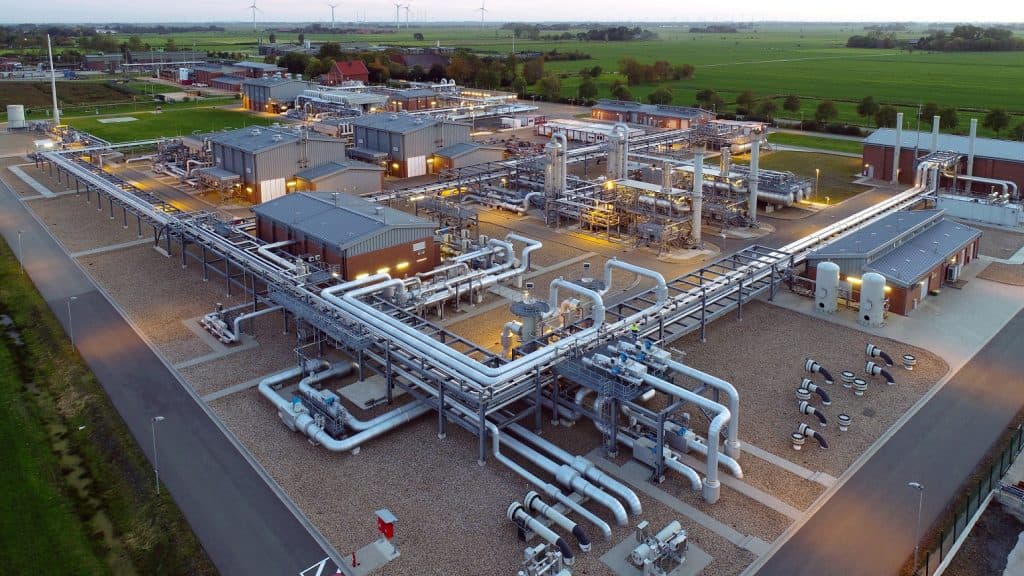
The European Union's dependence on natural gas imports fell year-on-year by one percentage point to 83% last year. According to data published by Eurostat, however, the EU-27's dependence was affected by higher withdrawals from gas storage facilities, which had been filled in the previous year.
Following Russia's invasion of Ukraine, the European Union's dependence on natural gas, particularly from Russia, has become the number one issue. Russian gas accounts for approximately 45% of total natural gas imports.
Import dependence, expressed as the share of net imports in natural gas consumption in a given country, stood at 83% last year. Although import dependence declined, the long-term trend has been more upward. In 1990, import dependence was 52%, reaching its highest level (90%) in 2019.
Despite the slight year-on-year decline in dependence, this is not a long-term trend. On the contrary, natural gas production in the EU is falling, largely due to the closure of the Groningen field in the Netherlands.
While the overall trend in the European Union pointed to a decline in import dependence, the trend in Czechia was the opposite. In 2021, import dependence rose by 6 percentage points to 92%.
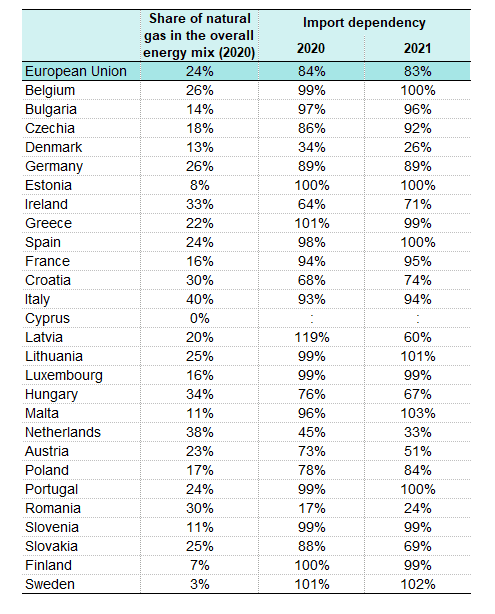
Natural gas import dependence of individual European Union countries.
To assess the risks that may arise from disruptions to natural gas supplies, it is also necessary to take into account the share of natural gas in a country's final energy consumption.
While import dependence in Sweden, Finland and Estonia is close to 100%, the share of natural gas in their energy mix is relatively low (3%, 7% and 8%).
By contrast, Italy has the highest share of natural gas in its energy mix (40%), and its import dependence stands at 94%. The Netherlands has the second-highest share of natural gas in its energy mix, but its import dependence is much lower thanks to domestic natural gas production.
Czechia is among the countries with a below-average share of natural gas in total energy consumption. While the European Union average is 24%, it reaches only 18% in Czechia.
Translation disclaimer
This article is a machine translation of the Czech original and has not yet been fully reviewed. In case of any doubt, please refer to the Czech version.
Sdílejte článek prostřednictvím:
You might also like
23 October 2026, 11:01
23 October 2026, 06:34