23 October 2026, 06:34
Loading...
Gazprom wants to “launder” gas supplies to Europe via Turkey

Jakub Malý
5 September 2024, 07:07
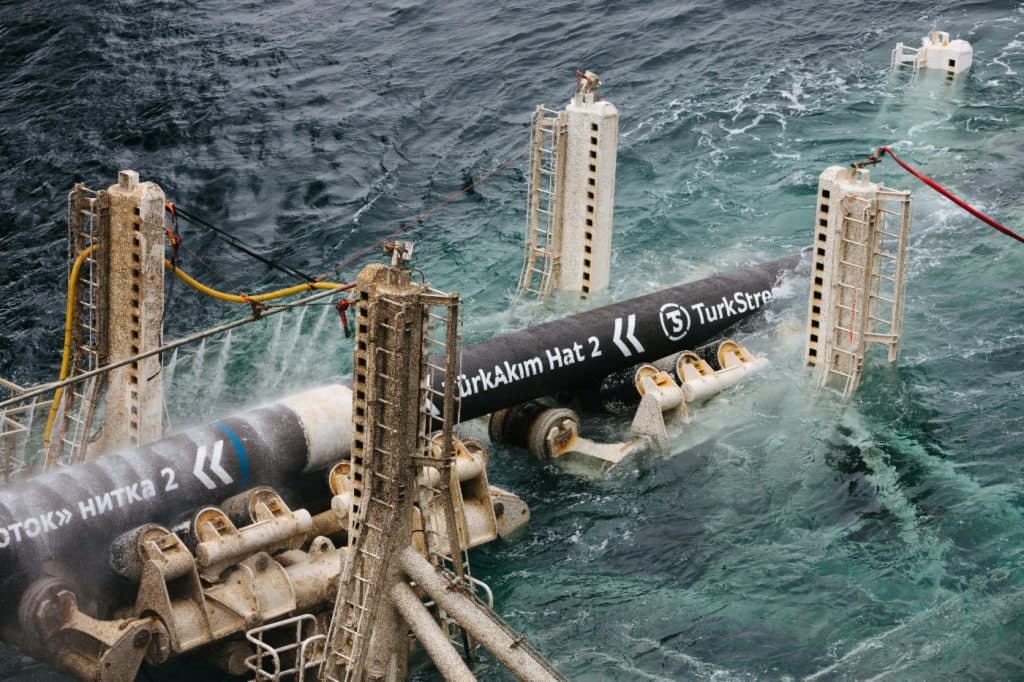
At the end of August, Turkey announced plans to expand the capacity of TurkStream, which brings gas from Russia to Turkey. Turkish state-owned company BOTAŞ plans to export the gas onward to Bulgaria via the Malkoclar-Strandzha.
At the beginning of the year, Turkey and Bulgaria agreed to expand the capacity of the Malkoclar-Strandzha interconnector by around 4 billion cubic metres (bcm) of gas per year. According to ENTSOG data, its current maximum daily capacity is around 584 GWh/d and Turkish gas is indeed flowing into the EU with the cross-border point operating at almost full capacity.
"Through the Turkish gas transmission network, access is provided to natural gas originating from local fields, Azerbaijan, Iran and the global LNG market via Turkey's LNG terminals," Bulgartransgaz said.
The interconnector does give Bulgaria and other countries in the region access to diversified gas supplies. The problem, however, is that it is difficult to verify the gas's origin.
Turkey therefore plans to sell gas under the "Turkish Blend" label, comprising a mix of gas from different fields. According to Turkish Minister of Energy and Natural Resources Alparslan Bayraktar, Russia remains Turkey's largest gas supplier, accounting for around 40% of its consumption. Turkey also has contracts to buy liquefied natural gas (LNG) from the US, Qatar, Algeria, Nigeria and Oman.
This approach is also in line with President Erdoğan's statement that Turkey wants to become a hub for distributing Russian gas to Europe. State-owned company BOTAŞ is therefore working with Russia's Gazprom to further expand Turkey's gas infrastructure. The two companies are also discussing the establishment of a joint operator for Turkey's gas trading zone, to be based in Istanbul.
Turkey currently consumes 50 bcm of gas and plans to export 7.5 bcm per year, equivalent to 15% of its total consumption. This could mean that Bulgaria, along with other European Union countries, would buy gas containing a share from Russian fields. The infrastructure includes key pipelines such as TANAP (running east to west across the country, from Caspian fields to Europe) and TurkStream (running directly from Russia under the Black Sea). These pipelines, together with the interconnector to Bulgaria, allow Turkey to supply gas onward to Europe.
Unclear flows and potential market manipulation
Expanding this capacity will also allow Russia to continue bypassing Ukrainian pipelines when supplying gas to Europe. Turkey's failure to comply with EU rules further complicates efforts to monitor gas flows across its borders. There is also a possibility that the Turkish-Bulgarian agreement could violate EU competition law by blocking third parties' access to information about gas transportation. The EU's antitrust authority, the Directorate-General for Competition, has therefore begun examining the agreement over potential manipulation of market rules.
This is further evidence suggesting that Russia is managing to partially circumvent the sanctions imposed on it in gas supplies. Russia is also managing to make use of a fleet of LNG tankers managed by companies with opaque ownership structures. The tankers often switch off their location signals or report a location different from where they are later spotted in satellite images. Russia uses similar tactics for oil deliveries, with some ships caught transferring oil off the coast of Morocco.
Translation disclaimer
This article is a machine translation of the Czech original and has not yet been fully reviewed. In case of any doubt, please refer to the Czech version.
Sdílejte článek prostřednictvím:
You might also like



22 October 2026, 10:45