23 October 2026, 14:38
Loading...
Infographic: How the LNG terminal in Poland's Świnoujście works
Adéla Denková
16 June 2016, 18:06
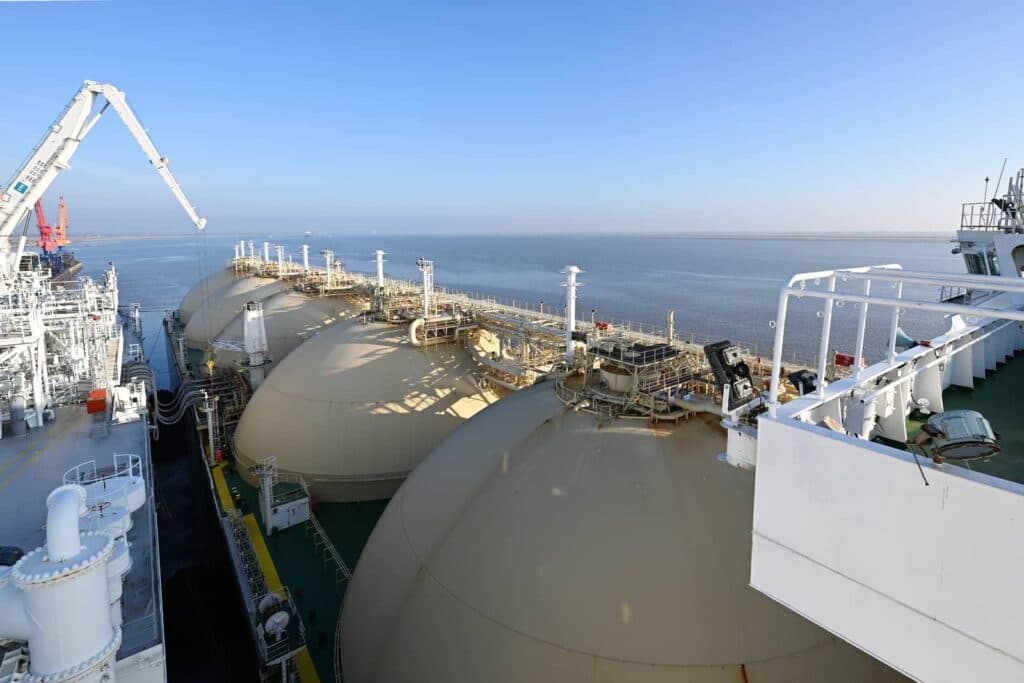
A tanker from Qatar carrying the first commercial delivery of liquefied natural gas (LNG) ever received by the terminal is due to arrive in Poland's Świnoujście on Friday. Over recent months, Świnoujście has already received two test tankers and tests have been carried out to demonstrate that the terminal is ready both to receive gas deliveries and feed them into the Polish transmission network.
The Qatari gas, with a volume of 206 thousand cubic metres in liquefied form, will arrive in Poland under a 20-year contract between Polish state-owned company PGNiG and Qatargas. A few days later, a tanker carrying gas from Norway's Statoil (140 thousand cubic metres), which PGNiG bought on the spot market, will also arrive.
The following infographic explains how the LNG terminal will operate.
The article was written by Adéla Denková, Euractiv.cz.
1. Breakwater
The tanker unloading berth is protected by a three-kilometre breakwater. According to Polskie LNG, the company operating the terminal, it is the longest structure of its kind in Europe. It also serves as an access road from the mainland to the unloading platform. It includes a water pump for firefighting purposes. The onshore part of the terminal also contains a water reservoir for use in case of fire.
2. Tanker
LNG is unloaded at the unloading platform using four 20-metre unloading arms. Tankers carrying liquefied gas can be up to 315 metres long and 50 metres wide, with a draught of up to 12.5 metres. Such a vessel can carry 216 thousand cubic metres of gas. In liquefied form, the volume of gas is 600 times smaller than in gaseous form.
3. Connection between the terminal and the unloading platform
From the tanker, liquefied gas is transported to the onshore part of the terminal through pipelines laid on pipe racks, which also carry power lines and water. The longest of the pipe racks measures 1.5 kilometres. An undeveloped green belt between the beach and the gas processing facilities protects coastal fauna and flora from potential damage.
4. Storage tanks
While still in liquefied form at a temperature of -162 degrees Celsius, the gas is stored in two cryogenic tanks with a combined capacity of 320 thousand cubic metres. Both are 52 metres high and 80 metres in diameter. Their inner layer is made of nickel and the outer layer of concrete. The terminal currently has an annual capacity of 5 billion cubic metres (bcm). If the plan to build a third tank is carried out, capacity would increase to 7.5 bcm per year.
5. Vaporisation facility
To return LNG to its gaseous state, it needs to be heated in a special system of pipes submerged in warm water (but not seawater, as the Baltic is too cold for this). Although it sounds simple, this is a complex and technologically advanced process.
6. Compressor station
After regasification, the gas goes to the compressor station so that it can continue into the transmission network and then to end customers. Modern BOG (boil-off gas) compressors can also be used to compress gas that evaporates spontaneously in the terminal's facilities.
7 + 10. Control buildings
Several buildings used to control and operate the terminal stand in the part of the terminal farther from the sea. The main control room (in Polish, “sterownia”) is the brain of the entire facility and monitors all processes taking place there. This part of the terminal also contains administrative buildings, maintenance facilities and an electrical substation.
8. Ventilation tower
The terminal's tallest structure is a ventilation tower more than 60 metres high, which makes it possible to maintain the correct pressure throughout the facility. It acts as a safety valve through which excess gas can be released into the atmosphere in a controlled manner.
9. LNG truck loading facility
Gas can also be distributed from the terminal in liquefied form via tanker trucks. Three loading stations will operate at the Świnoujście terminal for this purpose.
Translation disclaimer
This article is a machine translation of the Czech original and has not yet been fully reviewed. In case of any doubt, please refer to the Czech version.
Sdílejte článek prostřednictvím:
You might also like
23 October 2026, 11:01
23 October 2026, 06:34