Is Germany building more LNG terminals that nobody needs?

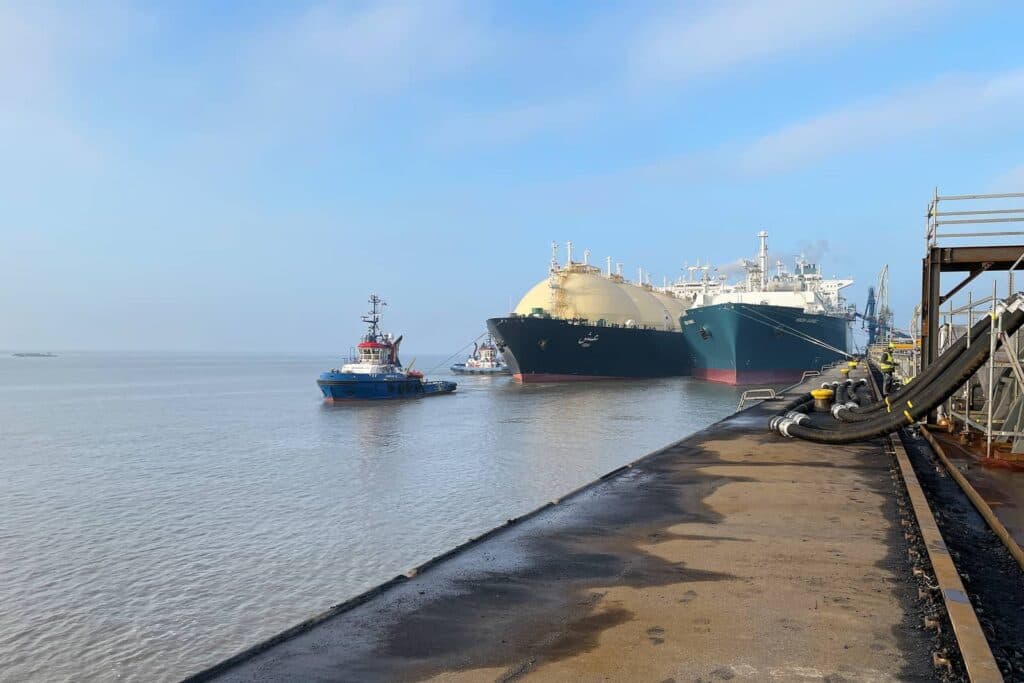
Two more floating terminals for importing liquefied natural gas (LNG) are expected to start operating in Germany before winter. The company has not specified the expected start-up date, which is already several months behind the original schedule. Data on the use of Germany’s existing LNG terminals raise the question of whether the country needs any more terminals at all.
Work is under way on two floating terminals in Wilhelmshaven and Stade, both on the coast of the state of Lower Saxony. Both terminals are expected to start operating before winter, the state-owned operator Deutsche Energy Terminal (DET) said, according to German news agency dpa.
Three temporary LNG terminals are currently operating in Germany, in Wilhelmshaven, Brunsbüttel and on the island of Rügen, with a total of four ships known as floating storage and regasification units (FSRUs). In the long term, the floating terminals are expected to be replaced by fixed terminals.
According to the German Federal Ministry for Economic Affairs and Climate Action, once all six approved floating terminals are operating, their combined annual capacity will be around 30 billion cubic metres (bcm) of natural gas, equivalent to just under half the amount imported from Russia in 2021. The volume could potentially increase with the construction of onshore terminals, if the network has the capacity.
Oversized terminals?
After less than a year of operation, it is clear that the first three terminals, which together supply 5-12% of the gas consumed in the country, have been used at only around half their capacity. The largest volumes of LNG are delivered through the Wilhelmshaven terminal, while volumes are lower at Brunsbüttel. No LNG has been delivered to Lubmin since spring 2024, as the terminal’s vessel was moved to Mukran. However, almost no LNG has yet arrived at Mukran.

This raises the question of whether Germany has overbuilt its terminal capacity. Niklas Höhne, a professor at Wageningen University and founder of the NewClimate Institute, says he cannot imagine the terminals being economically viable.
After Russian gas supplies were halted, the German government expected a shortfall of around 28 bcm in gas supplies to Germany. It also forecast additional demand from central and eastern Europe, which could import gas through Germany in the future. Floating terminals were initially intended to cover this demand, with Germany able to import around 37 bcm of LNG a year from 2023, according to the government’s forecast at the time.
"At the time, we were worried that we were creating excess capacity. Today, we know for certain that we have excess capacity," says Höhne, who criticised the government’s forecasts.
A study by the NewClimate Institute concluded that the planned expansion of Germany’s LNG import capacity is excessive. The authors write that it could jeopardise the achievement of climate targets. A February 2024 study by the DIW research institute also finds that plans to expand LNG infrastructure are oversized.
"In view of the expected decline in natural gas consumption in Germany and the stabilisation of supplies, it seems appropriate to review the sites for projects envisaged in the LNG Acceleration Act. The German government should abandon plans to build onshore LNG terminals and reassess the floating terminals. Energy efficiency and proactive gas saving remain important for climate protection," the DIW study states.
Translation disclaimer
This article is a machine translation of the Czech original and has not yet been fully reviewed. In case of any doubt, please refer to the Czech version.




