23 October 2026, 14:38
Loading...
LNG imports to Europe
Michal Kocůrek, EGU Brno
29 August 2018, 17:12
Liquefied natural gas (LNG) complements the portfolio of gas supplies flowing to EU countries via pipelines from Russia, Norway, Algeria and Libya. Turkey, a major European gas importer, is additionally supplied by pipelines from Iran and Azerbaijan. Following crises in the supply of Russian gas to some EU Member States in 2006 and 2009, the European Commission has been actively seeking to promote diversification of natural gas supplies, both in terms of sources and the routes through which gas is transported to Member States. Tools intended to effectively enable such diversification include, for example, better integration of natural gas markets within the EU through the construction of new physical connections (interconnectors) or increasing the capacity of existing ones. However, this tool does not address diversification of sources, only diversification of routes, and only at the level of the EU internal market.
At the same time, declining natural gas production within the EU is making dependence on the dominant external gas supplier – Russia – increasingly apparent. Since the other main gas suppliers to the EU (Norway and Algeria) will not be able to reduce the share of Russian gas in the EU over the long term through increased supplies, this relatively risky situation for European countries will continue to intensify. This is well illustrated by developments since 2015, when gas consumption in the EU began rising year on year again, with Russia's Gazprom as the main supplier of this increase. Efforts to diversify sources at EU level have therefore so far failed, and the situation will not improve unless previously untapped gas sources are found.
Dreams of self-sufficiency linked to the development of shale gas production in some EU countries were dashed from the outset. From 2020, the TANAP and TAP pipelines are expected to supply southeastern Europe with only symbolic volumes of gas from Azerbaijan. The eastern Mediterranean also offers some diversification potential, but given the complex security and political situation in the region and the early stage of production development, these potential gas supplies cannot be considered significant in the medium term from the perspective of diversifying gas sources for the EU as a whole. Currently, only liquefied natural gas has this potential, as it can be supplied to EU countries in volumes of 229 bn m3 per year, covering almost half of total EU gas demand. As the figure above shows, LNG's share of total gas imports from non-EU countries was nevertheless just under 15 % in 2017, while utilisation of EU import terminals barely reached 22 %. This article examines the causes of this situation and the expected development of LNG supplies to the EU in the short to medium term.
The role of LNG in the European market
In 2010 and 2011, LNG reached its strongest position in the European market, when EU Member States imported almost 80 bn m3 of gas per year in this form and LNG's share of total gas supplies from countries outside the EU exceeded 25 %. This relatively short period was characterised by a mismatch between supply and demand in global LNG markets, as the sharp increase in production by Qatar, the world's leading exporter, did not meet anticipated demand in the US. This surplus gas was therefore shipped, on favourable price terms, primarily to the UK, where year-on-year LNG imports rose by 30 % in 2011. Two years later, however, LNG imports to the EU had fallen to barely half that level. Over the past three years, and specifically in 2017, the situation began to improve slightly again alongside rising gas demand in general. The volume of LNG imported into the EU increased by 12 % year on year last year, but remained well below its 2011 peak.
The so-called buyer of last resort effect worked very well at that time. As the US gradually withdrew from the global LNG market as a buyer, a process that began after 2007, EU countries became an attractive outlet, particularly during periods of market imbalance such as that seen in 2011. This is due, among other things, to the fact that, thanks to a better interconnected internal market, partially diversified supply sources and the bargaining power of European buyers, gas prices in European markets are not as high as in areas with growing demand and limited gas resources, namely East Asia.
Gas imports to the EU rely mainly on long-term contracts
LNG does not currently flow to Europe in larger volumes for three reasons. The first is the limited ability of European buyers to absorb increased LNG supplies, as most of the gas flowing to EU countries is contractually secured through long-term contracts. For example, in 2017 European buyers committed to take 130 to 155 bn m3 of gas from Russia alone. Actual offtake was even higher (167 bn m3), as the price of Russian gas was lower than prices on European markets. The flexible structure of long-term contracts allows offtake to be adjusted to clients' needs, typically by 15 % or more in either direction. The opposite approach to the Russian case is illustrated by offtake under long-term contracts concluded by European buyers with Qatari company Qatargas, which were fulfilled in 2017 at barely two-thirds of the contractual commitment.
LNG heads to the highest-priced markets
The second reason is the way the global LNG market operates. LNG exports are arranged so that companies operating liquefaction terminals also arrange gas delivery to their customers' receiving terminals. Such deliveries are often made under long-term contracts. The terminal operator does not necessarily have to be the gas producer (for example, Cheniere, which operates the US Sabine Pass terminal). The second, increasingly common option is for the liquefaction terminal operator merely to liquefy natural gas and sell it as LNG to traders. These usually large gas companies, which build global gas supply portfolios, then seek to deliver LNG to the market with the highest price. At present, the destination is most often East Asia, as the figure below shows.
In addition to its long-term contracts with fixed delivery points, not only a trader with a global portfolio but also a terminal operator can apply so-called price arbitrage, selecting gas buyers according to their willingness to pay the highest price and thus offer the highest possible sales margin. In such a situation, the relatively well-supplied and therefore not particularly price-attractive European market rarely becomes the final destination for spot-market LNG supplies.
Europe favours Russian gas because of its price
The third reason why liquefied gas does not appear in Europe in much larger volumes is its price, or rather the relationship between the price of LNG and the price of natural gas supplied to European buyers by other producers. Although natural gas may still be considered the commodity most closely tied to foreign policy, in reality the current regime of natural gas supplies to the EU reflects a distinctly economic approach. A good example is the situation after 2014, when Russia's annexation of Crimea prompted EU Member States to impose economic sanctions on Russia, which they renew every year, yet the volume of gas supplied from Russia to the EU rises every year. The primary factor determining the direction from which gas flows to the EU is therefore its price, not foreign-policy alignment.
This partly inconsistent approach is not apparent only at the level of the EU as a whole, but also among countries that speak out most loudly against any Russian projects that could potentially strengthen its future position in the EU. For example, since 2016 Poland has publicly declared that it does not intend to extend its contract for Russian gas supplies, which expires in 2022. Instead, it will build a new pipeline for gas supplies from Norway and further expand the capacity of its LNG terminal. However, in 2017 and in the first half of 2018, rather than fully using its LNG terminal or purchasing more gas in the EU, it increased its purchases of gas from Russia. The reason was again highly pragmatic: Russian gas was cheaper. LNG will therefore find wider use in Europe only when it can compete on price with traditional suppliers. Such periods are usually short-term, limiting LNG's ability to maintain a share at the level of the main suppliers, namely 25 % or more.
LNG cost calculation
What, then, is the future of LNG in Europe, and can the rapid rise of US LNG in global markets change the situation? The pricing parameters of US LNG are set in such a way that no significant price decline can be expected. The total charge for liquefaction, transport (from the Gulf of Mexico), regasification and entry into the European gas network ranges from 3,3 to 3,8 USD/mmbtu (approximately 120 to 140 USD/thousand m3). A more detailed cost breakdown compiled by Howard Rogers of The Oxford Institute for Energy Studies is shown in the table below.
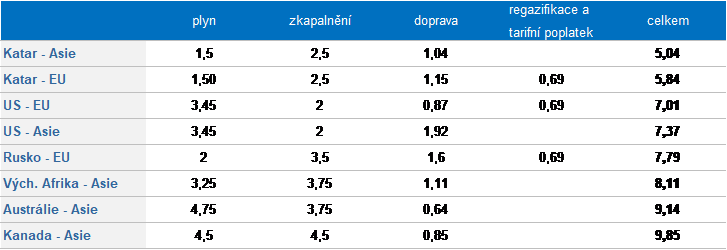
Gazprom Export, the company responsible for Russian gas exports, recorded an average price for gas delivered to Europe of 197 USD/thousand m3 (5,41 USD/mmbtu) in 2017. In 2018, it expected a price around 220 USD/thousand m3 (6,04 USD/mmbtu). However, in the case of LNG from the US, the commodity price must be added to the above-mentioned costs. For LNG supplies from the Sabine Pass terminal, the average price of gas used to produce LNG in 2017 was approximately 146 USD/thousand m3 (4 USD/mmbtu). The total price for a European buyer was therefore approximately 7,3 to 7,8 USD/mmbtu (266 to 286 USD/thousand m3). That is 35 to 45 % more than the price of Russian gas.
The example described above corresponds to a situation in which the price of Russian gas fell significantly below its ten-year average of 9,2 USD/mmbtu (approximately 334 USD/thousand m3) due to declining oil prices. Conversely, US LNG could have been highly competitive at price levels seen in 2014, for example, when the average price of Russian gas in Europe climbed to 10,4 USD/mmbtu (approximately 380 USD/thousand m3). In such a case, US LNG supplies would find a place in European markets while also helping reduce the price of Russian gas for European buyers.
Using a breakdown of the LNG price into individual components, we can clearly illustrate the reasons for the still low share of US LNG in European markets. Although almost 17 bn m3 of gas was exported from the United States as LNG in 2017, only 2,5 bn m3 reached Europe, one-third of which went to Turkey. The figure below therefore compares the average price of US LNG paid by European buyers in 2017 with the average gas price at Europe's largest trading hub, TTF (day-ahead gas price), the average price of gas imported into Germany (BAFA), and finally the average price of Russian gas supplied to the EU and Turkey published by Gazprom Export.
This comparison clearly demonstrates that in 2017 it was not economically advantageous, at least for countries in Central and northwestern Europe, to buy LNG from the US instead of, for example, Russian or Norwegian gas. LNG from Qatar could also be much more advantageous for European buyers given its low gas production costs. In this case, however, the final price is determined not by the cost of gas but by a contractual formula reflecting the price of oil. As described above, European buyers certainly did not use the option to purchase LNG from Qatar at the maximum contracted volume in 2017.
The future of LNG in the European market
For Europe to once again become an attractive destination for LNG from Qatar, the US, Nigeria or anywhere else, one or preferably several of the following conditions must be met simultaneously:
- a decline or stagnation in global demand for natural gas, including LNG (especially in Asia): this would bring Asian and European price levels closer together and reduce the currently preferred Asian direction of LNG supplies,
- the capacity of newly built LNG export terminals exceeds demand: increasing pressure for more flexible contracts would allow unused volumes under long-term contracts to be offered on the spot market at potentially favourable prices for European buyers as well,
- a reduction in Russian gas supplies to the EU: in recent years, Russia has been able to increase gas exports to Europe very flexibly thanks to its still unused production capacity (approximately 100 bn m3 per year), thereby preventing sharper increases in price levels,
- a sharp decline in domestic gas production in the EU without a response from the traditional main suppliers, Russia and Norway: the rather short-term effect of a sharp reduction in production, for example in the Netherlands in connection with ground instability around Groningen, combined with continued demand growth, could create room for higher supplies of LNG, even if it is relatively more expensive (than gas from Russia or Norway),
- a political decision by national governments in the EU to import LNG (for example from the United States) through their state-owned or semi-state-owned companies: Poland's case shows that some EU states are partly pursuing this route,
- a sharp increase in gas consumption linked to European utilities moving away from coal-fired generation, combined with the gradual implementation of programmes to phase out nuclear power in Germany, Belgium and especially France: this would drive up both gas demand and prices.
So far, nothing indicates that LNG, particularly that from the US, could reduce EU countries' dependence on Russian gas. On the contrary, Russian gas's share of the overall supply portfolio rose further year on year [1]. A decline in global gas demand due to recurring economic recessions or crises, together with the massive development of LNG export capacity (see figure below), may become the most likely stimulus for increased LNG demand in the EU. In the event of insufficient demand, especially because gas consumption in countries such as China does not grow sharply, LNG producers will be forced to seek outlets for their gas in last-resort destinations such as the EU. The price of these spot LNG supplies would then reflect not the price of oil (as in the case of long-term contracts), but the price of gas at, for example, the TTF trading hub, in order to remain competitive in the European market.
Space within European demand for these increased supplies will be created primarily by declining production from domestic producers and, after 2025, from Norway and Algeria as well. It cannot be ruled out that Russia would seek to fill this space by further increasing its supplies, particularly given the nature of Russian gas pricing, which still largely reflects oil price developments[2]. In the event of an economic recession, it can be assumed that oil prices, and therefore the price of Russian gas, will also decline. However, as the figure below shows, the capacity of pipelines running from Russia to EU countries is limited, as is the possible share of total gas supplies to European buyers.

If Russia continues to insist on ending gas transit to Europe via Ukraine, or on maintaining transit at a very limited level of approximately 15 bn m3 per year[3], the scope for further growth in gas supplies will be firmly constrained by available pipeline capacity of 174 bn m3 per year. Exports to the EU could therefore increase by only 6 % compared with the 2017 figure. However, scope for higher exports would open up through more extensive use of the Ukrainian transit route or through LNG supplies.
The question is to what extent the European Commission would be satisfied with such a form of source diversification, where declining domestic gas production would be replaced by increased LNG supplies from Russia. The level of the cost components shown in Table 1 demonstrates that LNG from the newly commissioned Yamal LNG terminal[4] could be competitive in the European market under conditions similar to those for US LNG. It is therefore theoretically possible that a growing share of LNG in the European market would neither displace nor supplement Russian gas, but instead further strengthen the overall share of gas originating in Russia within total gas supplies to EU countries.
[1] In 2017, Russia, or Gazprom Export, strengthened its position among external gas suppliers to the EU with a 46 % share. It was followed by Norway (31 %) and Algeria (12 %).
[2] Only 25 % of gas sold is based on the market price of gas; the rest reflects the price of oil, oil products or uses a hybrid system combining all three categories.
[3] Current Ukrainian transit capacity amounts to up to 146 bn m3 per year.
[4] The neighbouring Novatek project Arctic LNG 2 could have even lower costs, with LNG exports expected to begin in 2023.
Sources:
Expected long-term balance between electricity and gas supply and demand 2017, OTE, a.s. 2018 (http://www.ote-cr.cz/statistika/dlouhodoba-rovnovaha-elektrina/uvod/files_ddr_e_uvod/prezentacni-material.pdf)
Rogers, Howard (2018): The LNG Shipping Forecast: costs rebounding, outlook uncetain, The Oxford Institute for Energy Studies, Energy Insight 27, February 2018 (https://www.oxfordenergy.org/wpcms/wp-content/uploads/2018/02/The-LNG-Shipping-Forecast-costs-rebounding-outlook-uncertain-Insight-27.pdf)
World Energy Outlook 2018, International Energy Agency
U.S. Natural Gas Exports and Re-Exports by Point of Exit, U.S. Energy Information Administration (https://www.eia.gov/dnav/ng/ng_move_poe2_a_EPG0_PNG_DpMcf_a.htm)
Elliot, Stuart (2018): Gazprom raises 2018 gas price outlook, European Gas Daily, S&P Global Platts, Volume 23, Issue 83, April 30, 2018
GIIGNL Annual Report 2018, The LNG Industry, GIIGNL
BP Statistical Review of World Energy 2018, BP (https://www.bp.com/en/global/corporate/energy-economics/statistical-review-of-world-energy/downloads.html)
Gas supply and exports as well as the development of border-crossing prices since 1991, Federal Office for Economic Affairs and Export Control, (http://www.bafa.de/DE/Energie/Rohstoffe/Erdgas/erdgas_node.html)
Spot TTF 2017 price, Elexys NV (https://my.elexys.be/MarketInformation/SpotTtf.aspx)
The article was published in the Slovak professional gas industry journal Slovgas.
Translation disclaimer
This article is a machine translation of the Czech original and has not yet been fully reviewed. In case of any doubt, please refer to the Czech version.
Sdílejte článek prostřednictvím:
You might also like
23 October 2026, 11:01
23 October 2026, 06:34