23 October 2026, 14:38
Loading...
Clouds gather over European nuclear power
Jan Žižka
12 April 2016, 17:10
China versus the European Union: 24 : 4. That is the ratio of nuclear reactors under construction in the Middle Kingdom and on the old continent. And Europe is only being “saved” by the plant at Mochovce in Slovakia, where older Russian-designed VVER 440 reactors are being built behind schedule.
Russia itself is also gaining a substantial lead over the EU, with nine reactors under construction, according to statistics from the US think tank Nuclear Energy Institute. State-owned Rosatom also boasts further contracts abroad.
South Korea can be said to be experiencing a nuclear power boom, while India has major ambitions. On the other hand, apart from the aforementioned Slovakia, only two projects are currently under way in the EU, neither of which offers a particularly positive reference. The construction of a new nuclear unit at Flamanville in France and a reactor at Olkiluoto in Finland is becoming significantly more expensive – more than three times the original budget – and is facing huge delays. In both cases, the supplier of the modern EPR (European Pressurized Reactor) units is France’s Areva.
As the South China Morning Post notes, the Chinese, like the Russians and South Koreans, are seeking to use the current situation to expand nuclear power abroad. China is expected to contribute financially, for example, to another controversial European project to build new EPR reactors at the UK’s Hinkley Point plant, effectively rescuing it.
„Exports of nuclear reactors will become one of the key pillars of China’s Silk Road strategy.“
Analyst Zheng Tantan of Zheshang Securities
Reactors are ageing
Although Europe’s current lag in building new reactors might appear to be due to their being less needed here, the European Commission’s latest analytical document (Nuclear Illustrative Programme) shows the opposite. Existing reactors are ageing, with an average age of 29 years, and will need to be replaced within a relatively short period. By 2030, half of reactors will have exceeded their originally envisaged “end-of-life” age.
According to the European Commission, investment of EUR 350-450 billion in new nuclear reactors will be needed over the next 35 years to prevent nuclear power from declining significantly from its current level. Even then, the total installed capacity of nuclear power plants will fall from the current 121 gigawatts to around 100 in 2050. The authors of the Brussels document consider such investment feasible and necessary, but acknowledge that all prospects currently look rather uncertain.
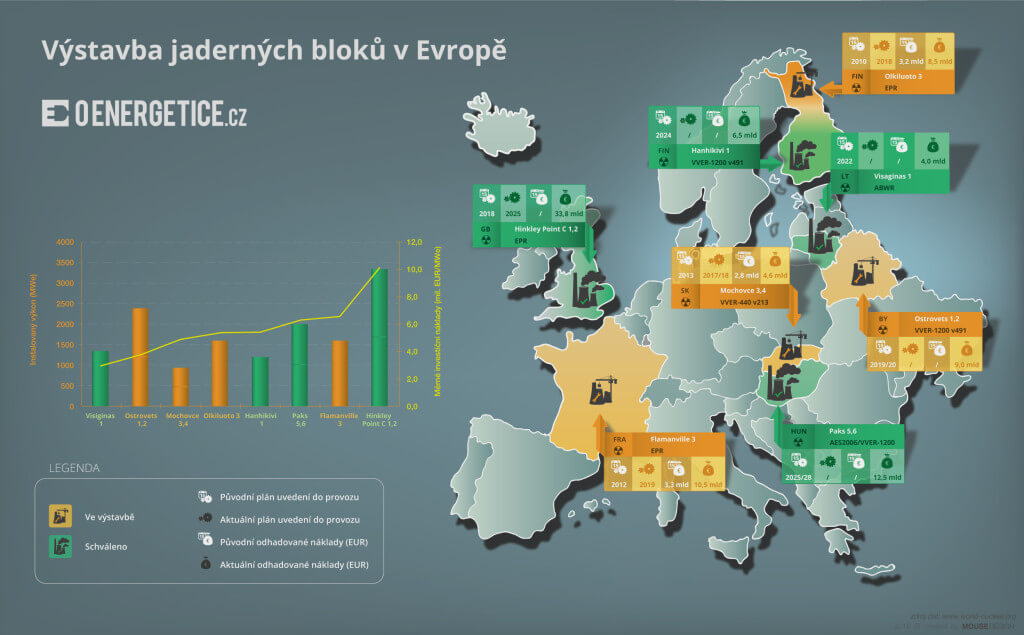
Europe’s slower pace compared with other world regions cannot be fully explained by Germany and other countries moving away from nuclear power. Countries such as the UK and France are still in the picture, although France wants to reduce nuclear power’s share of electricity generation to “just” 50 percent. Moreover, the entire eastern part of the EU has nuclear ambitions.
„New reactors could represent 80 GW of installed capacity by 2050, with two-thirds potentially accounted for by just two Member States (France and the United Kingdom).“
European Commission analytical document
Innovation has yet to make nuclear power cheaper
In the past, a number of experts have pointed out that the development of new, and not only nuclear, power plants is hampered by a distorted European market. At a time of massive support for renewables, only sources that receive state aid in some form make economic sense. However, the continuing wrangling over the UK’s Hinkley Point plant shows that not even a high guaranteed price for future electricity from new units guarantees a project’s success.
The European Commission now highlights another important factor. While innovation makes technologies cheaper in other sectors, the opposite is currently true for nuclear power. Innovation is associated – especially in the period following the Fukushima accident – with ever-increasing requirements for greater safety. And costs naturally rise.
Brussels analysts point out that the nuclear industry’s attempt to achieve economies of scale by building larger reactors, such as the French EPR with an installed capacity of 1650 megawatts, has not fully served its purpose either. Construction times are lengthening and any financial savings are far from evident.
Nevertheless, the European Commission sees some hope in standardisation – across the entire supply chain for the construction of a nuclear unit. Using the same components could ultimately bring down overall costs.
Regardless of the European Commission’s analysis, it will be interesting to watch several key factors in the coming years that will indicate the further development of the entire sector in the EU. These include:
- Will French hopes be confirmed that, after gaining experience at Flamanville and Olkiluoto, they will be better able to manage construction? And what about critics’ claims that the EPR reactor is too sophisticated, complex and, for countries such as Czechia, too large?
- How will Russia’s Rosatom fare with its latest reactor projects in today’s EU environment? For now, these chiefly concern the project on Finland’s Hanhikivi peninsula, and potentially also at Hungary’s Paks plant, if Brussels ultimately approves it. The planned projects of US company Westinghouse will also be interesting to watch.
- Will other European countries besides the UK be willing to provide a guaranteed price for electricity from future units or another form of support? In the Czech case, for example, there has so far been no such willingness.
- Will companies in the European nuclear industry ultimately focus instead on nuclear power projects outside Europe, where they will seek to establish themselves as exporters in the supply chain? Views are also gaining ground in Czech industrial circles that this is the only opportunity.
The author works as a consultant and energy project specialist for the HATcom agency.
Lead photo author: Stefan Kühn
Translation disclaimer
This article is a machine translation of the Czech original and has not yet been fully reviewed. In case of any doubt, please refer to the Czech version.
Sdílejte článek prostřednictvím:
You might also like
23 October 2026, 11:01

23 October 2026, 06:34