Completion of Mochovce: Is the story of Czechoslovak nuclear power coming to an end?
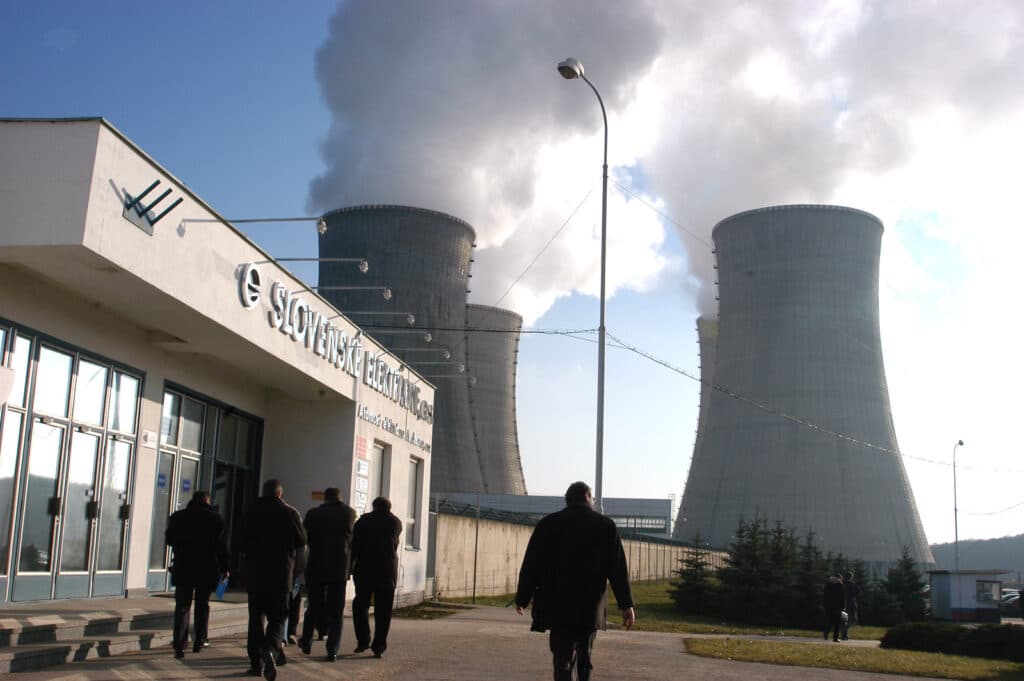
In a word, a horror show. Such assessments are also heard when it comes to the construction of the third and fourth units of the Mochovce nuclear power plant. The original budget has doubled, and completion of the two reactors, which were supposed to be finished in 2012 and 2013, is still not complete.
In this respect, the Mochovce project certainly does nothing to improve the reputation of the historically successful Czech and Slovak nuclear industry, although its ability to influence the aforementioned basic parameters of the entire project is very limited. Czech and Slovak companies operate at Mochovce merely as subcontractors to Italy's Enel.
But if we look at the matter from another angle, we can assess the Mochovce project as excellent. At least in that it gave Czech (and naturally also Slovak) industry an opportunity to retain its know-how and expertise in building nuclear power plants. There has been no other project of similar scale in recent years on which Czech companies won contracts worth more than CZK 20 billion. And there most likely will not be one for a long time. This, however, raises another question: we have retained at least some of the necessary capabilities, but will they be of any use in the future?
It is not over yet
Before we get to the post-Mochovce era, however, let us stay with this era for a while longer. It is still not over, after all. Slovenské elektrárne (SE) announced that Mochovce's third unit will be completed later this year, with the fourth unit due by the end of next year. Total project costs should reach EUR 5.4 billion. (At the official start of construction in 2008, the figure discussed was EUR 2.8 billion.)
The continual extension of the entire project could mean more work for builders and suppliers. Some observers believe that this is precisely why there is no real interest in completing the project. On the other hand, it is clear that any further problems could now have devastating effects on the reputation of all participants. This is not changed by the fact that the French, for example, are facing even greater problems in building their modern reactor—whether at France's Flamanville or Finland's Olkiluoto. This is why even reliable sources are suggesting that the latest timetable may finally be met.
However, the position of Slovakia's Nuclear Regulatory Authority at the very least casts doubt on such optimism. The authority's spokeswoman, Zuzana Hosťovecká, put it perhaps somewhat diplomatically but clearly in an interview with vEnergetike.sk: “According to the contractor's statement, Slovenské elektrárne are not counting on any time reserve; this is the best estimate assuming the completion work continues without problems.” Yet, according to Zuzana Hosťovecká, problems that cannot be foreseen inevitably arise in a project as large and complex as the construction of a nuclear power plant. We have witnessed this many times at Mochovce.
Slovakia's nuclear regulator is not satisfied with the management and coordination of work on the completion project. It has even suspended administrative proceedings on SE's application for authorisation to bring the new nuclear units into operation.
Italian twists and turns
The truth is, however, that the entire project is highly specific. Once observers become familiar with the facts, the report card for the Czech and Slovak subcontractors will be far from as bad as it might seem at first glance.
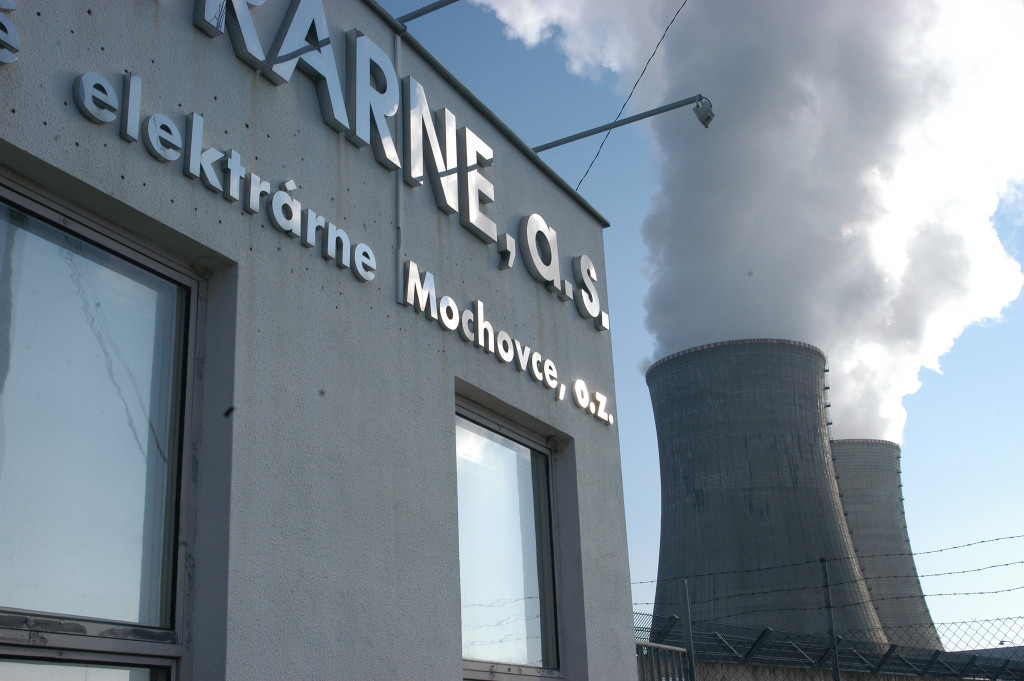
The beginning of the problems can be traced back to roughly ten years ago. At that time, the majority shareholder in Slovenské elektrárne—the Italian company Enel, which still remains one of its shareholders—decided to retain the role of main contractor in-house. The role was taken by Enel Ingegneria & Innovazione. Enel remains primarily responsible for completing the project under SE's current ownership structure. That is, a company with no experience in building nuclear power plants.
At the start of construction, the situation looked entirely different. Italy, under Silvio Berlusconi's government, had enormous ambitions in nuclear energy. Enel was joining forces with France's EDF, was making major strides towards acquiring nuclear know-how, wanted to build nuclear reactors at home and abroad, and even temporarily acquired a stake in France's Flamanville nuclear power plant.
The world after Fukushima
Let us recall the period: as late as the end of summer 2010, Westinghouse's European head Anders Jackson, based on his talks in Berlin, predicted that Germany was not only slowing its nuclear phase-out but would eventually begin building new units as well. The Fukushima accident came in 2011, after which Germany instead accelerated its nuclear phase-out. Italians also voted against nuclear energy in a referendum, and Enel abandoned its plans. The Mochovce completion project remained a sad relic of that era.
After Fukushima, moreover, the approach of nuclear regulators changed and safety requirements were tightened. It was virtually impossible to avoid some delays and budget increases, although not all problems can be blamed on this.
According to some sources, overall management of the completion project improved after another shareholder joined SE's ownership structure in 2015—the Czech Energy and Industrial Holding (EPH), although it has only an indirect influence on the project.
After Mochovce, the flood?
Nevertheless, let us assume that the completion of Mochovce can be finished—sooner or later. These may very well be the last two completed units that were planned back in former Czechoslovakia. After political turbulence and many years of forced interruptions, some reactors—including the two Temelín units—did eventually enter operation.
The construction of further units has been discussed in the Czech Republic for decades, and politicians endorse this vision, but key political decisions either fail to come or do not lead to the final goal, as demonstrated by the cancellation of the Temelín tender for construction of the third and fourth units. And even if a decision on further reactors is eventually made, it appears that construction would begin in the most optimistic scenario in around eight years' time. Equally unlikely is the rapid implementation of construction of another reactor at Slovakia's Jaslovské Bohunice, which, according to available sources, was more of a backup option should completion at Mochovce fail.
Also given the deadlock in the Czech Republic, the Mochovce project was so important for the Czech nuclear industry, which is seeking further opportunities. Unless there are further contracts directly related to the construction of new nuclear power plants, many existing capabilities and skills may disappear. There is even a risk that the successful story of the domestic industry, spanning more than sixty years and beginning in 1956 with work on construction of the first Czechoslovak A-1 nuclear reactor at Jaslovské Bohunice, may be nearing its end. Opportunities on projects abroad are limited. It remains true that in the construction of nuclear power plants, companies from the country concerned or from the country of the main contractor often receive preference one way or another.
Besides Škoda JS (formerly Jaderné strojírenství), a key supplier for the nuclear island of power plants, companies that won contracts at Mochovce included Doosan Škoda Power, Modřany Power, Královopolská RIA, ČKD Praha DIZ and Chladící věže Praha. Many of them have already run into existential difficulties.
We do not live in the last century
Capable Czech companies could continue cooperating with major foreign players in nuclear energy, but there can be no talk of preserving broader reactor-building capabilities. Some experts (including nuclear regulator chief Dana Drábová) argue that sixty years ago we also began building nuclear power from scratch, so there is no reason for excessive concern. We could, after all, return to building nuclear units again. But in the middle of the last century, everyone was essentially starting out, whereas today competitors can gain a lead that will be practically impossible to catch up with.
Some opportunities are nevertheless offered by certain nuclear power plant projects abroad, above all projects of Russia's Rosatom corporation, with which Czech industry has cooperated over the long term. At present, these are mainly Rosatom projects in third countries—in Finland, Hungary and Turkey. In theory, winning significant contracts on these three projects could compensate to a large extent for the “loss of Mochovce”. But this is far from certain.
Bad news, on the other hand, is coming from Jordan, where Czech companies had their greatest prospects as potential Rosatom subcontractors. The entire nuclear power plant construction project has stalled, apparently because of demanding local conditions as well as disagreements between the Jordanians and the Russian supplier.
As far as Czech business is concerned, the post-Mochovce era will be interesting in one other respect. Completing the project will allow Enel to withdraw from SE, so the question is what stake and influence the existing shareholders will gain in the power company —the Slovak state and EPH, the holding company of businessman Daniel Křetínský. Existing agreements do not yet provide a clear answer to the question of who will then become the majority owner of Slovenské elektrárne.
The author is a consultant and energy projects specialist at the HATcom agency.
Translation disclaimer
This article is a machine translation of the Czech original and has not yet been fully reviewed. In case of any doubt, please refer to the Czech version.