
23 October 2026, 14:38
Loading...
Czech environment ministry approves surveys at three sites for radioactive waste repository

oEnergetice.cz, ČTK
18 October 2024, 10:37
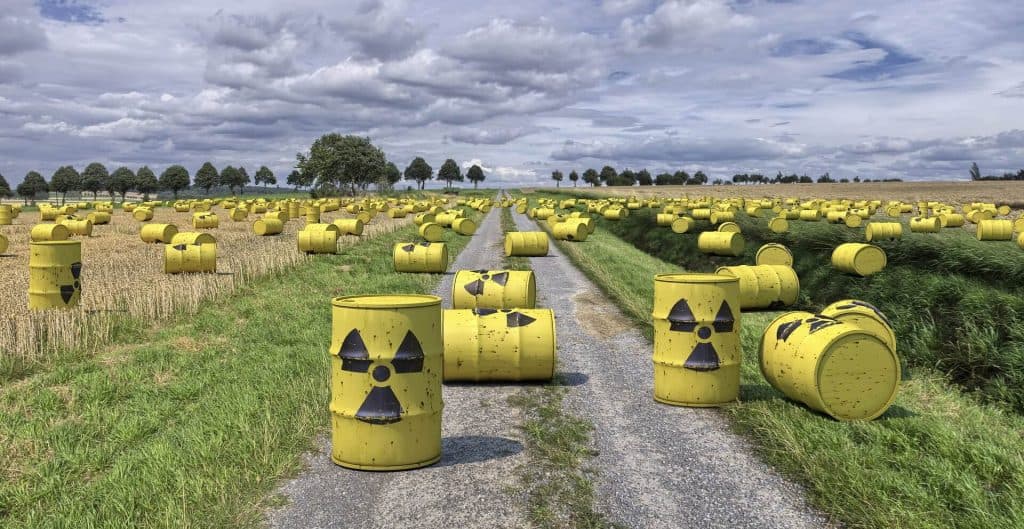
The Ministry of the Environment (MŽP) has approved surveys at three sites being considered for a radioactive waste repository. They are Horka in the Třebíč region, Janoch near the Temelín nuclear power plant in South Bohemia, and Březový potok in the Klatovy region. The Radioactive Waste Repository Authority (SÚRAO), which applied for the permits in February last year, informed the Czech News Agency (ČTK). The authority will carry out deep boreholes, among other work, at the selected sites. The affected municipalities will receive contributions, which they can use as they see fit.
„The aim of the surveys is to obtain more detailed information about the geological composition and development of the rock environment at the four sites under consideration, so that a final site and a reserve site can be selected for the deep geological repository,“ said SÚRAO Director Lukáš Vondrovic.
The authority is also investigating the Hrádek site in the Jihlava region.
Until now, the authority’s knowledge of all the areas has come solely from surface studies. It now needs to obtain more detailed information about their geological composition and the development of the rock environment. In addition to deep boreholes, geophysical measurements will also be carried out. Using a range of specialist methods, these help identify areas where the rock mass is more fractured, as well as any cavities within it.
„We need to know everything about the rock itself, including its petrographic and mineralogical composition. We need to know how strong it is, whether it is fractured anywhere, how water flows through it and exactly what its composition is. Above all, we need to understand how depth affects all these factors and parameters,“ said Marek Vencl, head of the Geological Barriers Department.
Other work has already been carried out at the selected sites that did not require the designation of survey areas. Last year, for example, a biological survey focused on plants and animals. This year, so-called hydromonitoring began, which will monitor the behaviour of surface and groundwater and the protection of water resources over the long term.
The survey areas are considerably larger than the surface or underground facilities of the deep geological repository themselves. The underground section will cover an area of two to three square kilometres. According to completed studies, the surface facility will cover between 15 and 20 hectares. This will depend, however, on local conditions, such as the terrain’s morphology and transport access.
The affected municipalities oppose the repository. The law gives them 140 days to submit their views on the government’s proposal for the repository’s location. The Ministry of Industry and Trade must also discuss the proposal with the Ministry of the Environment and residents of the affected municipalities. The law also sets out rules for oral hearings and primarily defines the affected municipalities’ right to participate in proceedings to designate a protected area for the deep geological repository. The government is to establish a working group to communicate with municipalities, which should make it easier for them to take part in preparing and operating the repository. However, municipalities do not have the right to veto the site decision.
The state is expected to select the most suitable site by 2030. According to the authority’s plans, the deep geological repository is intended as the final solution for the lifecycle of radioactive waste. It will permanently store mainly thousands of tonnes of spent fuel from nuclear power plants, half a kilometre underground. It was originally due to be built by 2065, but speeding up construction is being discussed because nuclear power has been temporarily included among green investments in the EU. The condition is that countries relying on nuclear energy must have deep geological repositories from 2050. Other countries are also preparing repositories, alongside Czechia.
Translation disclaimer
This article is a machine translation of the Czech original and has not yet been fully reviewed. In case of any doubt, please refer to the Czech version.
Sdílejte článek prostřednictvím:
You might also like


23 October 2026, 11:01


23 October 2026, 06:34