
23 October 2026, 14:38
Loading...
Feature: how France's Framatome is preparing for a nuclear renaissance
oEnergetice.cz
2 December 2024, 10:15
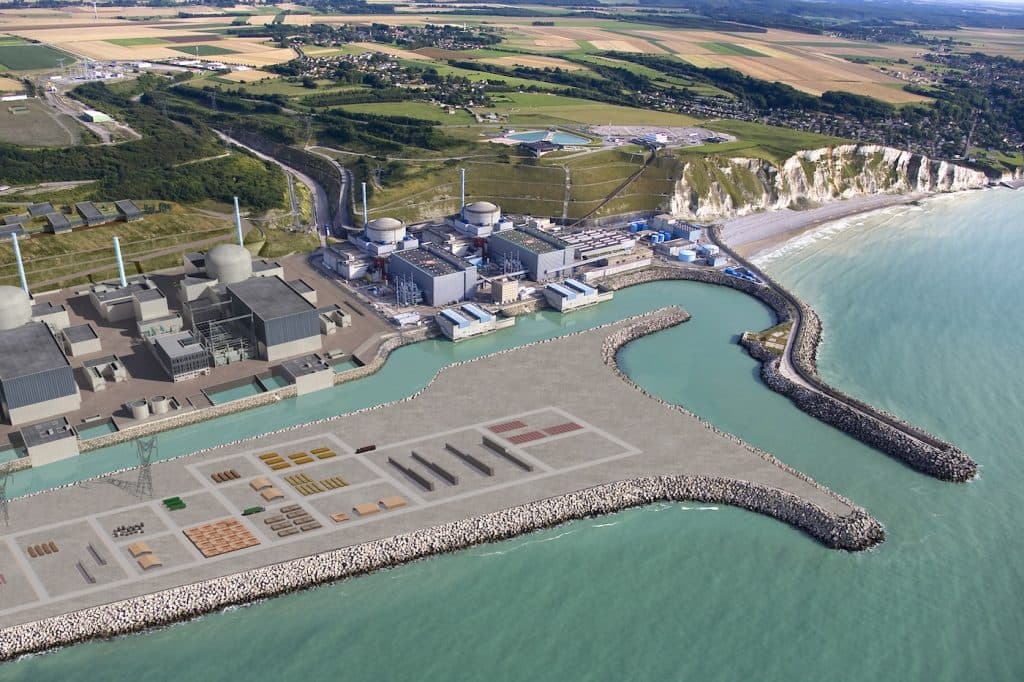
EDF, the world’s largest nuclear power plant operator, is seeking to ramp up production of new reactors at an unprecedented pace. This challenge is forcing its subsidiary Framatome to rethink its existing manufacturing processes. We take you behind the scenes of this transformation in a report by French magazine L´Usine Nouvelle.
At the plant in Saint-Marcel, about 100 kilometres north of Lyon, the EDF subsidiary assembles 25-metre-tall steam generators and reactor pressure vessels for both older pressurised water reactors and new EPR reactors. Stéphane Ecoffey, technical manager for the plant’s capacity expansion project, stands in front of a large table displaying plastic models of all the parts of a steam generator. “We analysed the processes in detail and, as a result, defined thirty stages in the steam generator production cycle,” he says.
The next step, he says, is to create 120 workstations requiring different skill levels. This will enable a shift from an approach based on labour hours to so-called “takt time”, a concept that defines the ideal pace of production. It is well known in the automotive industry, but is unprecedented in the nuclear sector. To put this approach into practice, the company drew inspiration from proven practices at Dassault Aviation and tractor manufacturer Claas. The ultimate goal is to produce six steam generators a year, compared with eight over the past six years.
The French nuclear industry believes it can reconcile safety requirements with mass production. EDF CEO Luc Rémont announced plans to build 1 to 1.5 EPR nuclear power plants a year, rather than one or two every ten years.
The Excell project
At the end of 2022, EDF presented an assessment of the Excell project, which was launched in 2019. The plan aims to restore French industry to its former operational level through the standardisation of processes, plant certification, lean manufacturing, robotics, digitalisation and a focus on transparency.
The renewal project covers both EDF’s power plants and, in particular, Framatome’s twelve French plants. The EDF subsidiary designs, manufactures and services components that are fundamental to civil nuclear reactors and nuclear propulsion systems for the defence industry: reactor pressure vessels, steam generators, pumps, primary circuit piping and fuel assemblies.
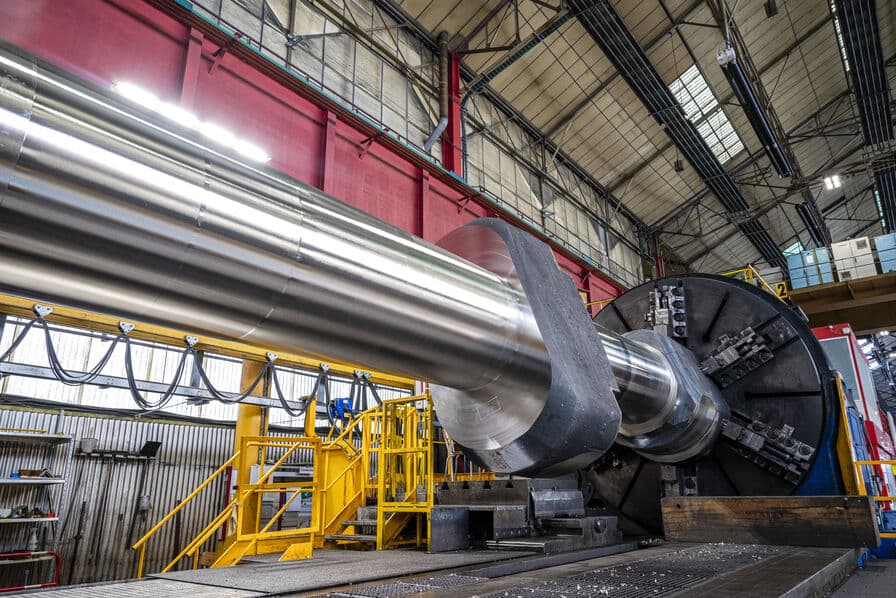
The transformation at Saint-Marcel is still at an early stage. The site is preparing to deliver two steam generators for the UK’s Hinkley Point C plant, while three more still need to be completed. The plant covers an impressive area of 39 000 m². It has two training schools: one for welding, established in 1975, and another for non-destructive testing. There are also assembly shops, as well as hot- and cold-working shops where enormous steel components five metres in diameter are processed.
Source: EDF
An investment of 300 million euros is planned to expand the plant and enable serial production. The new construction area will cover 27 300 m², with work expected to be completed in 2028. The entire production organisation will also be restructured so the plant can make six steam generators a year and three reactor pressure vessels every two years.
“In September 2021, we introduced lean manufacturing using the 5S method to eliminate time lost between two operations,” says Stéphane Ecoffey, who, together with his three-person team, analysed the production of components for Hinkley Point C over the course of a year.
The new, more streamlined organisation will be implemented for deliveries to France’s latest EPR2 reactors. To keep pace with the new production rate, operators will also need to familiarise themselves with QRQC (quick response, quick control) quality methods. These were introduced at Saint-Marcel a year ago and are displayed on large white boards around the plant. Training in neuroscience applied to safety is even held here to improve understanding of the role of human factors in errors.
Doubling capacity at Le Creusot
For Saint-Marcel to meet its “takt time”, other plants must supply it at the right pace. Let’s start in Le Creusot, 45 km to the west. This is where the cylindrical components needed to assemble each steam generator, primary circuit piping or reactor pressure vessel head are forged and machined. The plant will soon also start making EPR reactor pressure vessels, which are currently cast in Japan by Japan Steel Works.
Source: EDF
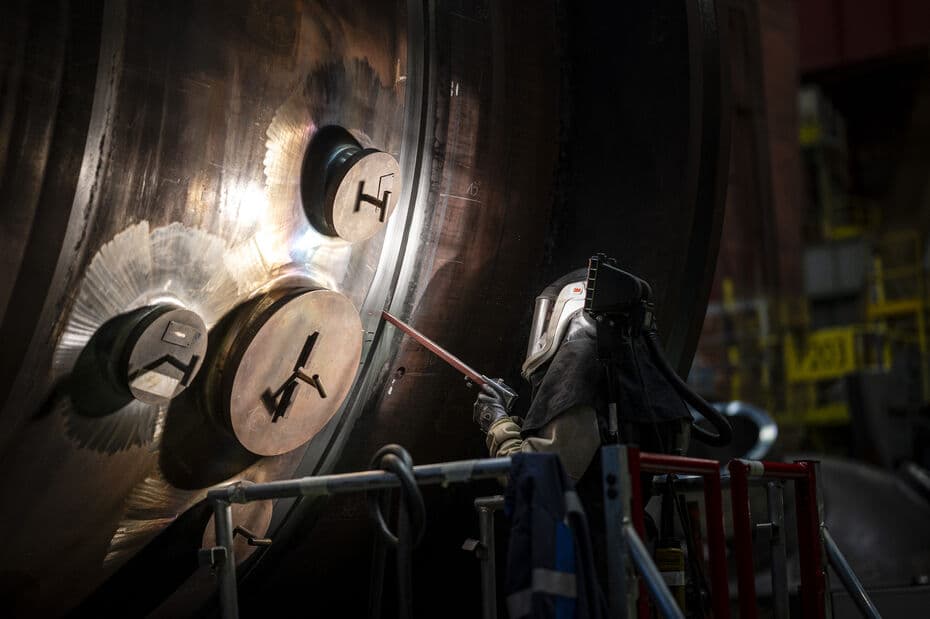
Since 2019, everything at Le Creusot has doubled: the number of employees has risen from 250 to 500, and the number of forged components from 30 to 70. More than 100 million euros has been invested, with a further 40 million euros planned for a furnace and new forging and machining equipment.
The plant, which was almost shut down in 2019, has gained a new lease of life and recently received authorisation to forge components for EPR2. The large Eiffel-style hall is gradually being tidied up in line with the principles of lean manufacturing. By the furnaces, which provide welcome warmth on a chilly November day, operators are installing a huge mandrel in an 11 300-tonne press. Further along, component number 455 for EPR2, cast in mid-November, is waiting its turn for forging. Here, too, the pace needs to increase from 0.7 to 1.5 EPRs a year.
Pipes under close scrutiny
At the Montbard plant, about 100 kilometres north of Le Creusot, the industrial challenges are quite different. Framatome bought the plant from Vallourec in 2021 to preserve its unique expertise in cold rolling and bending pipes. These are used for heat exchange inside steam generators. Located in the centre of town, the plant employs 240 people and already produces 30 000 tonnes of pipes suitable for EPRs each year. It can supply enough for 1.5, or even two, EPRs a year and theoretically has the capacity for three.
At the end of 2023, pipes for the steam generators at the UK’s Sizewell C plant came off the rolling mills here. In the non-destructive testing and finishing workshop, each pipe is coated and inspected before being carefully laid flat in large wooden crates. Here, too, EDF and its customers can drop by whenever they want to check the quality of the work. Although the plant is certified to ISO 19443, it must also comply with EDF programme standards. Like the group’s other plants, it is gradually introducing visual management tools, daily meetings, rapid problem-solving and QRQC workshops.
A digitalisation pilot plant
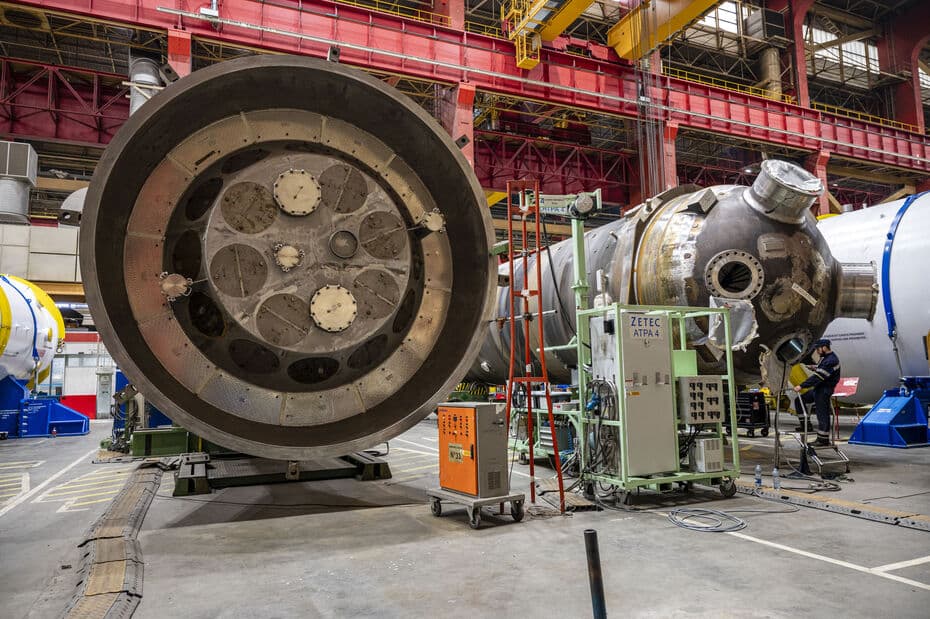
These methods have already been tested at two plants belonging to another Framatome division, the nuclear fuel division. The company is also working to incorporate digital tools into these methods. The most advanced site is the plant in Romans-sur-Isère, where uranium pellets, as well as the grids and end fittings used to make finished fuel assemblies—rods more than four metres long for EPR reactors—are produced.
The plant receives an annual investment of 50 million euros to increase its capacity, which has already risen from 853 to 1 000 tonnes of pellets a year. An expansion project on an adjacent 35-hectare plot would make it possible to relocate logistics operations and create more space for workshops.
Source: EDF
As part of its strategy, the plant is a pilot site for the digitalisation of production flows, operator training and visual quality management, particularly through Gemba tools that bring managers onto the shop floor, and QRQC on touchscreens. “It’s a very welcome change. Meetings are held on the shop floor with operators. The aim is to identify defects as early as possible, record them and maintain full traceability for every incident,” explains Pierre-Antoine Alazard, head of production.
Resuming operations in Paimboeuf
Framatome’s second pilot site for the digitalisation of lean manufacturing tools, particularly the Fabriq performance monitoring system, is in Paimbœuf. “It is clearly the largest zirconium tube plant in the world,” says Damien Cholet, who has run the plant for the past two years. Founded in 1974 on the edge of a village in the countryside, the company has 470 employees, 200 of them in production. Since 2020, it has produced 9 200 km of tubes a year, compared with 6 000 in 2016, thanks in particular to annual investments of 5 million euros.
The revival in activity can be heard and seen at every turn. Tubes roll and clatter through the workshop as they are cut into sections that will be loaded with uranium pellets in Romans-sur-Isère. To further increase capacity, the plant is looking for ways to reduce lost time. Its first on-site SMED (single-minute exchange of die) trial is focused on speeding up tool changes on a rolling stand. It has already saved three hours. This small success may partly explain the smiles we encountered during our visit, and the atmosphere of ease and trust that has taken hold at the plant after several difficult years and despite the challenges facing the nuclear industry.
(reproduced from L´Usine Nouvelle, abridged and adapted)
Translation disclaimer
This article is a machine translation of the Czech original and has not yet been fully reviewed. In case of any doubt, please refer to the Czech version.
Sdílejte článek prostřednictvím:
You might also like


23 October 2026, 11:01


23 October 2026, 06:34