23 October 2026, 14:38
Loading...
Finnish nuclear waste repository starts drilling deposition holes. Czechia continues to seek its own path

Eduard Majling
3 September 2026, 13:18
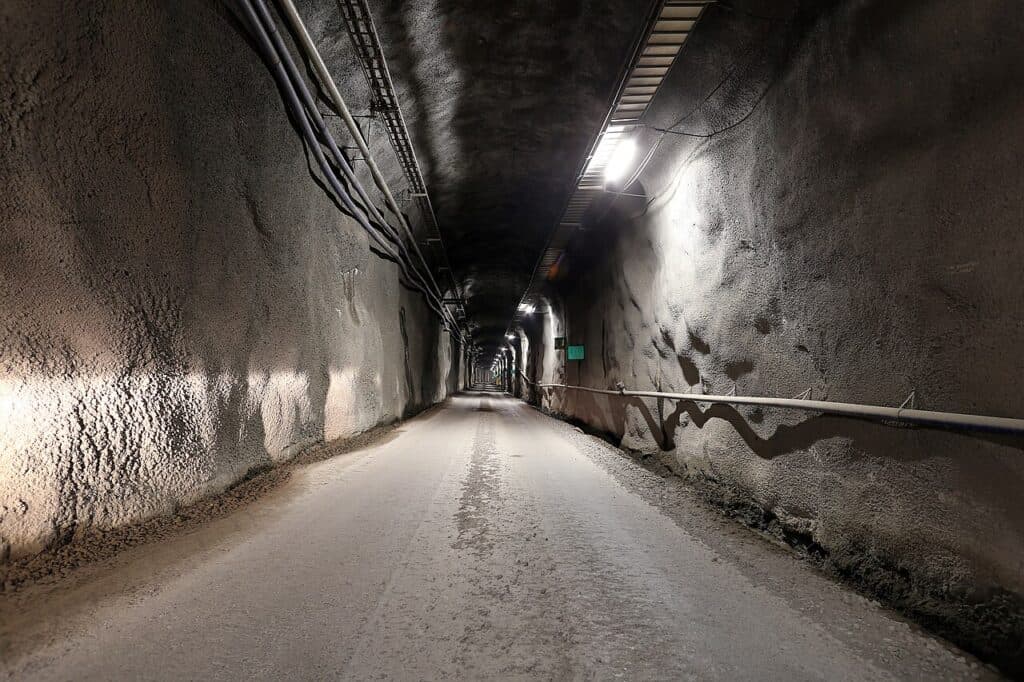
Finland's Onkalo deep geological repository has entered another phase of preparations for the disposal of spent nuclear fuel. Posiva has begun drilling the first actual deposition hole, which is to become part of the final repository. The project is thus moving from trial work to infrastructure intended for full-scale operation.
Drilling began in the underground complex within the Olkiluoto bedrock formation at a depth of more than 400 metres. The first hole is being drilled into the floor of an already excavated disposal tunnel, and its parameters demonstrate the high demands Posiva places on the precision of future operations. Finland is thus taking further steps in a project that has been debated for decades and is now approaching the point of actual use.
The completed deposition hole is to be 8.4 metres deep and 1.75 metres in diameter. Its centre must not deviate from the vertical axis by more than 25 millimetres along its entire length. If the hole exceeds this limit, it cannot be used for the final disposal of fuel.
The first at least three holes will therefore undergo enhanced inspections and will be remeasured immediately after completion, before drilling continues on further holes. This is an important operational stage, as it verifies not only the drilling technology itself but also the ability to repeat it under actual repository conditions.
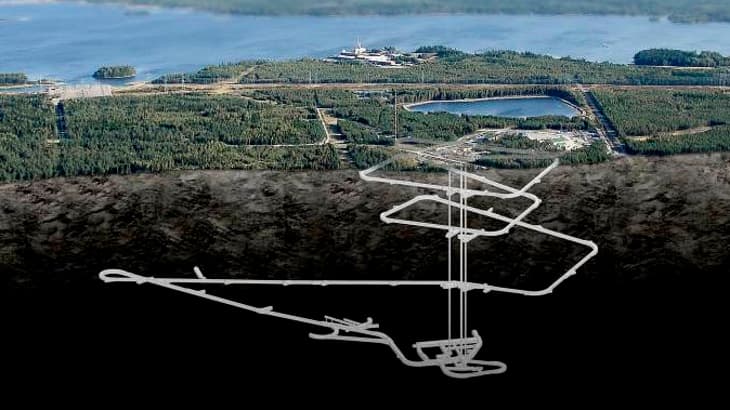
Visualisation of an underground spent nuclear fuel repository. Source: Posiva
The drilling machine used was delivered to Onkalo in June 2022 by German company Herrenknecht AG. Posiva has already carried out a series of test drills with it, initially with the supplier's involvement and subsequently using its own team. According to the operator, drilling a hole roughly eight metres long takes around ten hours of net time.
The target for standard operations is to complete approximately two deposition holes per working week. From the perspective of the future economics of operations, the ability to maintain a stable pace, drilling quality and inspection regime will be one of the decisive parameters.
Repository at a depth of 450 metres
Spent fuel is to be disposed of at Onkalo in bedrock at a depth of approximately 450 metres. The concept involves tightly sealed iron-copper canisters, a bentonite barrier, clay backfill in the tunnels, closure structures and the surrounding rock.
The first disposal tunnel, where drilling is now under way, is around 330 metres long and will accommodate approximately 30 deposition holes. Around 100 disposal tunnels with a total length of roughly 35 kilometres are to be built over the entire planned operating period.
Finland is therefore preparing not merely a one-off technological solution, but a long-term industrial process. For Europe's nuclear sector, Onkalo is significant because it demonstrates a concrete path from geological exploration through the construction of underground facilities to repeatable fuel disposal.
Licensing decision remains with the government
According to World Nuclear News, Posiva applied for an operating licence for the encapsulation plant and final repository on 30 December 2021. The application covers operation from March 2024 until the end of 2070. The final decision rests with the Finnish government, while a favourable opinion from regulator STUK is an essential condition.
STUK began its review in May 2022 and, according to earlier information, has already concluded that the safety requirements for issuing an operating licence have been met. Posiva now says its goal is to achieve operational readiness to begin final disposal by the end of 2026.
For Czechia, the Finnish approach is an important reference
The Finnish repository is a step closer to launch, while for the Czech debate, the selection of a site remains the key issue, along with gaining the trust of affected municipalities and establishing a stable long-term timetable. Onkalo shows that it is not enough simply to select suitable geological conditions; decades of preparation must also be turned into an operationally manageable system.
For the Czech Republic, the Finnish experience will be valuable particularly in assessing technical implementation, licensing procedures and communication with regions. Practical results from Onkalo can therefore provide an important reference point for decision-making in Czechia.
Translation disclaimer
This article is a machine translation of the Czech original and has not yet been fully reviewed. In case of any doubt, please refer to the Czech version.
Sdílejte článek prostřednictvím:
You might also like
23 October 2026, 11:01

23 October 2026, 06:34