3 October 2026, 13:01
Loading...
France to unexpectedly shut down more reactors, pushing up electricity prices in the Czech Republic

Martin Voříšek
17 December 2021, 09:13
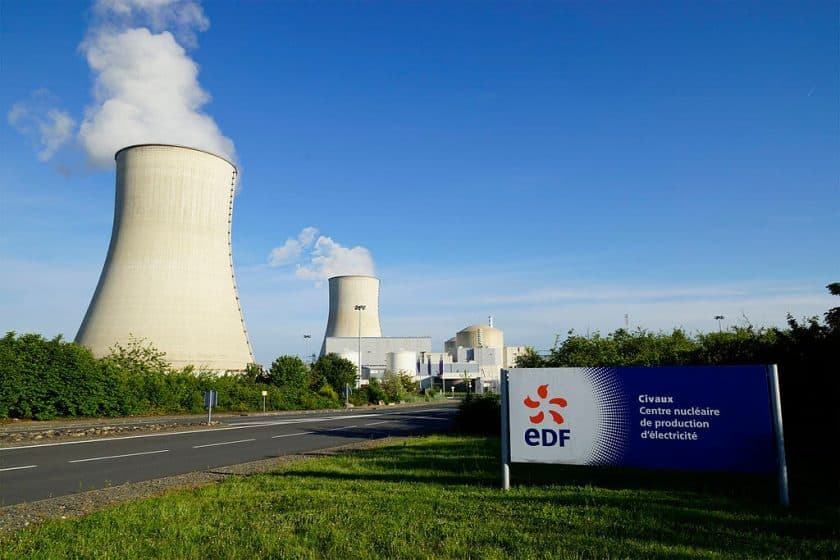
French utility EDF has announced that it will unexpectedly shut down two more of its nuclear reactors in France. It has also extended the outages at another two reactors until the spring months. The announcement triggered a sharp fall in the company's share price, while electricity prices for January and for 2022 in Europe rose substantially.
The French nuclear giant is facing problems at its reactors at the least opportune time. At a time when electricity and other commodity prices in Europe are rising significantly, EDF's announcement of unexpected outages at both reactors at the Chooz plant, along with the extension of outages at both reactors at the Civaux plant, has added to the pressure.
All four reactors are among the newest in the country. They were commissioned between 1996 and 1999. However, defects were discovered near some welds during a planned outage at the Civaux plant, and EDF therefore decided to replace the faulty components.
The Chooz plant has reactors of the same type, and EDF therefore shut down both units there as a precaution after consulting the local nuclear safety authority.
While the reactors at Chooz are due to return to electricity generation in the second half of January next year, the Civaux units will not be reconnected to the grid until 31 March 2022 and 30 April 2022, respectively, due to repairs.
France is also more dependent on electricity during the winter period than other countries. The share of heat produced from electricity is significantly higher than in other European countries. For this reason, too, the French transmission system operator is analysing resource availability for the coming winter. It warned of potential outages as early as last winter, and the situation this winter does not look much better.
The impact on electricity prices will also be felt in the Czech Republic
From the perspective of energy markets, it would be hard to find a less opportune moment. The outage announcement further boosted electricity prices on wholesale markets, which are already at record levels due to extremely expensive natural gas and a negative outlook for gas prices through to the end of winter.
Moreover, due to the increasing integration of European markets, the effects of the French outages are also reflected in the wholesale prices of other member states, including the Czech Republic. While in France, electricity prices for the following month (the Jan22 contract) reached a record EUR 665/MWh and EUR 297/MWh for the following year, prices for the same contracts in the Czech Republic rose to EUR 410/MWh and EUR 247/MWh, respectively, for the annual contract.
The annual contract (Cal22-BL) on the Prague exchange gained more than 19% on Thursday. In absolute terms, this represented a daily increase of approximately EUR 39/MWh. It is worth recalling that for most of 2020, this same contract traded at prices between EUR 40-50/MWh.
Outages also affected shareholders, with the share price falling by more than 15%
The outage announcement did not please EDF shareholders any more than consumers. Shares in the French utility ended trading 15% lower and have lost almost a quarter of their value over the past month.
All this despite the continued rise in electricity selling prices. EDF benefits from these only to a limited extent, however. Due to regulation, it must sell electricity to its competitors at a fixed price of EUR 42/MWh. In total, it must sell 100 TWh in this way, approximately a quarter of its nuclear power plant output.
In addition, EDF faces the completion of three EPR units currently under construction in Europe and likely the construction of up to six more units in France. It must also take care of its ageing reactors, for which maintenance costs and the costs of meeting operational safety requirements are increasing.
Translation disclaimer
This article is a machine translation of the Czech original and has not yet been fully reviewed. In case of any doubt, please refer to the Czech version.
Sdílejte článek prostřednictvím:
You might also like
3 October 2026, 07:43

2 October 2026, 21:55

2 October 2026, 15:14