
17 October 2026, 13:09
Loading...
German Wendelstein 7-X breaks world record in fusion energy

Marek Kršák
8 June 2025, 11:13
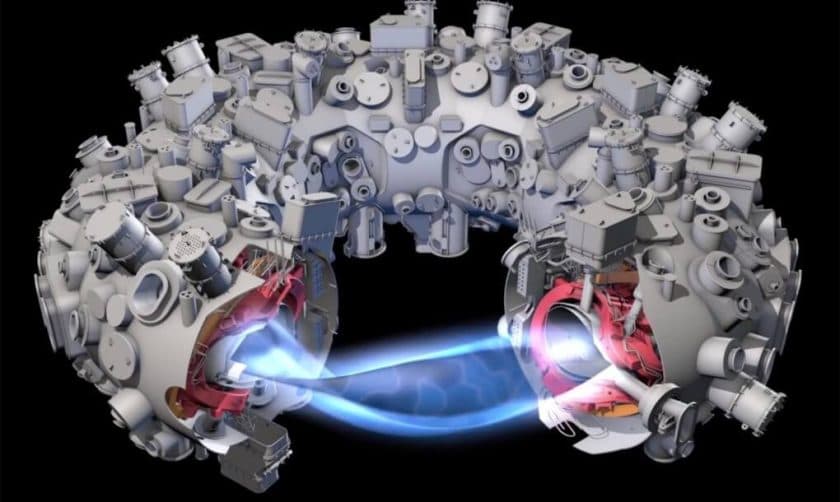
The world's largest stellarator fusion device, Wendelstein 7-X, has broken the world record for a key fusion physics parameter known as the triple product. In the latest experimental campaign, researchers from Europe and the US achieved a new maximum value for this key fusion parameter—calculated as the product of fuel density, fuel temperature and confinement time—for 43 seconds. This value now surpasses previous tokamak records for long-duration plasma operation.
A new pellet injector played a key role in achieving the record. It injects frozen hydrogen pellets into the plasma, enabling long-duration operation by continuously replenishing the fuel. The unique injector was developed by the US Department of Energy's Oak Ridge National Laboratory and has been successfully commissioned on Wendelstein 7-X. While it surpasses previous tokamak records for plasma duration, tokamaks still hold the records for short plasma pulses.
During the experiment, about 90 frozen hydrogen pellets, each about one millimetre in size, were injected over 43 seconds, while powerful microwaves heated the plasma. Precise coordination between heating and pellet injection was key to achieving an optimal balance between heating power and fuel delivery.
The key to success was the pilot use of a pellet injector with a variable, pre-programmed pulse rate—a sequence carried out with impressive precision. During the record-breaking experiment, the plasma temperature rose to more than 20 million degrees Celsius and peaked at 30 million degrees.
During the latest experimental campaign, energy throughput was increased to 1.8 gigajoules (over 6 minutes). The previous record, set in February 2023, was 1.3 gigajoules.
Wendelstein 7-X
Wendelstein is a stellarator fusion reactor, unlike tokamak fusion reactors such as the Joint European Torus in the UK or the Iter facility being built in France.
A tokamak is based on a uniform torus shape, while a stellarator twists this shape into a figure eight. This avoids problems faced by tokamaks, where the magnetic coils confining the plasma necessarily become less densely packed on the outside of the toroidal ring.
Wendelstein 7-X will not be used to generate electricity, but it should demonstrate whether stellarators are suitable for use as power plants. It is expected to show that stellarators can operate continuously. By contrast, tokamaks can operate only in pulses without auxiliary equipment.
Translation disclaimer
This article is a machine translation of the Czech original and has not yet been fully reviewed. In case of any doubt, please refer to the Czech version.
Sdílejte článek prostřednictvím:
You might also like




16 October 2026, 10:16