23 October 2026, 14:38
Loading...
New generation III+ nuclear reactors in operation – part 1
Vladimír Wagner
17 July 2018, 16:40
At the end of June, fission chain reactions were initiated at two new Generation III+ reactors in China. These were Framatome’s European Pressurised Reactor (EPR) at the Taishan plant and Westinghouse’s AP1000 reactor at the Sanmen plant. China’s Generation III ACPR-1000 reactor also entered operation in May. There are now six types of Generation III reactors in operation.
At the turn of June and July 2018, the two aforementioned reactors were connected to the grid in quick succession. Slightly earlier, on 25 May, China’s Generation III ACPR-1000 reactor also began operating as Yangjiang unit 5. They began supplying energy to the grid and are expected to start commercial operation by the end of the year. This year, three further designs have thus joined the three Generation III reactor types already in operation. The success of nuclear power depends on the success of reactors of this generation, and units of this type should begin to be built in Czechia as soon as possible. It is therefore a good time to look at the situation for the individual designs.
Generation III+ EPR reactor
The EPR is Framatome’s key reactor design. Framatome is the part of Areva that builds new reactors and has returned to its original historic name used from the 1970s to the 1990s. It is now owned by EDF (75.5%), Mitsubishi Heavy Industries (19.5%) and consultancy Assystem (5%). The latter is backed by French entrepreneur Dominique Louis, who bought the corresponding stake in Areva at the end of 2017. He expects a nuclear renaissance in Europe as well, mainly due to growing pressure to reduce emissions. The part of Areva focused on uranium mining and nuclear fuel production remains under its original name and under the control of the French government.
The first reactor of this type entered the commissioning phase at the Taishan plant. Construction of two EPR units there began in 2009. They were originally due to be completed in 2013, but substantial delays occurred. The reactor was therefore only completed in 2017, and its chain reaction began only in early June 2018. It was connected to the electricity grid on 29 June and could begin supplying electricity. Of importance to the Czech Republic is that Škoda JS was among the subcontractors for this project, manufacturing internal components of the reactor pressure vessel: the core barrel, heavy reflector and upper internal structure. It also supplied the same parts for the reactor at Finland’s Olkiluoto plant. The second Taishan unit is expected to start up in 2019.
Two further units are being completed in Europe, where delays have been even greater. The very first EPR reactor began construction as Olkiluoto unit 3 in 2005, with completion planned for 2009. Hot functional tests, which began in December 2017, were completed on 30 May 2018. Fuel loading is being prepared; the 241 fuel assemblies have a total weight of 128 tonnes. The reactor is currently scheduled to start up in 2019.
Another EPR reactor has been under construction at the French Flamanville plant since the end of 2007. It has also faced a number of delays and problems. The best known is the higher carbon content in the steel of certain parts of the reactor pressure vessel. A number of tests had to be conducted to determine how this deviation would affect the properties of the relevant components. Cold tests of the reactor were completed in January 2018. Problems were then discovered with some welds in the secondary part of the cooling system. Testing of individual plant systems has therefore been prolonged. Hot tests will consequently only begin in the second half of 2018. This means the plant is also more likely to start up only in 2019.
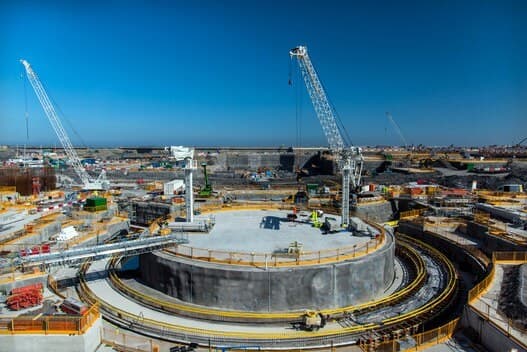
The future of this reactor design will depend crucially on how construction proceeds on the two EPR units at the Hinkley Point C plant in the United Kingdom. The first key concrete pours for the nuclear island foundation slab are approaching, along with the official start of construction. Subcontractors for the individual reactor components are currently being selected. Škoda JS will again supply a number of internal reactor pressure vessel components. These will again include an 80-tonne stainless-steel core barrel, a 100-tonne heavy reflector made of the same material, and an 80-tonne upper internal structure for the reactor pressure vessel.
Experienced specialists will become available for the UK project after the completion of the units in China, Finland and France. Crucial to Hinkley Point C will be how experience from the previous projects can be used. Importantly, reactors of this type will soon be operating in Europe, clearing the way to meet not only the formal requirements of the relevant authorities in the region. This creates very good conditions for the project to proceed efficiently and quickly. The very good cooperation between EDF and its Chinese partner CGN (China General Nuclear) could also help. CGN wants to become strongly involved in nuclear power in the UK as well. It is therefore negotiating with EDF and Centrica to buy stakes in eight British nuclear power plants. Centrica currently holds 20% and EDF 80%. The Chinese plan to buy Centrica’s stake and an additional 29% from EDF. EDF, with a 51% stake, and CGN, with 49%, would thus jointly invest in the British nuclear plants. For CGN, this would be a way to gain experience and enter the European market more substantially. This will also be useful in preparing construction of two Hualong One reactors at the Bradwell B plant.
Two further EPR reactors are also to be built at the Sizewell C plant, again with EDF and CGN as joint investors. This is expected to be an improved version of the unit, retaining identical characteristics but optimised to make construction simpler and cheaper. The most important task at present is finding a financing model for the project. Chaos caused by Brexit could become a problem for nuclear power in the UK. It could also lead to broader economic stagnation affecting the energy sector.
Plans to build six EPR units at Jaitapur in India are also at an advanced stage of negotiations. India is building domestic heavy-water reactors and fast reactors. In future, this combination should enable it to use domestic thorium. However, it now needs to build sufficient capacity relatively quickly to meet its growing needs linked to the country’s nearing full electrification. So far, this has involved Rosatom’s Russian VVER reactors at the Kudankulam plant. Framatome could now become involved in India’s nuclear build-out with EPR units.
However, the EPR was primarily developed for French needs, for the gradual replacement of France’s ageing nuclear fleet. Flamanville 3 is intended to replace two units at the oldest plant, Fessenheim, whose closure is being urged by Germany and Switzerland. For other units, extending operation is more likely to be considered. Although France has declared a gradual reduction in nuclear power’s share of its energy mix in recent years, events during the last several winters and current rising electricity prices, especially in Germany, are leading to a return to a more realistic approach. Even the closure of Fessenheim has therefore been postponed until Flamanville 3 enters operation. The time is approaching—around 2022—when installed capacity will decline dramatically not only in Czechia but in a number of European countries. The impact on Czechia is discussed here. A number of countries around France plan to address such a situation by importing electricity. For now, France, Germany and Czechia all have surpluses and export capacity. However, this may no longer be true around 2022. France may therefore reconsider its approach to building new units.
Generation III+ AP1000 reactor
On 30 June, a day after the first EPR unit, the first AP1000 reactor was also connected to the electricity grid. This was unit 1 at the Sanmen plant. This reactor was originally developed by the US company Westinghouse. Construction of two units of this type at Sanmen began in 2009. The first unit was originally due to be completed in 2014 and the second in 2015. However, there were a number of delays, and the chain reaction at the first reactor began only on 21 June 2018, four years behind schedule. The unit’s output is now being gradually increased and different operating conditions are being tested; the reactor should enter commercial operation later this year. The second unit at the plant is also nearing the start of a controlled fission chain reaction. Its 77-day hot testing programme ended in late January. On 5 July, the unit received permission from China’s nuclear safety authority to load fuel.
Two further units are being completed at the Haiyang plant. Haiyang unit 1 should also start up this year; fuel loading began there on 21 June 2018. The second unit is due in 2019.
Two AP1000 reactors are under construction at the US Vogtle plant. The reactor pressure vessel was installed at Vogtle unit 4 at the end of March 2018, while the vessel for Vogtle unit 3 was installed in 2016. Their completion is planned for 2021 and 2022. Construction of two units at the VC Summer plant has been frozen. At the same time, construction of two such units is planned at Florida’s Turkey Point plant, units 6 and 7. The regulator issued a licence for these units in April 2018. However, whether and when construction will take place remains an open question.
For this reactor design, the question of how many units will be built and where remains unresolved. Originally, a number of potential customers for this model were expected in the US, China, India and the UK. In the US, nuclear power has stagnated, mainly because of cheap gas. Apart from completing the two aforementioned reactors at Vogtle, no further projects are planned in the coming years.
In China, projects where AP1000 units were originally considered have switched to other designs. In cooperation with Westinghouse, China developed a Chinese AP1000 variant known as the CAP1000, as well as the higher-capacity CAP1400 variant. CAP1000 models are planned for the addition of four further units at Sanmen and two further units at Haiyang. Further projects are planned at the Xudabao and Lufeng plants. Construction of two CAP1400 reactors is being prepared at the Shidaowan plant, where site preparation is already under way.
The continuation of AP1000 production by Westinghouse remains an open question, while the construction of Chinese CAP1000 and CAP1400 variants appears more promising. However, they will compete with China’s Hualong One reactor.
Generation III+ VVER1200 reactor
The first VVER1200 reactor started up as unit 6 at the Novovoronezh plant in 2016. It began supplying electricity on 5 August 2016. Between 17 March and 28 April 2018, it underwent its first outage for core reconfiguration and maintenance. By 4 June 2018, the unit had generated 10 TWh of electricity. The second VVER1200 unit at the plant is entering the testing phase. A reactor core was therefore assembled with dummy fuel assemblies, which had already been used at the first unit. They have the same thermal properties and assist in hot testing.
At the start of 2018, commissioning began for another model of this reactor type at the Leningrad II plant. Fuel loading began at the first unit in early December 2017; it reached minimum controlled power on 6 February 2018, was connected to the electricity grid for the first time on 9 March and began supplying electricity. By mid-April, it was operating at half of installed capacity, and it reached 90% on 9 June. At the second unit, the upper section of the inner containment was completed at the end of June.
Two units at Belarus’s Ostrovets nuclear power plant are also close to completion. Construction began in 2013 and 2014. They are expected to enter operation in 2019 and 2020. Rosatom will therefore soon have units built abroad in operation.
The same VVER1200 reactor model as at Novovoronezh is also being built at Bangladesh’s Rooppur plant. These are two units at the start of construction. Concrete pouring for the reactor island foundation slab of the first began in November 2017 and was completed at the start of April 2018. The pour for the second is to begin in July 2018. Very positively, India will assist Bangladesh in introducing nuclear power. India has several years of experience in building and operating Russian VVER reactors. Completion of the units is expected in 2023 and 2024.
Four units are to be built at Turkey’s Akkuyu site. Concrete pouring for the reactor island of the first unit began in April 2018, officially marking the start of its construction. It would be Turkey’s first nuclear power plant. The units should be completed progressively in 2023-25.
The construction of four such reactors at Egypt’s El Dabaa plant is also gradually taking concrete shape. Russian specialists are participating in research at the future construction site and in the launch of site preparation. The first portion of the loan Russia has provided for construction is also available. Potential subcontractors are already being approached on a preliminary basis. Construction of the units themselves should begin in two to three years.
Based on experience from the construction and operation of VVER1200 reactors to date, an optimised version, the 1255 MWe VVER-TOI, has been prepared. It is being deployed for the first time in the second phase of the Kursk plant, where it will progressively replace RBMK-1000 reactors. Construction of the two units is currently progressing successfully. On 30 June 2018, the foundation slab for the reactor building at the first unit was completed. Around 17,000 cubic metres of special concrete were used for the slab, which measures 77 m by 88 m and is 2.6 m thick. Concrete pouring for the building walls has been under way since 7 July; the required reinforcement was installed during the foundation slab pour.
At the same time, six large cranes and other support equipment are currently being installed. Preparation for construction of the second unit is also continuing, including preparation of the site for the future foundation slab of its reactor building. Concrete pouring for it should begin in December this year. The Kursk units are reference units, and Russia plans to offer this version abroad as well, so it will be very interesting to see how quickly construction proceeds. The advantage is that all experience gained from previous projects can be applied here, making construction potentially very efficient.
In early June 2018, an agreement was newly reached to build two pairs of VVER1200 units at China’s Tianwan and Xudabao plants. The new reactors at Tianwan are planned as units 7 and 8; units 5 and 6 are already under construction and are of the ACPR1000 type. At Xudabao, these would be units 3 and 4, while units 1 and 2 are expected to be CAP1000 designs. Four VVER1000 units are already operating at Tianwan, with the latest having begun operation at this time. Some Czech companies, including Armatury Group, Kabelovna Kabex, Modřany Power, Sigma Group and ZPA Pečky, also worked as subcontractors on the project.
Construction of three units of this type is also being prepared in the European Union. Two units will expand Hungary’s Paks plant and one will be built at Finland’s new Hanhikivi plant. Site preparation and the preparation of all documents needed to begin construction of the units are continuing there. A number of supporting structures have been completed at Hanhikivi, including the main gatehouse, worker accommodation and concrete plants. The supplier and subcontractor chain is being specified. Preparation of all materials and the granting of a construction licence are expected in 2019, when construction of the unit itself should begin. Completion is expected in 2025.
Hungary’s Paks nuclear power plant is to be expanded with two units. Construction is expected to begin in 2018 and 2019, with completion in 2025 and 2026. A large number of important suppliers have already been selected there as well.
Another opportunity to build this reactor in Europe may soon open up. In Bulgaria, officials are again considering completing the Belene plant, and parliament has lifted the moratorium on its completion. An investor is currently being sought to finance construction. Rosatom again has the greatest chance of completing it, having taken part in both previous attempts, which were halted for political reasons.
As can be seen, Rosatom has a considerable number of these units under development in Russia, Europe and other parts of the world. Its huge advantage is that it has continuously built the Generation II reactors from which the VVER1200 was developed in a number of countries. In Russia, the reactor’s home country, there is an extensive construction base, a broad base of supplier companies and experienced workers. There is a high probability that construction of the several dozen units under preparation and planning will make it possible to leverage the benefits of serial production, lower costs from mass manufacturing and accumulated experience.
The article will continue in part 2…
Lead image: Sanmen plant with two AP1000 units (source: SNPTC)
Translation disclaimer
This article is a machine translation of the Czech original and has not yet been fully reviewed. In case of any doubt, please refer to the Czech version.
Sdílejte článek prostřednictvím:
You might also like
23 October 2026, 11:01

23 October 2026, 06:34