23 October 2026, 14:38
Loading...
New Generation III+ nuclear reactors in operation – part 2
Vladimír Wagner
23 July 2018, 17:30
This is the second part of an article summarising the current status of Generation III nuclear reactors in operation. The first part is availablehere.
Generation III APR-1400 reactor
The APR-1400 reactor was the second type of Generation III reactor to enter operation. It was the Sin Kori (Shin Kori) 3 unit in South Korea. Its chain reaction began in December 2015 and it entered commercial operation in December 2016. The Sin Kori 4 unit is expected to enter operation this year. Two such reactors at the Sin Hanul (Shin Hanul) plant are also expected to be completed in 2018 and 2019. Construction of Sin Kori units 5 and 6 has also begun.
Four of these units are being built at the Barakah plant in the United Arab Emirates. The first unit was completed in March 2018 and moved into the testing phase, while the containment dome of the fourth unit was completed in April 2018. The first unit is expected to start up at the turn of 2019 and 2020. The reason for the delay is to allow sufficient time to establish all the necessary regulatory and operational structures in a country that is just beginning with nuclear power. This includes sufficient time to train reactor operators. Safety and quality will be the main priorities in bringing the reactors into operation.
The planned improved version of this unit, which would meet Generation III+ criteria, is referred to as APR+ and has not yet been implemented. The main issue for the APR1400 and APR+ reactors may be that South Korea has announced a gradual nuclear phase-out and a moratorium on starting new construction projects. However, it is questionable whether this decision will not change when faced with the reality of a country that imports fossil fuels and has limited potential for renewable energy deployment. Clearing forests to build large photovoltaic plants is not a particularly environmentally friendly approach (see, for example, here). The direction taken may therefore change in the future, particularly as public opinion on this issue is shifting. Even now, however, it is significantly weakening KEPCO's position in international tenders for nuclear unit construction, for example the one currently under way in Saudi Arabia.
Generation III ACPR-1000 reactor
The ACPR-1000 is a version of the Chinese CPR-1000 reactor that meets the requirements for Generation III reactors. The first two units of this type began construction in 2013 as units 5 and 6 at China's Yangjiang plant. The first of these began supplying electricity on 23 May 2018. The construction period is around 5 years, which is the timeframe expected for these reactors. The second unit should be completed in 2019. Another two began construction as Hongyanhe units 5 and 6 in 2015 and are expected to be completed between 2019 and 2020. The final two are Tianwan units 5 and 6, construction of which began in 2015 and 2016, with completion expected in 2020 and 2021. With this reactor, China has demonstrated that it can build a Generation III reactor in five years. It has since moved on to the Hualong One model, which meets Generation III+ requirements.
Generation III+ Hualong One (HPR1000) reactor
This is a reactor designed by China as a key technology both for its own needs and for offering to foreign customers. Reference units are being built at the Fuqing plant as units 5 and 6. At unit 5, the reactor pressure vessel, designed in China and manufactured by China First Heavy Machinery, was installed at the end of January 2018. The steam generators were installed earlier that month. All heavy components are therefore in place at this unit.
Construction of the units began in 2015, and the containment dome of unit 5 was completed as early as May 2017. So far, everything is proceeding according to plan. If the units can be completed as expected in 2019 and 2020, construction will also take 4 to 5 years, which is the construction time expected for a Generation III reactor. It appears that in this case the Chinese are drawing on their long-term experience from the continuous construction of both Generation II and III reactors.
Another two reactors of this type are being built at the Fangchenggang plant, as units 3 and 4. Pouring of concrete for the reactor island of the first began in December 2015, and for the second a year later. The containment dome of the first was completed at the end of May. Its start-up is expected in 2019. The second should be completed in 2020. A further two units of the same type are planned there, and their construction should begin as soon as possible.
Outside China, two HPR1000 units are being built at Pakistan's Karachi nuclear power plant. The first, Karachi 2, began construction in 2015, followed by Karachi 3 in 2016. They should enter commercial operation in 2021 and 2022. At the end of 2017, a contract was signed to build this reactor as the fifth unit at Pakistan's Chashma nuclear power plant.
In China, construction of these units is being prepared at a number of plants: Ningde units 5 and 6, Zhangzhou units 1 and 2, Huizhou units 1 and 2, and Changjiang units 1 and 2. Their construction should begin in the near future, although exactly when remains uncertain.
The same reactor is being offered by Chinese company CGN for the Bradwell plant in the United Kingdom, and it is also being considered for the planned third Igneada plant in Turkey. In this case, the Chinese AP1000 or CAP1400 variants are also under consideration.
This reactor type has very strong backing in its manufacturer's home country. China itself will therefore ensure a sufficient number of implemented units for the construction and operating efficiency expected of Generation III reactors to become evident.
Generation III ABWR reactor
All the previously mentioned reactors are pressurised-water reactors. The ABWR is a boiling-water reactor. It was also the first Generation III reactor to enter operation. This was in Japan, and it was a reactor offered by GE Hitachi Nuclear Energy and Toshiba. The first two were completed in 1996 and 1997 as units 6 and 7 of TEPCO's Kashiwazaki-Kariwa plant. Hamaoka unit 5 began operating in 2004 and was completed in four years. The fourth unit in operational service is Shika 2.
Two units are under construction in Japan, Shimane 3 and Ohma. However, all Japanese ABWR units have been shut down since the Fukushima events. They are undergoing modifications to comply with the new safety rules of Japan's Nuclear Regulation Authority (NRA). The NRA granted initial safety approval for the aforementioned Kashiwazaki-Kariwa reactors in early October 2017. However, the prefectural governor and much of the surrounding population oppose restarting the reactors. Their consent is a condition for operations to begin. When the reactors will restart therefore remains a very open question. The same can be said of the start-up or possible completion of the others.
Two of these reactors are close to completion at Taiwan's Lungmen plant. However, their completion and start-up were frozen in 2014. Their future depends primarily on public attitudes towards nuclear power in the country.
The ABWR reactor is also planned for the United Kingdom. Toshiba would like to build it at the Wylfa and Oldbury plants. However, it is impossible to predict whether these projects will be realised.
The fate of this reactor type depends heavily on how the situation with nuclear power develops in Japan. Here too, it appears that the public is increasingly beginning to recognise the reality of an industrial country that has to import fossil fuels, cannot export and import electricity, and has limited potential for renewable energy deployment. Japan's latest energy strategy is therefore based on nuclear power supplying 20-22 % of electricity in 2030. It is possible that the situation will continue to gradually change in favour of nuclear power. If the reactor had strong support in its home country, the likelihood of its success abroad would increase.
Other potential Generation III reactors
Other Generation III reactor projects currently exist only on paper. One of them is the ATMEA 1 pressurised-water reactor from EDF and Mitsubishi Heavy Industry. The reactor has a capacity of 1200 MW. Construction of the first four is planned at Turkey's second nuclear power plant in Sinop. In this case, the financing method has not yet been determined, and whether and when construction will begin remains an open question. Other planned Generation III+ units include the improved ESBWR boiling-water reactor model. Canada's Candu heavy-water-moderated reactors should also have a Generation III+ successor designated ACR-1000. These are only some of the more interesting examples.
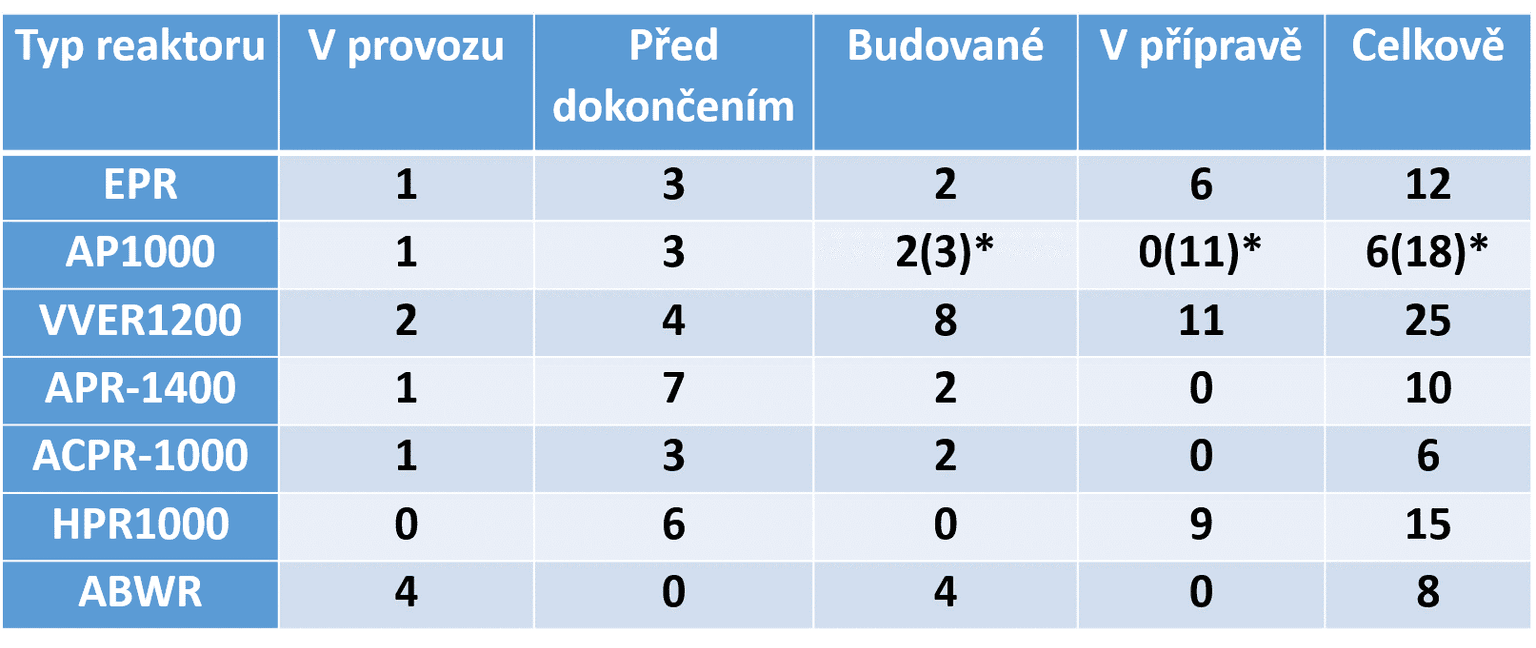
Table: Overview of the status of Generation III reactor construction (‘Close to completion’ are those expected to start up within the next few years, ‘Under construction’ are those where at least site preparation has begun, and ‘In preparation’ are those for which contracts and a specific project are under discussion).
Conclusion
We are now in a situation where six types of Generation III reactor are already in operation, and a seventh is close to completion and start-up. Four of them meet Generation III+ criteria. It will therefore be possible to observe their efficiency, economics and reliability.
The economic advantages of Generation III reactors will largely begin to emerge when they are built serially in larger numbers. Only then can the experience gained progressively be used effectively. It is therefore clear that only a limited number of the types mentioned have a chance of wider deployment and success. How many there will be, and which will ultimately succeed with customers, depends on how many are needed overall and how well they meet expectations. An advantage for all types will be that the growing total number will lead to increased experience among subcontractors. These work for multiple companies. For example, Czech company Škoda JS supplies components for both EPR and VVER1200 reactors.
In this respect, Rosatom's VVER1200 reactor is in the best position. It builds on a long-standing, continuous tradition of constructing nuclear units at home and abroad. It can provide all services for the construction, operation and decommissioning of nuclear facilities. Its Generation III+ reactor already has two units in operation and four close to completion, two of them abroad. It is building or has 23 units at an advanced stage of preparation, three of them in the European Union. This provides sufficient backing for serial production and for taking advantage of the benefits associated with the standardisation of a large share of components and the long-term stability of supplier chains. Russia also has a vision for developing nuclear power and using it to reduce the share of fossil fuels. The company thus has a long-term prospect of domestic support.
The combination of Chinese ACPR1000 and HPR1000 (Hualong One) reactors is in a similar position. Only one ACPR1000 unit is in operation, but nine of these reactors are close to completion and 11 are under construction or being prepared. At the same time, China is succeeding in completing its Generation III units within timelines corresponding to an overall construction period of around five years. China has an extensive domestic programme for developing nuclear power and using it in combination with renewable sources and electric mobility to reduce the emissions choking Chinese cities. This reactor also has a strong chance of becoming a key technology for nuclear power in the coming decades.
The success of Framatom's EPR reactor will depend on how construction of these units proceeds in the United Kingdom and on how the situation with nuclear power develops in France. In other words, whether it proves possible to make positive use of experience from construction projects to date and whether the company will also have the backing of reactor construction in its home country. Its future therefore remains uncertain.
As for KEPCO's South Korean Generation III APR1400 reactor, the key issue is the transition to the APR+ variant, which meets Generation III+ parameters. It was first intended to be deployed in South Korea, but the recent election of a new president led to the announcement of a halt to the construction of new nuclear capacity and a gradual nuclear phase-out. If South Korea maintains this moratorium on new nuclear capacity, it will be a major handicap for KEPCO's activities abroad. The future of this reactor is therefore highly uncertain.
The future of the AP1000 reactor is also uncertain. It likewise lacks domestic backing, and in this case Westinghouse anticipates offering primarily the design only, without ensuring its implementation. The situation changes somewhat when the Chinese CAP1000 and CAP1400 variants are included. However, the question is to what extent China will be interested in continuing in this direction, as its priority may instead be the HPR1000 (Hualong One) reactor.
All ABWR boiling-water reactors have remained out of operation since Fukushima. The future of this reactor also depends on successful deployment of a variant with Generation III+ characteristics and on the future of nuclear electricity generation in Japan.
Of course, the future of Generation III reactors will depend above all on how their individual types prove themselves in operation, particularly on their efficiency, economics and reliability. As with all nuclear technologies, however, safety is the most important factor.
If Czechia or any other European country decides to build new nuclear reactors, it is highly likely that it will have to choose from among the types and manufacturers mentioned. For the Czech Republic, moreover, the EPR and AP1400 reactors are too large, and given the country's long-term experience, it is sensible to remain with pressurised-water reactors. In practice, the Russian or Chinese reactor thus emerges as the most likely choice.
As a result of its dominant anti-nuclear ideology, Europe is becoming heavily dependent not only on imports of Russian gas and Chinese photovoltaics, but also on Russian and Chinese nuclear reactors. It is true that Russia will use nuclear units to save gas for export to Europe, while China will use abundant nuclear electricity to efficiently and economically produce photovoltaics and electric vehicles that it can export to Europe. Europe can thus meet its energy needs through these imports. However, this could have very negative impacts on European countries. Not only energy-intensive industries but also technologies, which will largely be replaced by services, will increasingly shift away from Europe. The question is what impact this will have on Europe's technological level and development, and on the living standards of its inhabitants.
The article was written for the oEnergetice and Osel websites.
Note: In the coming weeks, a book by a group of authors entitled ‘Czech energy at a crossroads’ will appear in bookshops, following on from the book ‘Prospects for Czech energy’. It examines the changes that have occurred since the adoption of the update to the Czech State Energy Policy, both domestically and in the country's immediate and wider surroundings. It highlights the risks emerging before Czech energy and rapidly approaching, partly as a result of inaction. It shows the options for addressing these risks and ensuring efficient, environmentally friendly and sustainable energy for Czechia.
Opening image: Completion of the dome of Hualong One (HPR1000) Fuqing 6 unit (source: CNI23).
Translation disclaimer
This article is a machine translation of the Czech original and has not yet been fully reviewed. In case of any doubt, please refer to the Czech version.
Sdílejte článek prostřednictvím:
Topics:jaderná energetika
You might also like
23 October 2026, 11:01
23 October 2026, 06:34