23 October 2026, 14:38
Loading...
New results from real fusion experiments at the European JET tokamak
Vladimír Wagner
11 February 2022, 13:08
The JET tokamak is one of the largest facilities of its kind and also one of the very few where experiments involving actual deuterium-tritium fusion have been carried out on a significant scale. Results have now been presented from the latest series of experiments using fusion fuel and plasma heating by fusion itself.
The European JET (Joint European Torus) tokamak in Culham, UK, is the largest such facility in the world. Its toroidal vacuum chamber has a major radius of 2.96 m and a minor radius of 1.25 m. The total volume of the vacuum chamber is 100 m3. Its toroidal magnet produces a magnetic field with a flux density of 3.45 T. It is therefore the largest facility testing the potential of magnetic confinement of fusion plasma.
In this case, a lower plasma density is achieved, but the plasma is maintained for a relatively long period of several seconds using a magnetic field. To achieve a high rate of fusion reactions, a certain value of the product of plasma density and confinement time must be reached. This value is achieved differently in inertial confinement. In this approach, the plasma is irradiated from all sides and compressed to a very high density comparable to that of lead. A confinement time on the order of nanoseconds is then sufficient. The methods used in different fusion facilities were discussed in more detail in a review article in 2020.
We recently wrote about the breakthrough achieved by the NIF inertial plasma confinement facility; now let us look at today’s presentation of breakthrough measurements in magnetic confinement achieved at JET.
Fusion experiments at the JET tokamak
The JET tokamak is exceptional in that it is one of the very few facilities where work involving tritium-deuterium fusion has taken place. The first tritium experiments were conducted in 1991. In 1997, experiments known as DTE1 achieved record plasma parameters using fusion fuel containing tritium.
It should be stressed that tokamaks only exceptionally conduct experiments involving tritium and fusion reactions. Besides JET, these were also carried out at the US TFTR (Tokamak Fusion Test Reactor) facility. Fusion reactions are not needed to study plasma properties and the possibilities and conditions for its confinement. However, once such experiments begin, one significant problem must be addressed. Deuterium-tritium fusion reactions produce neutrons with a relatively high energy of 14 MeV. Through reactions with materials, these generate radionuclides. The experiments therefore produce intense radioactivity and radiation, creating highly demanding conditions that must be managed.
The DTE1 experiments in 1997 achieved two types of record shots. The first reached output of up to 15 MW, but plasma stability could not be maintained and it was only a peak lasting around one second. In this case, the Q ratio between the energy released in fusion reactions and the energy used to heat the plasma was between 0.6 and 0.7. In the second type of shot, long-term plasma confinement was achieved, limited only by the design of the facility. For JET, this maximum duration is around 5 seconds. However, the facility’s output was lower, at less than 5 MW. In this case, Q was around 0.2 and a total of 22 MJ was produced. Plasma temperatures exceeded 100 million degrees in both types of shot.
It should be emphasised that the 5 seconds in question is not a fundamental limit. Achieving stable discharges lasting tens, hundreds or even thousands of seconds is not a major problem. This is demonstrated by records achieved at smaller but more modern tokamaks, which we discussed in a recent article.
In these experiments, the inner wall of the fusion chamber was made of carbon. In this case, the generation of radioactivity and neutron damage posed a major problem. It also led to plasma contamination.
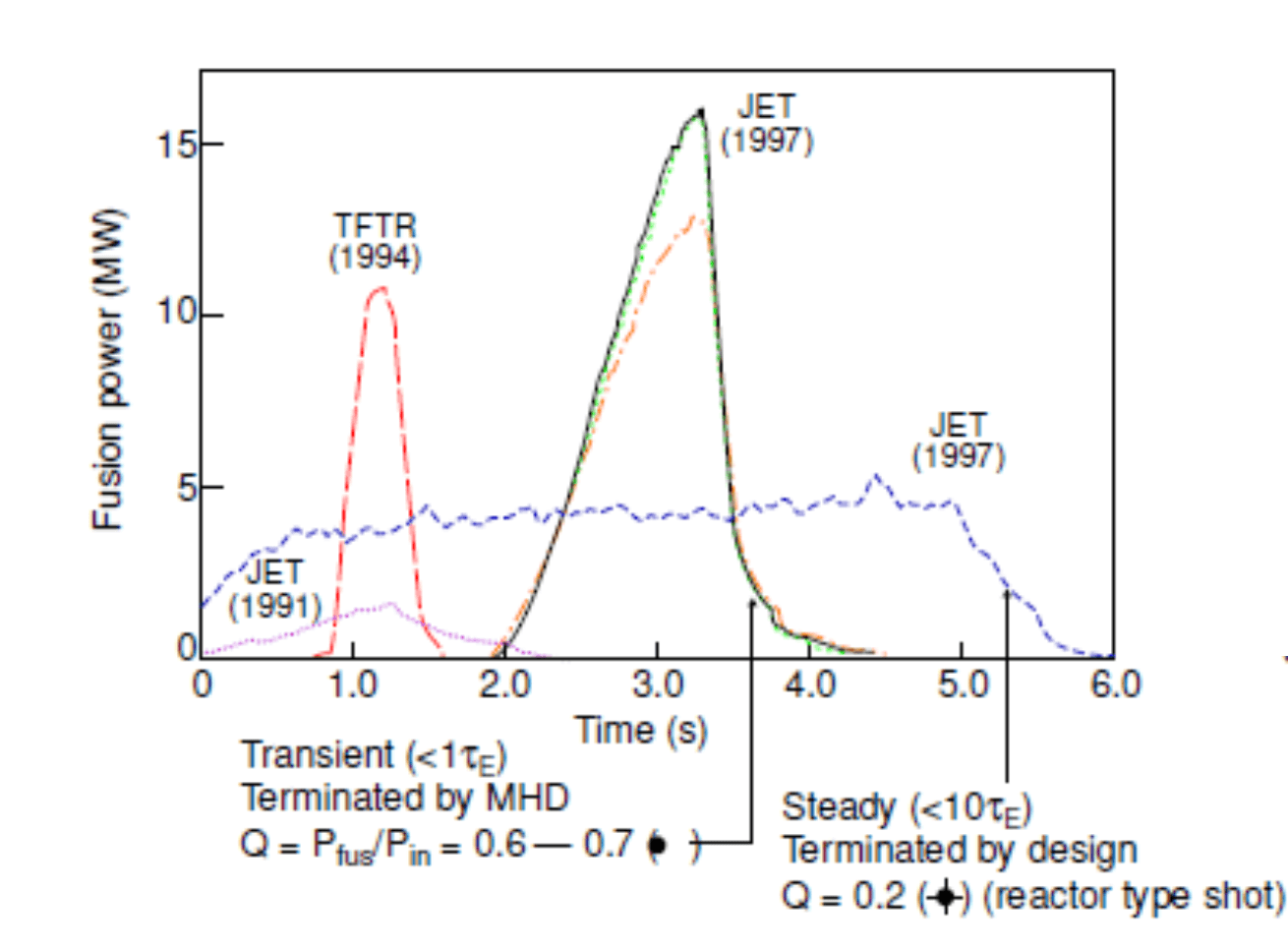
Record shots carried out at the JET tokamak in 1997. The first achieved very high output of 15 MW, but with a shorter confinement time. In the second, the plasma was stable and lasted the full 5 seconds. The graph also shows a shot carried out at the US TFTR facility in 1994. (Source: presentation by D. Storka).
DTE2 experiments with tritium fuel in 2021
JET underwent several years of intensive upgrades across the entire facility. It now has a metallic inner wall made of tungsten and beryllium, which is also planned for the ITER tokamak. More generally, it should be noted that JET is the predecessor of the ITER tokamak; although it is smaller, it is otherwise very similar. It is therefore a highly important source of information for work with the future ITER facility. It is vital to determine what works there and what does not, as the same will apply to ITER.
Understanding the impact of the new wall material on plasma behaviour is therefore crucial in preparing ITER. The interaction of plasma with the tungsten wall was studied, including its dependence on plasma quantity and the amount of tritium in the fuel. Before research into fusion reactions began, the behaviour of different types of pure plasma was also tested. Experiments with pure tritium plasma were conducted for the first time. Research into various ways of improving plasma heating was also very important.
In 2021, an experimental campaign lasting roughly six months took place. A number of shots achieved the aforementioned maximum duration of 5 seconds. Stable output significantly exceeded 10 MW. Several achieved up to 59 MJ of energy, significantly surpassing previous values. The results show that the expected and required parameters are being met. This is a very positive sign for the future operation of ITER. New data from JET are testing the models and computational codes used in preparing the ITER tokamak. Experiments are expected to continue at least until 2023 and will make an enormous contribution to preparing experiments at ITER.
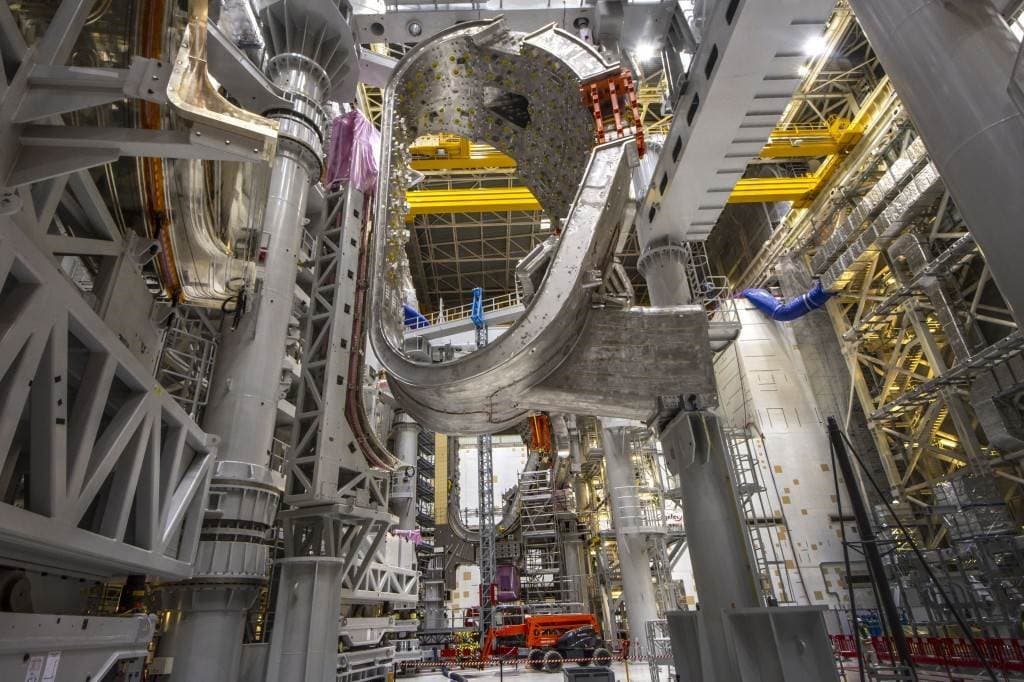
Installation of the ITER tokamak itself is already under way (source: ITER).
The ITER tokamak era is approaching
The ITER tokamak will have the parameters required for an industrial facility using thermonuclear fusion. Plasma temperature will be several times higher. Its maximum output will be 500 MW, which it should maintain for more than 300 seconds. In this mode, the Q value should be 10. At a lower output of 300 MW and a Q value of 5, it should be able to maintain stable plasma for an hour.
Construction of the ITER tokamak in Cadarache is now entering its final phase. The buildings are complete and installation of the tokamak itself is beginning. The facility can therefore be expected to start up in the second half of the 2020s and begin studying the properties of deuterium plasma. Fusion reactions could then begin to be studied at the facility in the 2030s. There is certainly much to look forward to.
You can watch the press conference presenting the latest results described above here.
Translation disclaimer
This article is a machine translation of the Czech original and has not yet been fully reviewed. In case of any doubt, please refer to the Czech version.
Sdílejte článek prostřednictvím:
You might also like
23 October 2026, 11:01

23 October 2026, 06:34