
23 October 2026, 14:38
Loading...
Proton-boron-11 fusion in magnetically confined plasma
Vladimír Wagner
9 March 2023, 14:00
Tao Technologies is one of the startup companies focused on exploring the potential use of proton-boron-11 fusion. Together with Japanese physicists, it has published the results of experiments involving these fusion reactions conducted in magnetically confined plasma. Let us look at what this actually delivers.
The fusion reaction of a proton with the boron-11 isotope, which produces three helium-4 nuclei and releases 8.7 MeV of energy, is among several reactions potentially usable in fusion power plants on Earth. It has both advantages and disadvantages. Its advantage is that, similarly to the deuterium-helium-3 reaction, it produces no neutrons. Interactions between neutrons and the chamber walls create radioactivity, which subsequently causes problems in operating and maintaining the equipment. Its fundamental disadvantage, on the other hand, is that the temperature required to achieve conditions for sustaining fusion reactions is orders of magnitude higher than for fusion using deuterium and tritium. Even at this high optimum temperature, the probability of this reaction is many times lower than that of the deuterium-tritium reaction at its optimum temperature. The required very high temperature also leads to high energy losses through radiation and electron bremsstrahlung in the plasma.
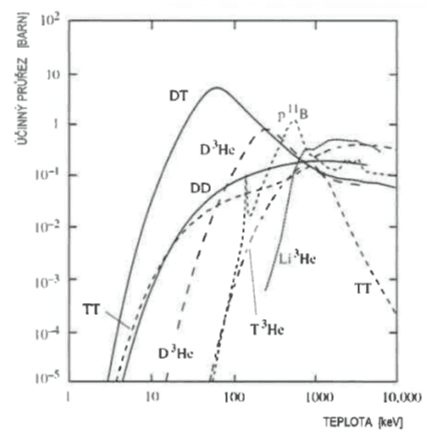
Dependence of the reaction probability, expressed as the effective cross-section, on temperature in keV (1 keV equals 11.6 million K)
A detailed overview of the challenge of achieving conditions for igniting thermonuclear fusion and its energy use can be found in an earlier article, the latest achievements on the path towards thermonuclear fusion using inertial plasma confinement are covered in a recent article, and recent real-world experiments involving deuterium-tritium fusion reactions under magnetic confinement at the JET tokamak are described in a somewhat older article. Most scientific efforts focus precisely on deuterium-tritium reactions.
Despite the challenges mentioned, several startup companies involved in developing fusion power plants have focused on the proton-boron-11 reaction. A recent article described research into reactions between laser-accelerated protons and boron-11, and the detection of the resulting helium nuclei. The experiments described were carried out by HB11 Energy.
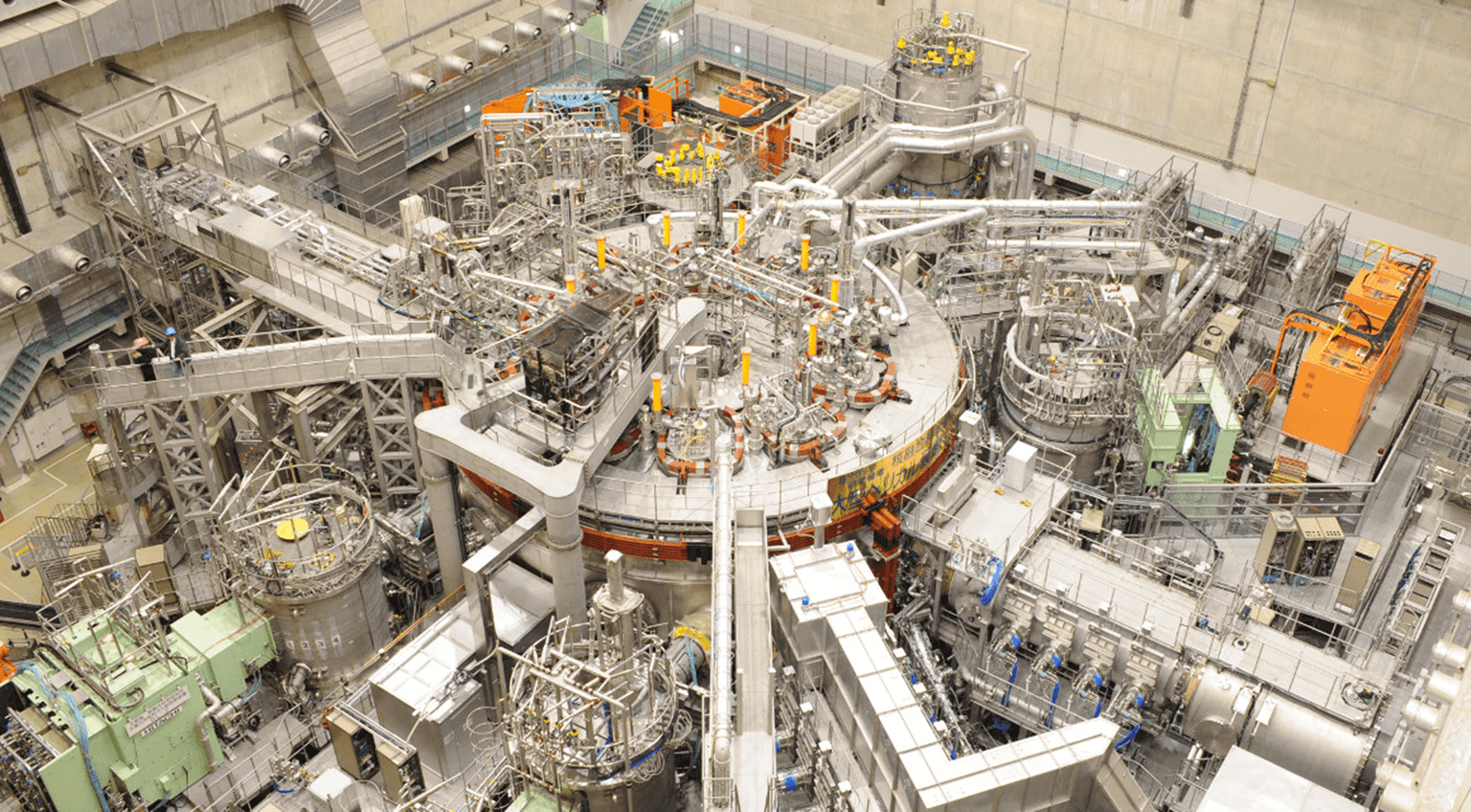
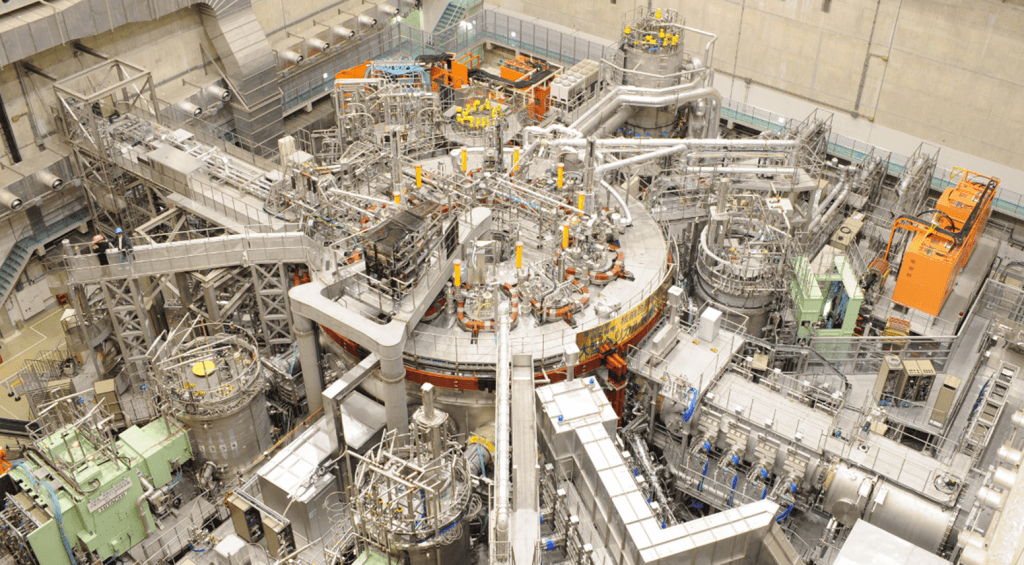
Japan's LHD facility is the second-largest stellarator currently in operation. Source: NIFS
The new experiments, which for the first time carried out proton-boron-11 fusion reactions in a magnetically confined plasma environment and were described in a recent article in Nature Communications, were conducted by TAE Technologies. Together with Japan's National Institute for Fusion Science (NIFS) in the city of Toki, it for the first time carried out proton-boron-11 fusion reactions in magnetically confined plasma. The superconducting LHD (Large Helical Device) magnetic trap at the Japanese institute was used for this purpose. It is the second-largest stellarator after Germany's new Wendelstein 7-X facility.
It should be recalled that, compared with a tokamak, a stellarator has a far more complex magnetic-field shape. This shape brings certain advantages, but is extremely challenging to create and to design magnets for. This is why there are far fewer stellarators than tokamaks. Progress in computing technology and in the mathematical methods needed to simulate and design magnetic fields, as well as in magnet-construction technologies, had to be awaited. Stellarators therefore only began to gain prominence around the turn of the century. More on these facilities can be found in the overview already mentioned.
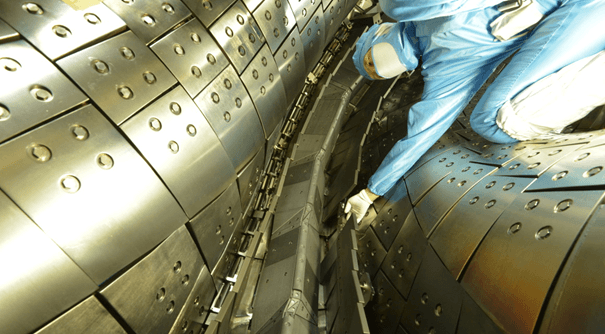
Japan's LHD stellarator. Source: NIFS
In the latest article, scientists from both institutions describe experiments at LHD involving proton-boron-11 reactions and the detection of helium-4 nuclei (alpha particles). Detectors developed by TAE Technologies were used specifically to detect the alpha particles produced in this reaction. Boron powder was injected into the plasma in the LHD stellarator. Its grains were well below one millimetre in size. This achieved a significant boron admixture in the plasma. At the same time, a high-energy neutral hydrogen beam was injected. This is obtained by neutralising accelerated protons before they enter the plasma. It is one method of heating the plasma and also a way to supply high-energy protons suitable for fusion reactions.
In this particular case, three neutral-beam injectors with an operating voltage of 160 kV and power of 2 MW were used. This created a substantial population of high-energy protons in the magnetically confined plasma. This significantly increased the probability of proton-boron-11 reactions. Under such conditions, fusion reactions occurred with sufficient probability for the produced alpha particles to be measured reliably.
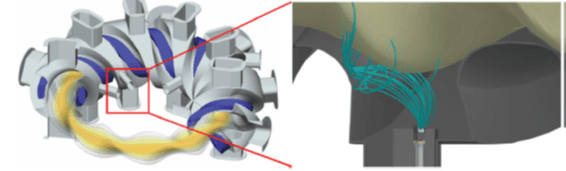
A 3D model of the LHD stellarator vacuum vessel, with a cutaway showing the shape (yellow lines) of the magnetically confined plasma within it. The location where alpha particles were measured is marked, while the cutaway on the right shows examples of alpha-particle trajectories depicted by blue lines. Source: R. M. Magee et al: Nature communication (2023)14:955
Until now, proton-boron-11 fusion reactions had been studied theoretically in laser-produced plasma and using accelerators, in collisions between accelerated protons and boron-11 in a solid target. The experiment using the LHD stellarator made it possible to study these reactions occurring in magnetically confined plasma. Boronisation, meaning the addition of boron to the plasma, carried out during the stellarator shot, resulted in boron-ion densities in the plasma of up to 6·1017 m-3. The second important component was the high-energy protons supplied by the three neutral-beam injectors described. According to calculations, firing all three injectors at the stated boron-ion density could result in up to 1014 fusion reactions per second.
Planar PIPS (Passivated Implanted Planar Silicon) silicon semiconductor detectors were used to detect alpha particles. This type of detector responds to both charged particles and gamma radiation. They were therefore oriented so that they could not directly see the plasma and were shielded from its gamma and X-ray radiation. Charged alpha particles reached the detector by a more complex path. In addition, the detector was shielded against gamma radiation by platinum foil. The detector's energy calibration was carried out using an americium-241 alpha source, which emits alpha particles with an energy of around 5.5 MeV. This radionuclide is used not only as a calibration source for alpha and gamma spectrometry. An earlier article describes its planned use in a European radionuclide source for space equipment.
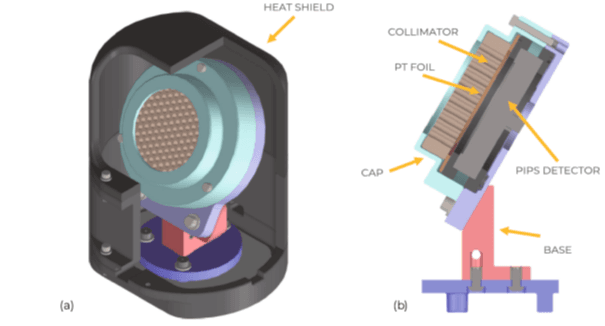
Alpha-particle detector developed by TAE Technology. On the left is its CAD model, with the graphite thermal shielding cut away to reveal the detector itself. On the right is a diagram identifying the detector's main components. The collimator and platinum foil shield the detectors from gamma radiation. Source: R. M. Magee et al: Nature communication (2023)14:955
During the experimental shots described, the toroidal magnetic field had an intensity of 2.75 T. The plasma's electron temperature was around 2 keV (roughly 23 million kelvin). The shot itself lasted around 4 s. Control shots were carried out both without and with boron added. A clear correlation was observed between the detection of alpha particles and the presence of boron and fusion reactions. In the case of fusion reactions, namely with a boron admixture in the plasma and injection of high-energy protons, the rate of signals from the alpha detector increased by more than two orders of magnitude.
The observed detection rates were compared with theoretical simulations. Calculating the number of fusion reactions and alpha particles, as well as their energies, is relatively straightforward in these simulations. Modelling the transport of alpha particles in electric and magnetic fields and their detection is far more complex. Comparing the experimental data obtained with the simulation results makes it possible to refine the models and software used for simulations. Further future experiments will make it possible to study proton-boron fusion reactions under different plasma conditions. This will refine our knowledge and specify the conditions that future fusion facilities will have to meet.
It should be recalled that TAE Technologies' concept envisages using the proton-boron-11 reaction in its future fusion power plant. It would use intense accelerator beams to create an intense magnetic field and very hot plasma through the FRC (field-reversed configuration) process. Facilities using FRC were extensively employed in fusion research before tokamaks. They are now returning to the scene mainly among startup companies.
TAE Technologies has already built several facilities, and at the latest of these it has succeeded in reaching plasma temperatures exceeding 100 million kelvin. Achieving fusion ignition will require an increase of more than an order of magnitude. At such temperatures, electron bremsstrahlung in the hot plasma, mentioned at the beginning of this article, will have very negative effects. This could be reduced by keeping the electron temperature in the plasma lower than that of the ions.
This facility is still a long way from achieving scientific, ignition and especially engineering breakeven. It is also necessary to address the fact that converting energy in the accelerator into plasma heating is not highly efficient. The fusion experiments described at the LHD facility will not directly contribute much to this. However, studying proton-boron fusion in a stellarator using a high-energy proton beam may improve the description of achievable conditions at future facilities. Developing a methodology for detecting alpha particles in fusion experiments is then a significant contribution for any fusion reaction used and for a wide range of fusion facilities.
Translation disclaimer
This article is a machine translation of the Czech original and has not yet been fully reviewed. In case of any doubt, please refer to the Czech version.
Sdílejte článek prostřednictvím:
You might also like
23 October 2026, 11:01

23 October 2026, 06:34