
23 October 2026, 14:38
Loading...
What was behind the recent inertial fusion ignition?
Vladimír Wagner
6 February 2022, 08:42

In inertial fusion, essentially micro-thermonuclear explosions take place. Over the past two years, the US NIF facility has succeeded in surpassing the threshold for fusion ignition. Let us look at what this event means for the path towards thermonuclear spacecraft propulsion in light of the current publication of a detailed analysis of this achievement.
We have already written on oEnergetice about the successful shot at the US NIF (National Ignition Facility) in mid-2021, which achieved the conditions set by the Lawson criterion for fusion ignition. Under these conditions, fusion thermonuclear reactions produce at least as much energy as is consumed in heating the plasma. Nature has now published a detailed article on the path towards this key experiment.
Let us recall that the conditions needed for fusion reactions to proceed intensively are an appropriate plasma temperature, followed by the product of its density and confinement time. These conditions differ for the individual possible fusion reactions. They are easiest to achieve for the deuterium-tritium reaction. The temperature should approach, and ideally exceed, one hundred million degrees Celsius. One of two approaches can be used to achieve the required product of plasma density and confinement time.
The first is magnetic confinement, where the relatively lower plasma density is compensated for by a long confinement time. This is then on the order of seconds, or even tens to hundreds of seconds. A well-known example of magnetic confinement is magnetic traps known as tokamaks, of which perhaps the best known is ITER, being built in Cadarache, France.
The second option is to achieve a very high plasma density through so-called inertial confinement. This can reach the density of lead. The confinement time can then be many orders of magnitude shorter than microseconds. Compression is achieved by isotropically irradiating a droplet of thermonuclear fuel with a radiation beam, most commonly a laser so far. It is therefore essentially a microscopic thermonuclear explosion. It is inertial plasma confinement that is being studied at NIF.
The various fusion reactions, the conditions necessary to achieve fusion, and the facilities and results obtained are described in detail in an overview article on Osel. It also describes the current state of research in this field. Updates and a comparison of the situation at today's large tokamaks and smaller private facilities seeking to combine magnetic and inertial confinement can be found in a recent article.
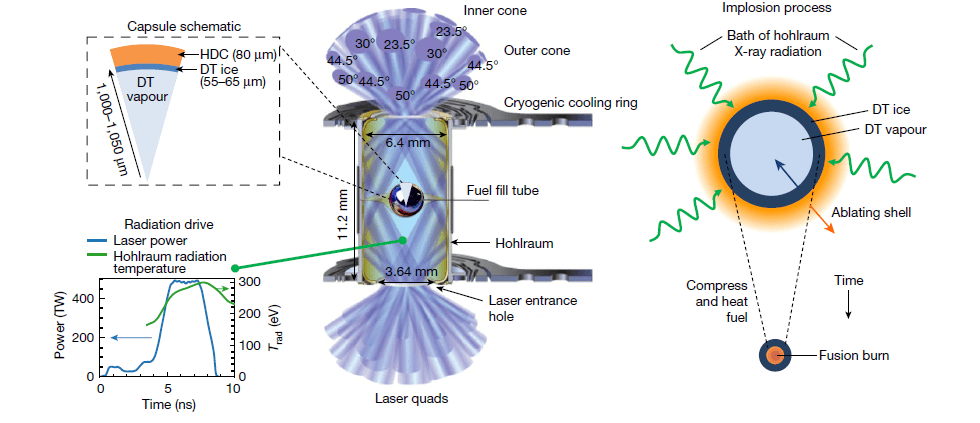
Diagram of a fuel capsule showing the thickness of the ablator layer and the inner fuel section, a diagram of the hohlraum cavity and its irradiation by laser beams, and a graph showing the beam power and hohlraum temperature over time (source: Nature, Vol 601, 27 January 2022).
Achieving fusion ignition at NIF
Let us now take a closer look at what has been achieved at NIF. At this facility, inertial confinement is achieved by irradiating a tiny sphere of frozen deuterium-tritium mixture, the size of a peppercorn, with a split, highly intense beam from a powerful laser. The resulting implosion heats and compresses the fuel to extreme levels.
The NIF laser is among the largest. Its power is up to 500 TW and it can deliver up to 1.9 MJ of energy in a shot. Plasma confinement time is on the order of nanoseconds. The original beam is split into 192 beams, which in the current configuration irradiate from precisely defined directions a gold cavity known as a hohlraum. This heats it to an extremely high temperature and causes it to emit X-rays. Inside the hohlraum, a specific bath of X-ray radiation is created, which irradiates the peppercorn-sized sphere of frozen deuterium and tritium in a highly isotropic manner. This creates the appropriate, as uniform as possible geometry for its compression and the course of the implosion. So far, such indirect irradiation works far better in this respect than can be achieved through direct irradiation with laser light.
The outer ablator layer of the fuel capsule absorbs roughly 10–15 % of the X-rays, heats up, vaporises and turns into plasma, generating pressure of up to 10 TPa. This initiates an implosion that creates a shock wave travelling at as much as 350 to 400 km/s. The dominant share of the X-ray radiation, 92 to 95 %, is used in the ablator layer to initiate and drive the implosion and shock wave; only around 10 to 20 kJ reaches the tiny volume of fuel inside the compressed pellet. At the peak of the implosion, pressure there reaches up to 100 TPa. The mass of fuel in the pellet is around 200 micrograms, of which only around 20 to 30 micrograms is located in the extremely dense and hot core at the end of the implosion. Once thermal equilibrium is reached, the temperature is around 50 million degrees Celsius. This creates the conditions for ignition of fusion reactions, which subsequently raise the temperature even further.
The deuterium-tritium fusion reaction, which produces helium-4, or an alpha particle, and a neutron, releases considerable energy. Purely from kinematics, it follows that in the deuterium-tritium fusion reaction, of the total energy produced of 17.6 MeV, the alpha particle receives 3.5 MeV and the neutron carries away 14.1 MeV. Neutrons have no electric charge and leave the plasma without transferring their energy to it, so only the helium produced contributes to heating it. We can therefore use two different quantities to characterise the energy released in fusion and the extent to which the conditions for fusion ignition have been achieved. The first is the ratio between the total energy released in fusion and the energy supplied to the plasma. It is denoted Q. The second is the ratio between the energy acquired in fusion by helium nuclei heating the plasma and the total energy. It is denoted Qα.
In the case of tokamaks, the maximum value actually achieved so far is Q = 0.67 and Qα = 0.13. This was obtained at the JET tokamak in experiments in the 1990s, when it operated with a deuterium-tritium mixture. It should be recalled that the dominant share of tokamaks, including those that have achieved higher plasma quality, do not operate with deuterium and tritium. ITER should achieve values of Q = 10 and Qα = 2.
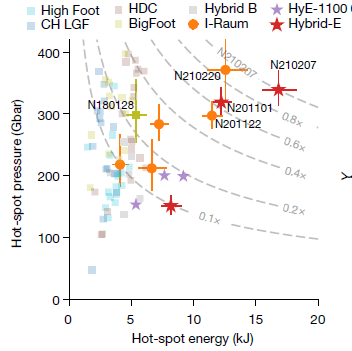
Illustration of the conditions achieved in various shots using different methods to achieve isotropic irradiation of the fuel pellet, showing pressure and energy delivered to the fuel. It shows that the final four shots moved dramatically towards meeting the conditions for fusion ignition. The shot designation is NRRMMDD. (Source: Nature, Vol 601, 27 January 2022).
Record shots at NIF
After 2014, experiments with pellets whose inner diameter of the fuel region was 0.91 to 0.95 mm gradually improved the laser irradiation conditions. Eventually, as much as 50 kJ of energy was extracted from the fuel through fusion. Further improvements in conditions inside the hohlraum made it possible to increase the isotropy of irradiation of the fuel capsule. Over the past two years, four shots have thus exceeded the conditions for fusion ignition, eventually reaching fusion energy of up to 170 kJ. The alpha particles thus gained as much as 34 kJ. The value of Qα exceeded 2.5.
The achieved parameters were verified using the relevant diagnostics inside the vacuum vessel where the micro-thermonuclear explosion takes place. Measurement of the parameters in question is, naturally, indirect and to a certain extent model-dependent. The relevant methods and resulting uncertainties are described in detail in the publication. In any case, it is certain that a dramatic breakthrough has been achieved.
An even greater breakthrough came with the shot on 8 August 2021, which released 1.3 MJ of fusion energy, almost an order of magnitude more than was achieved in the four aforementioned previous shots. This success came while the Nature article was being finalised, and its precise description and interpretation will be the subject of a new article now being prepared.
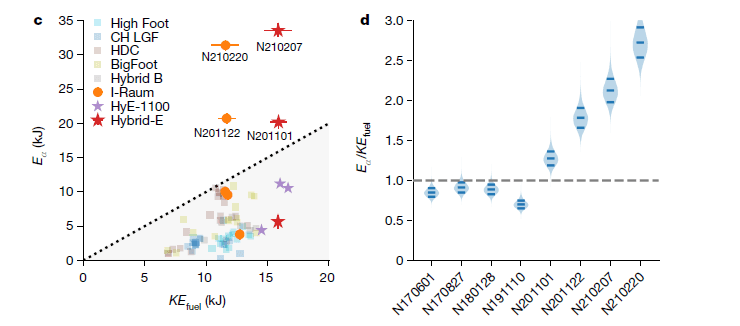
The graphs show, on the left, the energy KEfuel delivered directly to the fuel and the energy Eα transferred from fusion to alpha particles. For shots above the dashed line, conditions were reached in which the energy of fusion alpha particles would be sufficient to heat the plasma. On the right, the value of Qα = Eα/ KEfuel is shown for individual shots. The shot designation is NRRMMDD. (Source: Nature, Vol 601, 27 January 2022).
Conclusion
As can be seen, the published article does not describe the details of the August shot that attracted such considerable attention at the end of last year. It is therefore unclear precisely what made it possible to increase the energy produced in fusion by almost an order of magnitude compared with the four highly successful shots from the turn of 2020 and 2021. It cannot therefore be said whether the key factor was increasing the amount of energy delivered to the fuel pellet or increasing the temperature and density of the plasma produced. However, it is clear that the conditions enabling the Q value required for fusion ignition to be exceeded are now being achieved routinely, and can be substantially surpassed, as confirmed by the 8 August 2021 shot. This is a real promise of dramatic future progress in this field.
The properties of plasma and the achievement of conditions needed for sustainable fusion energy production in magnetic confinement can be studied even without using deuterium-tritium fuel. In contrast, the study of inertial confinement must work directly with the fuel. It is now clear that the NIF inertial facility has exceeded by an order of magnitude the Q value achieved at the European JET tokamak. In principle, this is in the range of values that should be achieved at the ITER tokamak.
On the other hand, one important aspect must be emphasised, showing why inertial facilities are still far behind tokamaks on the path towards a thermonuclear power plant. As our analysis also shows, shots involving a very small plasma volume can only be repeated at very low frequency at an inertial facility. In a real fusion reactor, they would have to be repeated ten times per second. At tokamaks, record experiments can be carried out relatively often at various facilities, and tokamak operation can come much closer to being continuous and routine. Even so, the latest results at NIF are a very positive promise for the future development of interstellar thermonuclear propulsion.
I recently gave a lecture on the subject for the Jičín observatory:
Translation disclaimer
This article is a machine translation of the Czech original and has not yet been fully reviewed. In case of any doubt, please refer to the Czech version.
Sdílejte článek prostřednictvím:
You might also like
23 October 2026, 11:01

23 October 2026, 06:34