
23 October 2026, 14:38
Loading...
Will nuclear reactors finally be used in space?
Vladimír Wagner
10 May 2018, 18:25
Intensive tests of the new Kilopower space reactor took place from September to March 2018. The final series was devoted to operational tests under flight conditions in a vacuum chamber. Given the renewed interest in the Moon and Mars, reactors could genuinely begin to be used in space this time. Let us take a closer look at both the current situation and the reactor itself.
In recent years, interest has been renewed in returning humans to the Moon and in missions to Mars. Missions by robotic spacecraft to the giant planets and the outer regions of the Solar System, or even beyond its boundaries, are again being considered. It is not only state institutions that are considering missions to Mars, but also private entities. The energy needs of such projects cannot be met without nuclear sources based either on radioisotope generators or fission reactors. The options are described in detail in an article on nuclear sources for space colonisation and an earlier article on nuclear sources.
The current state of radioisotope sources for space
The aforementioned later article also discusses how very poor the current situation is with these technologies. Potential candidates for missions to Mars or the construction of a Moon base have no way of securing these sources for the projects in question. Space radioisotope sources were predominantly based on the use of plutonium-238. Such sources supplied the lunar bases built by the US Apollo missions, probes that studied Jupiter, Saturn, Neptune and Pluto, and also power the Curiosity Mars rover. However, the United States lost the capability to produce plutonium-238. Its production from neptunium-237 through irradiation by an intense neutron flux requires specialised reactors. These operated at the Savannah River site, but plutonium-238 production stopped in 1988. NASA later bought smaller quantities of this radionuclide from Russia, but it currently has only around 35 kg, of which 18 kg is of poor quality and requires purification. There are no more than a few kilograms of this radionuclide elsewhere in the world either.
It should be recalled that the original GPHS-RTG sources used, for example, on the Voyager, Galileo, Cassini and New Horizons probes required around 11 kg of plutonium-238 and could produce around 240 We of electrical output. Cassini had three such sources. If all current stocks were purified, they would be enough for one Cassini mission. The new MMRTG sources, whose electrical output is 100 We, require 4.8 kg of plutonium-238. Curiosity uses one such unit. At present, one is ready for a new Mars rover (a biological laboratory).
In recent years, efforts have emerged to restart plutonium-238 production using the existing HFIR and ATR research reactors, but annual production will be 1.5 kg at best. This would improve the situation only minimally. Another option is to develop an entirely new radioisotope source using americium-241. It has a longer half-life and therefore lower source activity. More fuel will thus be needed. However, a more significant problem is the much higher intensity of gamma radiation emissions, which places greater demands on shielding. Its enormous advantage, on the other hand, is that it is part of spent fuel from conventional nuclear reactors. It can be recovered from it. Europe is involved in their development, especially the United Kingdom, which has spent-fuel reprocessing plants. The issue of fuel for radioisotope sources is described in detail here and here.
Fission reactors for space
This is one of the reasons why NASA and Los Alamos Laboratory have returned to developing nuclear reactors in recent years. Another advantage of fission reactors over radioisotope sources is the greater output they can provide. This makes it possible to move from hundreds of watts to units or tens of kilowatts and beyond. Space reactors for space applications have very specific requirements. They must be as compact and lightweight as possible. They therefore use very highly enriched uranium-235, reaching and exceeding 90%. This is also one reason why they operate at very high temperatures. These simultaneously increase the efficiency of converting thermal energy into electricity. Safety and reliability requirements are also very important, as it is generally impossible to rely on the possibility of repair or human intervention. Passive safety features must therefore be applied as much as possible. The reactor must also operate for as long as possible without fuel replacement.
The Americans developed a nuclear reactor for space in the 1960s and sent one into space. Development in this field was far more intensive in the former Soviet Union. There, reactors were used to power radar systems on RORSAT military satellites monitoring US military submarines.
The most advanced model of a space reactor was TOPAZ, developed mainly in the 1970s, which used thermionic conversion of heat into electricity. It reached orbit in 1987. It was a liquid-metal-cooled reactor (using a sodium-potassium alloy), allowing an operating temperature of 610 °C. However, the maximum temperature inside the reactor core could reach almost 1900 °C. This very capable reactor also had enrichment of 90%. The 12 kg of uranium was in the form of uranium dioxide. The reactor was a conventional thermal reactor with moderated neutrons, using zirconium hydride as the moderator. The reactor's total mass was 320 kg and its thermal output was 150 kW. It used a beryllium reflector to reflect neutrons back into the core. It contained rotating cylinders made partly of neutron-reflecting beryllium and neutron-absorbing material. These ensured safe control as well as reactor start-up and shutdown. In this case, thermionic conversion of thermal energy to electricity was used, with efficiency of up to around 5%; electrical output was 5 – 10 kWe and the planned operating period was 12 months.
An improved reactor variant designated TOPAZ II did not make it into space. It has a fuel mass of 27 kg and enrichment of up to 96%, while the reactor's total mass is just over 1000 kg. The core is 920 mm high and has a diameter of 408 mm. Thermal output is 135 kWt and electrical output is around 6 kWe. The larger core size extended the reactor's active operating life to 3 years.
NASA also acquired it in order to accelerate the development of its new reactors, and its further testing and development took place through international cooperation. However, this ended in 1993 for financial reasons. The dominant reason, though, was that there were no real projects for the Moon and Mars on the horizon that would require these systems.
At the beginning of this century, a project to develop new space reactors was launched again through cooperation between NASA, the DOE and Los Alamos Laboratory. There was an effort to build as much as possible on previous experience and the TOPAZ reactor. However, for reasons similar to those in the previous cases, the project was again terminated before reaching the stage of more intensive testing.
The Kilopower project
Development of the reactor designated Kilopower began in 2014. The aim was to prepare within three years a prototype source delivering electrical output of 1 to 10 kWe for at least ten years. The project followed tests of the DUFF (Demonstration Using Flattop Fission) system conducted by the same team in 2012. These were the first real tests of a space reactor in the United States since the 1960s. Heat from the reactor powered a pair of Stirling engines. Overall, the system was able to produce 25 We of electrical output. The experiment's purpose was to test the principles of heat production and its conversion into electricity for a simple system intended for space applications, using a nuclear reactor and Stirling engines.
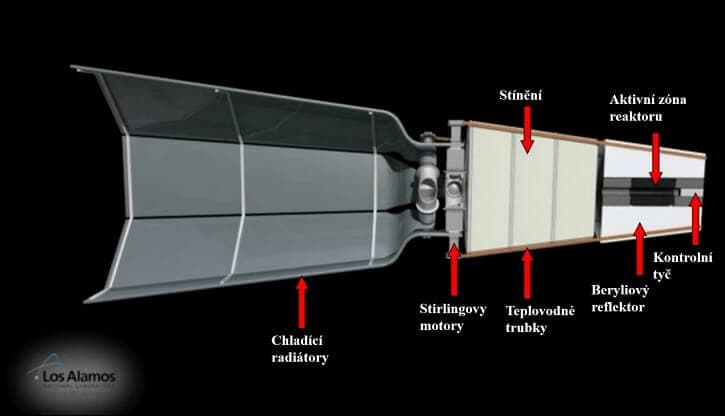
The reactor uses highly enriched uranium in metallic form in an alloy with molybdenum, and a beryllium reflector. It has one control rod containing neutron-absorbing boron. Its total mass is comparable to that of the TOPAZ II reactor. Heat is removed from the reactor by heat pipes filled with liquid sodium. These transfer heat to Stirling engines. Waste heat is radiated through a carbon-composite radiator. Different configurations of varying size and output are planned. The largest, with output of 10 kW, should have a mass of 1800 kg. That is a specific output of around 5.5 W/kg.
According to the plan, tests of individual reactor components were carried out first, followed by testing of the entire unit without fuel. The system's operating temperature in this case is 800 °C. It was therefore necessary to test the thermomechanical properties of the structure and fuel at these temperatures, as well as the entire process of removing heat from the core to the Stirling engines through the passive liquid-sodium heat-pipe system. This was achieved in 2015.
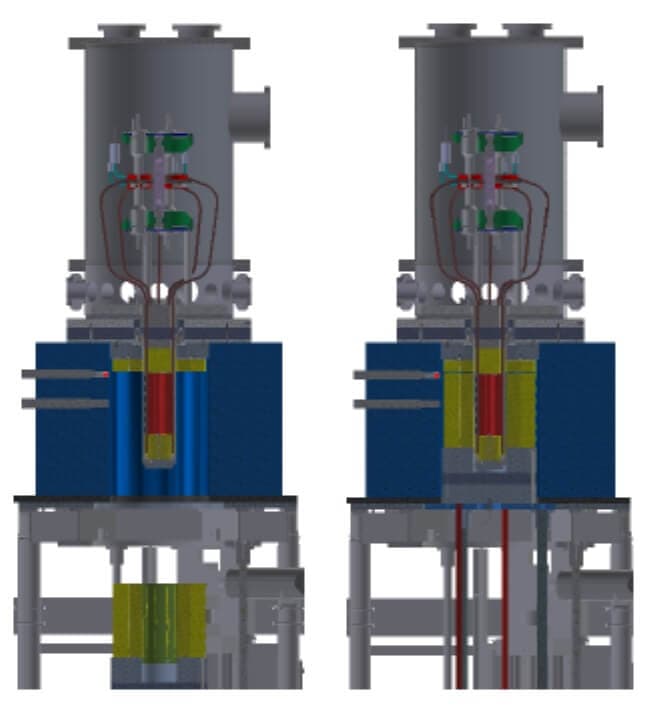
The following year, testing focused mainly on the conversion of thermal energy into electricity using Stirling engines. NASA already has experience with these, although only on Earth. They were developed for radioisotope sources. Several variants were developed for Kilopower, but the basic concept was to use eight Stirling converters, each providing 125 We of output. The source would therefore have a total output of 1 kWe. For financial reasons, however, actual tests were conducted with 70 We Stirling converters manufactured for advanced radioisotope sources, ASRG (Advanced Stirling Radioisotope Generator). There were only two of them, so the slots for the remaining six were fitted with mock-ups during testing.
The reactor uses highly enriched uranium. It is therefore important that the core can be loaded with fuel only shortly before launch and under well-controlled conditions. Such a system was successfully designed, allowing the core to be loaded in just 12 hours. Including further installations and testing of the whole assembly, pre-launch reactor preparation will not exceed four working days.
Before tests with enriched uranium began, the assembly's behaviour was tested using depleted uranium. In this case, the fission heat source was replaced by electric heating. This assembly made it possible to test the thermomechanical properties of the entire configuration, the process of loading the core with fuel, and other reactor handling procedures.
In 2017, development of the new reactor reached the stage at which testing of a prototype unit with enriched uranium could begin as part of the KRUSTY (Kilopower Reactor Using Stirling TechnologY) experiment. This included several critical experiments with the core, testing its neutron physics, reactivity and the course of the fission chain reaction under different conditions. It began at zero power, then gradually moved to low-power modes, with power increased until hot tests were conducted.
The test programme was planned from November 2017 until the end of March 2018. Its culmination was a 28-hour reactor run at full output and an operating temperature of 800 ˚C. This took place at the end of March. A vacuum chamber was also used in the experiments to simulate spaceflight conditions. The reactor's behaviour in various operational and accident scenarios was also tested continuously. These included the loss of function of a heat pipe or Stirling engine, or even a complete loss of cooling. In this case, the temperature increase leads to higher radiative heat losses, so thermal radiation is sufficient to remove the generated heat into the vacuum. The series of tests was concluded at the end of March with the aforementioned more-than-one-day operation at full output.
Conclusion
The successful KRUSTY experiment is a crucial step on the path towards a flight-ready example of a space nuclear reactor. This time, there is a strong chance that the journey will be completed and that the Kilopower reactor will reach space. This would be a major breakthrough, enabling scientists to begin work on spacecraft projects for distant regions of the Solar System. For example, a mission to explore Saturn and its moon Titan, an orbiter around Chiron, and a probe to enter orbit around an object in the Kuiper Belt. In this case, the reactor would power not only the probe's instruments but also its ion engines. Without nuclear sources, these missions are unthinkable.
They are also necessary for robotic and inhabited bases on the Moon, especially in craters at its poles. Almost no sunlight reaches there. The use of the space station NASA plans to build would be very limited without them. Energy sources are also crucial for journeys to and stays on Mars. Without nuclear sources, the options there are very limited, and a human base is unthinkable without them.
Kilopower could solve the energy supply problem in these cases. Its variants would operate reliably in different environments, and larger modular systems could be assembled to provide outputs from units to tens of kilowatts. The basic condition, however, is that this output is needed in space. Current activity in preparations for Moon and Mars missions among private entities and state organisations gives cause for optimism. It is therefore very likely that we will encounter this technology on the Moon, Mars and beyond within just a few years.
Recommended reading: Marc A. Gibson, Steven R. Oleson, David I. Poston, Patrick McCure NASA’s Kilopower Reactor Development and the Path to Higher Power Missions, NASA Report
Written for Kosmonautix and Osel.
Lead photograph: Artist's concept of the Kilopower reactor (Source: Los Alamos)
Translation disclaimer
This article is a machine translation of the Czech original and has not yet been fully reviewed. In case of any doubt, please refer to the Czech version.
Sdílejte článek prostřednictvím:
You might also like
23 October 2026, 11:01

23 October 2026, 06:34