A winter week and renewable energy sources in Germany
The power sector must ensure reliable electricity supplies even under the most adverse conditions, which in the case of renewable energy sources are determined by natural factors.
On internet forums, I quite often come across the view expressed by representatives of environmental movements that the Czech energy policy is fundamentally technologically outdated, overly dependent on nuclear and fossil dinosaurs, and pays very little heed to the gigantic potential of renewable energy sources (RES). Unlike the German policy, which is highly progressive, deeply thought through and aimed at the long-term strategic goal of a complete transition to RES. This is usually followed by either an explicitly stated or merely implied argument that conventional electricity generation sources will become unnecessary in the future and face inevitable economic demise. I do not deny anyone the right to their opinion, but arguments, especially on technical matters, should be based on real facts rather than ideologically motivated wishes presented as “inevitable technological development”. Moreover, we now have sufficient real-world operating experience available, because RES have for years been a truly significant part of the energy mix among our western neighbours. This winter in particular has brought further information about the real potential of RES within the electricity system of an advanced industrial country.
There is no question that Germany is one of the leading industrial countries that has long sought to increase the share of RES in its energy sector. They currently generate roughly one-third of all electricity there each year, and their combined installed capacity reaches a truly gigantic 103 GW (including biomass and hydro). This is a sufficient scale for us to assess the real contribution of RES to fulfilling the power sector’s primary everyday task: reliably supplying consumers with electricity.
To move beyond a vague general discussion that leads nowhere, I will present my view of the issue using a practical example.
Electricity generation in Germany in the third week of 2017
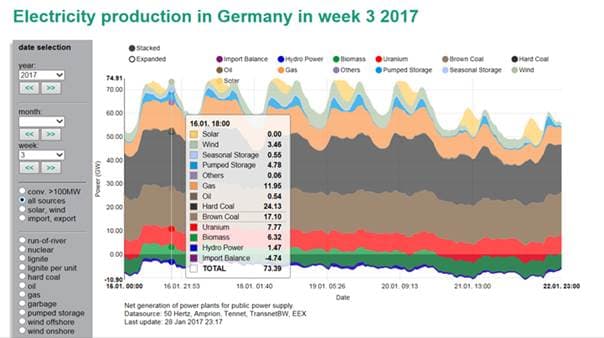
Germany, third week of 2017 (16.1-20.1), output supplied by individual energy sources, afternoon peak, 18:00:
Source: Fraunhofer Institute
The data shown graphically are from Monday 16.01; the remaining weekdays through Friday 20.01 were almost identical and are presented in the following table:
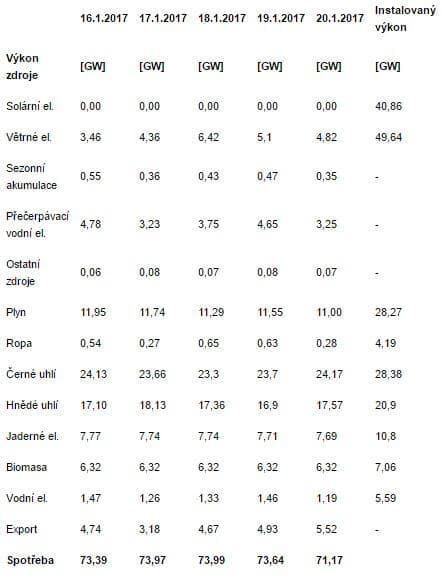
A closer look at the table shows that German domestic consumption during January afternoon peaks exceeded 70 GW, which is a relatively high figure, although the energy sector was a net exporter overall. It was not a particularly favourable week for RES generation. At six in the evening, solar generation was zero and wind generation was very weak, at roughly 7-13% of installed capacity, meaning the contribution from the most favoured and media-celebrated sources of the “new energy sector” was minimal. Hydro generation was also limited, leaving biomass, operating at 90% of installed capacity, as the only more significant RES source. By contrast, the outdated “dinosaurs” — coal, gas and nuclear — provided more than 80% of the required output.
In January, it would of course be possible to find other weeks with more favourable climatic conditions for RES generation. And over the course of the year, we can naturally find days that offer very favourable or even excellent conditions. Such cases are, after all, usually widely presented in the media and accompanied by celebratory discussion on green websites, precisely in terms of the above-mentioned inevitable consignment of other sources to the dustbin of history. However, I return to the introduction of this article. Grid operators must ensure reliable electricity supplies even under the most adverse conditions, in the case of RES primarily climatic ones. Especially when these conditions can occur repeatedly over several consecutive days.
The question for discussion is what the cited example can tell us about the real potential of individual sources and possible future developments. I will attempt to structure the conclusions according to my own typology of RES supporters.
Partial conclusion for “photovoltaic visionaries”
Photovoltaic visionaries love the figure for the intensity of solar radiation reaching the Earth’s surface. They use this figure to calculate the area needed to ensure generation of sufficient electricity for their house, village, town, urban area, country, continent or the whole world, while usually regarding the provision of the necessary capacity and continuous electricity supplies for large energy systems as a secondary technical problem. However, I assume that even the most die-hard supporters accept the fact that from six in the evening in January until the following morning, photovoltaics simply generate nothing in Germany, even if twice the current 41 GW of capacity were installed. Technological development of photovoltaic cells is unlikely to solve this problem. The only option for wider deployment of photovoltaics “beyond climatic limits” is the massive deployment of electricity storage technologies. However, in the case of a national system in an industrial country, we are talking about capacities in the tens of GW and electricity volumes in the TWh range.
Partial conclusion for “anti-fossil campaigners”
Campaigners against greenhouse gas emissions could perhaps infer from this real-world example that during winter and under unfavourable climatic conditions, replacing fossil energy with renewable sources is technically and economically unrealistic. The most radical among them, who on principle do not wish to accept even gas-fired generation and object even to burning biomass, must solve a “mission impossible”, and I would be glad to hear their technical proposals for a solution. They will simply have to accept that German grid operators require fossil back-up for an “RES-based energy sector”, primarily gas but also coal, amounting to several tens of GW, and that in winter they will burn whatever they can get their hands on. Campaigners only against coal can find a solution in the massive development of gas-fired generation, if they can accept the volume of CO2 emissions from burning gas, the construction of new plants and the high cost of gas, especially if the plants were to operate over extended periods during winter in the mid-merit or even baseload part of the daily load curve. They will also have to accept Germany’s increased dependence on imports of Russian natural gas.
Partial conclusion for “anti-nuclear campaigners”
Campaigners against nuclear energy have a relatively easier position. The shutdown of German nuclear power plants has, after all, already been enshrined in law, with a deadline at the end of 2022. Even so, this is a truly very ambitious task, because nuclear power has an installed capacity of “only” 11 GW, yet last year it generated one percentage point more electricity than the currently installed 50 GW of wind power. However, if green politicians take advice after 2022 and choose the right time of year for their campaigning, they will be able to tell the public that nuclear generation has been replaced by RES rather than coal or gas.
Author’s conclusion
Germany generated roughly one-third of its electricity from renewable sources in 2016, which is a truly respectable amount. If we start from the political goal of maximising the share of electricity generation from RES, it has so far completed the easiest first third of its journey. Increasing the share from 33% to, say, 66% will be incomparably more technically complicated and economically demanding. Yet national possibilities are already often exhausted, particularly in wind and solar energy. As shown, during winter the sun and wind often do not generate enough electricity for national demand, and installed capacity would need to be increased further. However, under favourable climatic conditions, especially during spring for photovoltaics and autumn for wind, they generate surplus output that significantly complicates life for transmission system operators in neighbouring countries. So much so, in fact, that they have decided to take technically complex and financially demanding countermeasures against Germany. So, to paraphrase: theory is green, but practice is grey.
Petr Nejedlý
Republished with the author’s permission from the iDnes blog.
Translation disclaimer
This article is a machine translation of the Czech original and has not yet been fully reviewed. In case of any doubt, please refer to the Czech version.