23 October 2026, 14:38
Loading...
Björn Lomborg’s contribution to a sustainable world in Czechia
Milan Smrž
19 April 2025, 08:37
The views of Danish statistics professor Björn Lomborg have been and continue to be characterised by many experts as anti-environmental. This is why Václav Klaus invited him to Prague, where he then settled more than 10 years ago. At the end of the last century, in 1998, he gained fame with his book “The Skeptical Environmentalist”; in the view of some experts, such as Bedřich Moldán, he is right about some things, but does not present them in a broader context.
A critical study by Professor Jeroen C.J.M. van den Bergh of the universities of Barcelona and Amsterdam identifies several fundamental shortcomings in Lomborg’s work. Above all, these include neglecting regional trends in favour of global and aggregate trends, extrapolating positive results far into the future, selectively choosing problems and data that support his theory, and conducting partial rather than comprehensive analyses. It also criticises Lomborg for failing to discuss problems associated with irreversible physical and biological processes and for citing articles that have not undergone scientific peer review.
Lomborg has traditionally disparaged renewable energy, which is a key concept of the Green Deal and the implementation of the Paris Climate Agreement. He did so in the past and continues to do so. His basic argument against renewables is that the most common renewable sources operate only sometimes, when the wind blows and the sun shines, and that funds allocated to their development should instead be devoted, for example, to reducing child mortality and advancing women’s rights. Lomborg argues that renewables are an insufficient tool for tackling climate change. He is partly right that emissions from fossil energy are not the only sources of greenhouse gases. However, they are the dominant source, accounting for nearly 3/4 of all emissions.
Nevertheless, there is extensive literature on fully renewable energy supply, comprising hundreds of original articles. A 2022 paper examines more than 600 studies in detail, while a more recent article looks at the current situation in countries with a high share of renewable electricity and prospects through 2030.
It should not be overlooked that Central Europe has areas with populations exceeding 100,000 that generate more energy than they consume themselves (Burgenland, Aller Leine Tal, Hassfurt), while the Rhein-Hunsrück district already generated around 2/3 more electricity from wind, solar and biomass per capita than the Czech Republic did from all sources several years ago.
Renewables with high utilisation
In the Czech Republic, the importance of renewable sources is often downplayed, including through the use of the term intermittent energy sources. No one doubts that the sun does not shine at night and the wind does not always blow. However, time-series charts of combined electricity generation from solar and wind show that the two sources often complement each other. There is more sunshine in summer, while winds are stronger in winter and transitional seasons. Periods without sun and wind can occur and, exceptionally, may last several weeks. The German term Dunkelflaute has become established for these periods. In 2024, at current installed capacity, around 20 multi-day major declines in wind and solar output can be counted. However, Germany’s installed capacity is expected to increase by around 3.6 times by 2045, reducing the number of days with insufficient electricity production.
The average annual utilisation of solar and wind resources is not high and is expressed as hours or percentages of full-capacity operation per year (FLH). Average values range between 15 and 35 %, while offshore wind farms can achieve up to 50 % annual utilisation.
New renewable sources that can operate with annual utilisation comparable to nuclear power plants have existed and been positively tested for some time, meaning their FLH can reach up to 80 %. These include kite power plants by SkySails, which operate at altitudes of up to 400 m, where winds are stronger and more regular. Besides kites, newly designed power plants using wave energy should also be mentioned. This highly efficient technology addresses key challenges: surviving the most demanding storms while delivering large amounts of electricity relative to the size, weight and cost of the equipment. With the installation of around 20 GW of this type of wave power plant, electricity prices of 33–44 USD/MWh, i.e. 0,76 – 1,02 Kč/kWh, could be expected thanks to cost reductions from manufacturing volumes. The system was successfully tested in Portugal, where it withstood 18-metre waves during a storm. Interestingly, the generator principle was designed by a cardiologist, who based its concept on the workings of cardiac muscle.
New trends in electricity storage
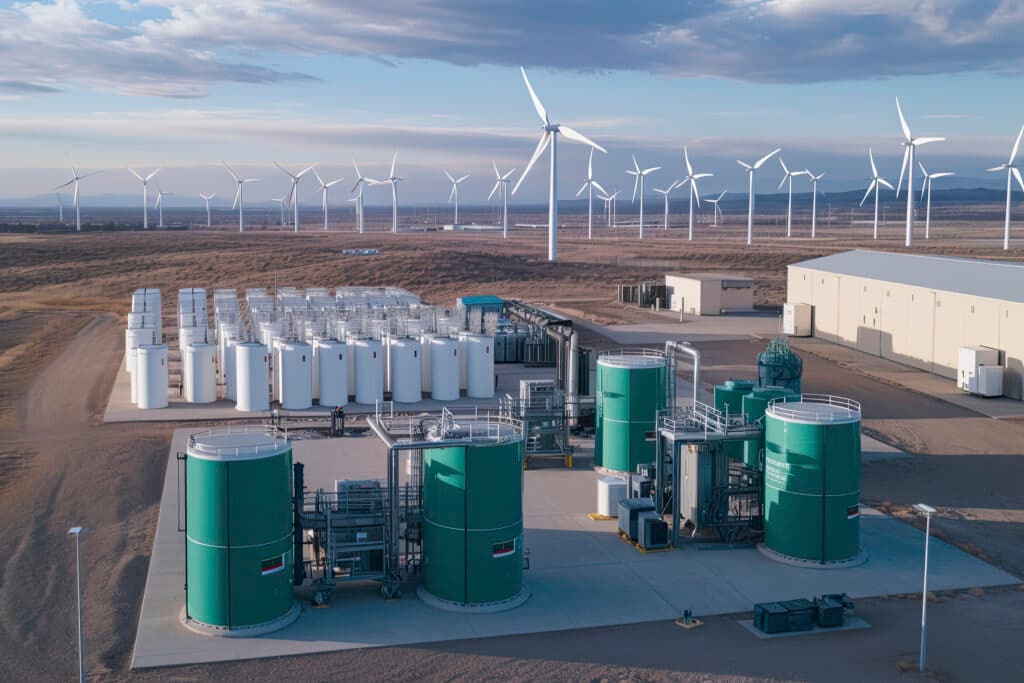
Interruptions in renewable electricity supply need to be covered by storage, which encompasses a range of methods and technologies. Electrochemical batteries are expected to be used for short-term storage over several hours, while storage in gases is envisaged primarily for longer periods. This may involve pure electrolytically produced hydrogen, synthetic methane or ammonia. Ammonia has the significant advantage of being readily liquefied and easily distributed in this form. Every form of storage is associated with energy losses, so it is important to focus on technologies with high efficiency at each stage.
Hydrogen can be compressed and stored (a pilot above-ground storage facility in Rüdersdorf near Berlin will be connected to the German hydrogen network). Methane can be produced from hydrogen through the Sabatier reaction with carbon dioxide, or in situ from injected hydrogen and carbon dioxide in former natural gas reservoirs with the help of archaea bacteria. An experiment involving underground methanation has been underway in Austria since 2013, while similar results have also been found in the underground storage facility at Lobodice in Moravia.
Another electricity storage option is the material-efficient redox flow battery using water and table salt from AQUABATTERY.
Efficient technologies reduce costs
In 2022, the journal Nature published an article on a new high-efficiency electrolysis technology. It features capillary-induced transport with a porous inter-electrode separator, resulting in bubble-free electrolysis. The alkaline, capillary-operated cell is more efficient in water electrolysis than commercial electrolytic cells, corresponding to 98% energy efficiency and energy consumption of 40,4 kWh/kg of hydrogen (compared with ~47,5 kWh/kg for commercial electrolysers). It is therefore around 15 % more efficient than current electrolysis techniques.
Nuclear energy is expensive and potentially dangerous, especially in today’s turbulent times. According to Lazard, renewable energy is 3-5 times cheaper than electricity from a nuclear power plant. The project by California-based Eland will supply electricity to the Los Angeles Department of Water and Power (LADWP) at record fixed prices for solar energy (0,01997 USD/kWh) and energy storage (0,013 USD/kWh) for 25 years. The combined price for generated and stored electricity totals 0,78 Kč/kWh. If recalculated for lower average Czech solar irradiation, the price comes to around 1,09 Kč/kWh.
The cost of nuclear electricity from the new Vogtle plant, the first power plant built in the US in more than 30 years, will range from 170–180 USD/MWh, i.e. 3,7-3,9 Kč/kWh.
According to the World Wind Energy Association, Germany could already have had electricity from 100 % domestic renewable energy last year. Changes to the EEG (the law supporting renewable electricity generation) led to slower growth in installations. For wind energy, installation growth fell from 14,4 % in 2001 to 2017 to 3,9 % in 2018-2024. For photovoltaics, it declined from 64,2 % growth in 2003-2012 to 9,6 % in 2013-2024. Without interventions in the EEG, Germany could have obtained electricity from 100 % domestic renewable sources as early as 2024 under conservative assumptions, and as early as 2022 in the central scenario.
The goal of the US Department of Energy (DOE) is to substantially reduce the cost of zero-emission hydrogen by targeting a price of one dollar per kilogram by 2031. This price includes production, delivery and dispensing at filling stations. An interim target of 2 dollars per kilogram by 2026 has been set.
We are second from bottom in renewable energy
It is a pity that research into and practical deployment of renewable energy did not begin earlier, as Noel Brown, former director of UNEP, called for when he declared in 1989 that we had 10 years to address the greenhouse effect before it got out of hand.
Did we do our utmost by 2000 and during the following quarter-century? Certainly not in the Czech Republic, which ranked second from bottom among European Union countries in 2024 in terms of the share of renewable electricity in the grid. In that year, the Czech Republic had 19,5 %, while the EU27 had 45,0 % renewable electricity in the grid. Lomborg’s views have also contributed to the long-term reluctance, and even resistance, of Czech politics and the public towards renewable sources.
Translation disclaimer
This article is a machine translation of the Czech original and has not yet been fully reviewed. In case of any doubt, please refer to the Czech version.
Sdílejte článek prostřednictvím:
Topics:Opinion
You might also like
23 October 2026, 11:01
23 October 2026, 06:34