23 October 2026, 14:38
Loading...
Can Czechia do without coal-fired power plants?
Vladimír Wagner
8 June 2018, 06:44
Environmental organisations (Hnutí Duha, Glopolis, Frank Bold, CEE Bankwatch Network and the Alliance for Energy Self-Sufficiency) commissioned Energynautics to conduct a study assessing the impacts of shutting down coal-fired power plants and developing renewable energy sources (Czech summary, the study itself). It examined the consequences for the Czech grid of ending the operation of Czech coal-fired power plants and developing renewable energy sources by 2030. According to their statement, the key finding should be that, according to the study, security of supply can be ensured even after coal-fired power plants are shut down. Even after their closure, the grid will be able to cope with an exceptional event on the scale of an unplanned outage of a Temelín unit, the largest source in the system.
The assumed scenario?
Let us look at what the study actually says about the feasibility of the aforementioned scenario and its impacts on energy security. It assumes that the only coal-fired sources remaining in operation will be combined heat and power plants, whose main purpose is to supply heat to large urban areas, and CHP sources at industrial facilities. Under the assumptions, the operating regime of CHP sources is driven by heat demand. For the Temelín nuclear power plant, annual unit utilisation of 80% is assumed; for the Dukovany nuclear power plant, it is 75% (assuming that three of the four units are always operating). Refuelling and major overhauls are carried out predominantly during the summer. For 2030, net electricity consumption in the Czech Republic is assumed to be 65 TWh, compared with 60.7 TWh in 2017. Electricity generation of 73 TWh is expected at that time, somewhat more than is needed.
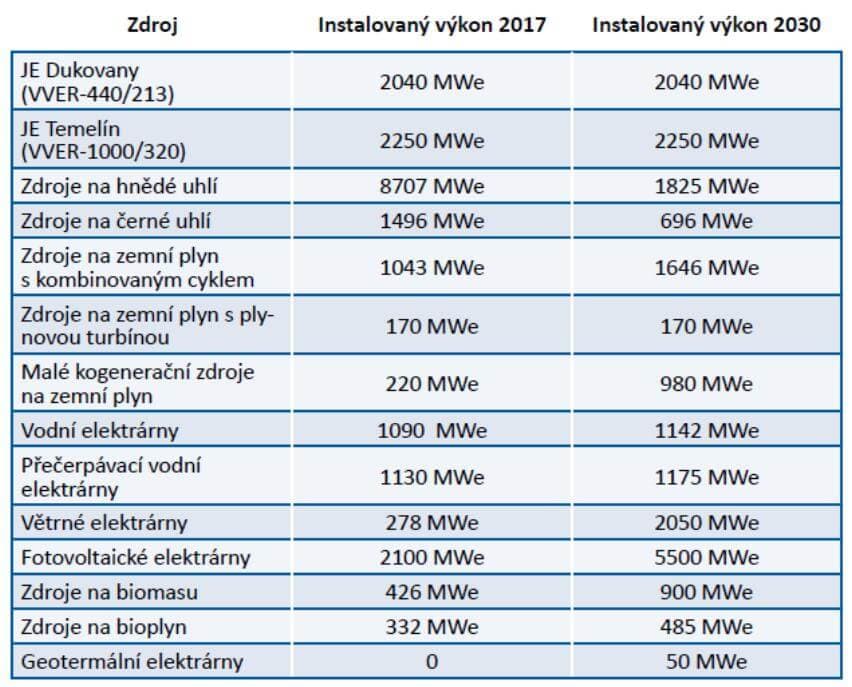
The Czech Republic will thus have 4.29 GWe of nuclear capacity, 2.52 GWe of coal-fired capacity, 2.80 GWe of gas-fired capacity, 1.14 GWe is planned in hydropower plants and 1.39 GWe in biomass. This gives a total of 12.14 GWe in weather-independent sources. A further 1.18 GWe is to be available in pumped-storage power plants, but these will not help in cases where conditions for surpluses that could be used for pumping do not occur for several days.
Moreover, it must be taken into account that the ability to use hydropower plants depends on how much water is available; one can never count on the maximum possible installed capacity, and especially during winter in a dry year, the potential may be greatly reduced. During very cold winter periods, demand for heat is high, meaning CHP plants focused on heat supply will not operate in an optimal mode for electricity generation. It must also be considered that some power plants are always offline for maintenance or due to faults, and reserves need to be maintained for balancing. Even in the most favourable case, the available capacity of weather-independent sources at any given moment will therefore be no more than somewhere between 10 and 11 GWe.
Will such a scenario ensure security of electricity supply?
Such capacity will not guarantee that needs can be met in winter conditions of high electricity and heat demand, when there is also no wind for several consecutive days and photovoltaic generation is minimal. Such situations are not particularly unusual. We experienced them this winter as well. One such week-long period occurred at the beginning of December. Demand at that time ranged between 10 and 11 GW (see ČEPS), and at the turn of January and February this year, peak demand even reached 11.5 GW. In previous years, we have experienced several consecutive days when peak demand almost equalled 12 GWe. Moreover, this was always at a time when our neighbours also had high demand and the wind was not blowing particularly well, so there would be nowhere from which to import electricity.
Until now, such periods have been managed thanks to a large surplus of coal-fired capacity, mainly in Germany, but also in the Czech Republic and Poland. However, this certainly will no longer exist after 2025. During these periods, pumped-storage plants or batteries would never have an opportunity to charge (there would be no surpluses), so they would not help either. In such a case, rather drastic restrictions on consumption would simply have to be introduced. An outage at Temelín would then be difficult for our grid to withstand in this situation. Even the outage of a much smaller source would pose a threat.
The claim that the study shows that an outage the size of one Temelín unit could be tolerated is therefore probably not true. It would depend on the circumstances. Moreover, Temelín will not be the largest single unit in the grid at that time. A larger unit will be more than 2 GWe of wind capacity and even 5.5 GWe of photovoltaic capacity. These depend on weather conditions, which are quite commonly the same across the entire country, and they can therefore fail as a whole relatively often. When there is no wind or sunshine, wind turbines and photovoltaic sources are suddenly missing, amounting to a total outage of 7.5 GW.
A change in the environmental organisations' stance on nuclear power?
Another interesting feature of this study, unprecedented so far among environmental organisations, is its recognition of the importance of nuclear sources. The study therefore assumes that Czechia will generate 40.0% of its electricity from nuclear power in 2030. This figure follows from the assumed utilisation factor of our nuclear power plants and assumed electricity generation of 73 TWh. Let us look at what renewable sources will supply in this scenario. Wind is expected to have a utilisation factor of 26.3%, photovoltaics 11.5%, which are, in my view, realistic figures for our conditions. Because of this lower utilisation factor, wind will generate only 6.4% and photovoltaics 7.6%. Biomass, at 10.0%, and hydropower, at 9.3%, will provide more. Renewable sources will thus supply a total of 33.3% of electricity. However, this scenario by environmental organisations still assumes very high use of coal. It is to provide 20.4% of electricity—more than photovoltaics and wind combined. Fossil-fuel sources will thus supply 27.1% of electricity in total.
But what happens if Dukovany is then shut down within a few years and our grid moves from a totally strained regime (in my view unsustainable) to total collapse with the loss of 20% of generation and 20% of stable, guaranteed capacity? Dukovany is to be shut down around 2035. Its capacity and generation will have to be replaced, and from an environmental perspective it would probably be sensible to gradually replace the remaining coal as well. The study suggests that environmentalists assume nuclear units replacing Dukovany will be built by 2035. The problem is that in reality they do not act accordingly. In any case, the shift towards a concept of generating almost 50% of electricity needs from nuclear power is quite interesting for these organisations.
Conclusion
In an extensive series (here, here, here, here, here, here, here, here and here), I analysed the current state of the Czech energy sector and scenarios for its possible development. According to it, increasing wind capacity to 2 GWe and photovoltaic capacity to 5.5 GWe by 2030 is feasible. The question, however, remains one of economics and financing. Given that our photovoltaic sources will compete with a large surplus of such sources in neighbouring Germany, and our wind farms with far more efficient wind resources in northern Germany, there will be a surplus of electricity in the region under ideal weather conditions and wholesale electricity prices will be low. Another form of financing for these sources, and thus an appropriate subsidy scheme, needs to be ensured.
As has been shown, while the scenario proposed by environmental organisations in the study ensures sufficient total annual electricity generation, it does not guarantee secure grid operation in demanding winter conditions. It quite often has no reserves for balancing, and there are not entirely exceptional periods when the proposed system cannot meet demand. Such a situation will, in all likelihood, arise in Czechia as early as 2022, as described in the article on the risks facing energy-sector development in our country.
This could be addressed, for example, by increasing gas-fired capacity by roughly 2 GWe. This would primarily cover periods of high demand and low wind and solar availability. Naturally, however, this would make the entire system more expensive and increase gas consumption. We thus arrive at the scenario described in the aforementioned article as the second Bavaria: a move towards a combination of gas and renewable sources. Development would then begin moving rapidly in that direction if replacement nuclear units are not built before Dukovany is shut down in 2035. The main problem with the study and its scenario is therefore that it says nothing about how development in the 2030s will be addressed. In Russia, the reactor pressure vessel of the same VVER440 unit type as at Dukovany was recently annealed, and there are plans to operate it for 60 years (for details see here). However, it is not very realistic, particularly in light of political pressure from our neighbours, that this could also be implemented here. Yet the Energynautics study itself shows that Czechia cannot do without nuclear power in the coming years and decades, and that at the very least a replacement for Dukovany must be built in time. To ensure this happens, intensive work is needed on preparing and commencing construction of the necessary nuclear units. From this perspective, this study commissioned by environmental organisations, which clearly demonstrates this necessity, is very useful.
Written for the Osel and oenergetice websites.
Note: The book Czech energy at a crossroads (edited by Hynek Beran, Václav Pačes and Vladimír Wagner), produced on the basis of a study prepared for the Czech Chamber of Commerce by a broad collective of authors, is currently going to print. It addresses precisely the critical periods for the Czech energy sector in 2022 and 2035, possible development scenarios and recommendations on how to confront looming risks and make use of the challenges ahead.
Translation disclaimer
This article is a machine translation of the Czech original and has not yet been fully reviewed. In case of any doubt, please refer to the Czech version.
Sdílejte článek prostřednictvím:
You might also like
23 October 2026, 11:01
23 October 2026, 06:34