
23 October 2026, 14:38
Loading...
Could we burn nuclear waste using an accelerator-driven transmuter?
Vladimír Wagner
5 June 2020, 10:43
Technologies enabling the efficient “burning” of transuranic elements could dramatically reduce the volume of radioactive waste. One option in this case is accelerator-driven transmuters. Let us look at how far we have come on the path towards making this option a reality.
If the course of a controlled fission reaction is governed precisely by the neutrons produced in that fission reaction, it is highly sensitive to the stability of the fission reactions and neutron production from fission. The ratio between the number of neutrons in the next generation and that in the preceding one, known as the multiplication factor, must in this case equal one. Such a nuclear fission system is described as critical. Conditions in the core must be maintained so that its neutron physics does not deteriorate and the fission chain reaction remains stable. The output of such a reactor is then controlled by very small deviations of the multiplication factor from one. If it is a fraction lower, output falls; if it is a fraction higher, output rises. The composition of the reactor core and the proportion of fissile materials (nuclides that can be fissioned by neutrons of any energy) must therefore be finely tuned and strictly defined. The achievable neutron fluxes in such a system are also limited. They tend to be higher in fast reactors than in conventional thermal reactors.
If we want to efficiently transmute fissile transuranic elements that are not themselves fissile, a given nucleus usually has to undergo several neutron captures. A high neutron flux is therefore important. This can be achieved using nuclear fission systems with a separate external neutron source supplementing neutron production from fission. The system is thus subcritical, and its control is provided by the external neutron source. A recent article describing the current state of efforts towards achieving thermonuclear fusion and potentially a fusion power plant discusses the possibility that a fusion reactor could serve as this external neutron source.
Spallation neutron sources
Another option is a spallation neutron source. In this case, it is an accelerator capable of accelerating protons or light ions to relativistic energies—that is, energies at which their speeds approach the speed of light. The resulting beam, which needs to be highly intense, strikes a target made of a heavy element. Lead or tungsten is generally assumed, although uranium is also sometimes considered.
When a relativistic proton strikes the target, a spallation reaction ejects several nucleons, which may have sufficient energy to trigger another spallation reaction. At the same time, a large part of the energy is distributed among the remaining nucleons in the nucleus, from which a large number of neutrons then “evaporate”; alternatively, the nucleus may fission and neutrons evaporate from the fission products. In any case, spallation reactions produce a large number of neutrons, and spallation neutron sources can provide very intense neutron fluxes. Neutron sources using spallation reactions have been in use for some time. They are replacing research reactors that are being shut down, while new ones are being built only to a limited extent.
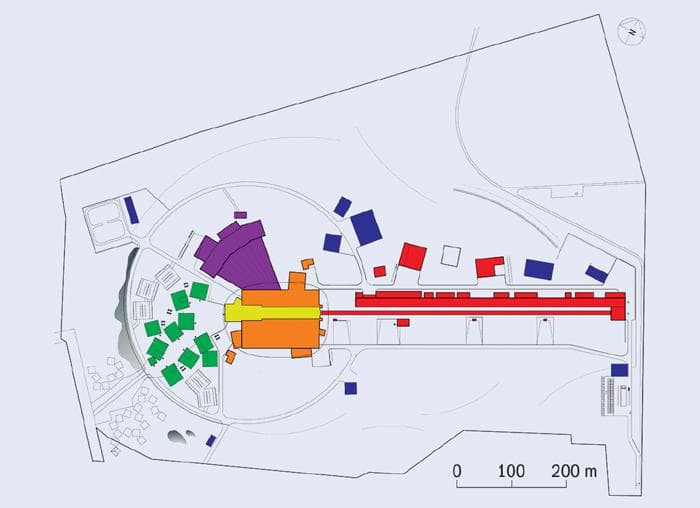
Europe is now building the highly intense ESS (European Spallation Source). Alongside the ITER tokamak and the LHC accelerator, it is one of Europe’s largest international projects. The neutron source itself and its laboratories are being built in Lund, Sweden, while a major computing centre to process its data is being built in Copenhagen, Denmark. European countries agreed on the need for a highly intense neutron source for materials research around twenty years ago. Actual construction of ESS began in 2014, with 17 European countries involved, including Czechia, which is among the organisation’s founding members. Activities on the Czech side are organised by the Nuclear Physics Institute of the Czech Academy of Sciences.
Construction of this facility is testing the two most important components of future accelerator-driven nuclear technology systems: a highly intense accelerator of relativistic protons and a spallation target made of heavy material that requires highly efficient cooling and removal of large amounts of heat.
In the case of ESS, a linear proton accelerator is being built: a superconducting linac with a final proton kinetic energy of 2 GeV. The protons will therefore travel at roughly 96 % of the speed of light. It will be an accelerator with the world’s highest-intensity relativistic beam, with an average beam current of 62,5 mA and power of 5 MW. It will be a pulsed source, with power in a pulse reaching up to 125 MW. The five-tonne rotating target is made of lead and will be cooled by helium. Each proton will produce an average of 80 neutrons in it. Some of the main components of the target and its helium cooling system are being supplied by colleagues at the Řež complex working at ÚJV a.s., and the prepared technologies are now being assembled.
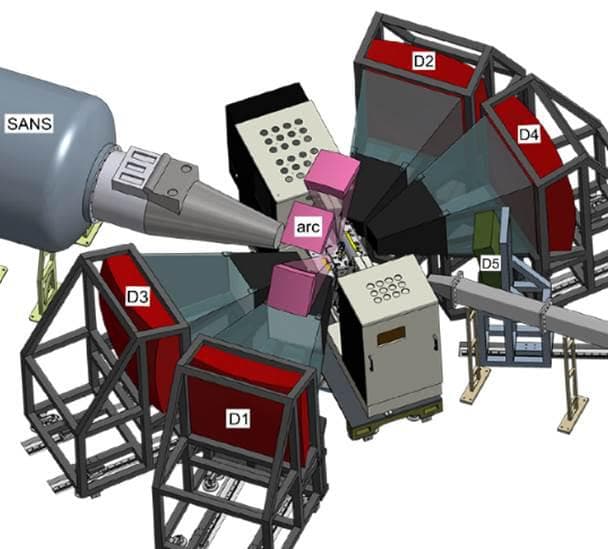
Because the neutrons produced are predominantly at energies of tens to hundreds of MeV, whereas low-energy neutrons are needed—ideally thermal neutrons like those from a conventional reactor—a moderator containing room-temperature water will be placed between the target and the experiment. Hydrogen at a temperature of 13–20 K will be used in some cases to obtain cold and ultracold neutrons. Neutron wavelengths, determined by their energy, range from tenths of a nanometre to centimetres. This makes it possible to study materials and their structure across all possible size scales. The facility’s achievable time resolution ranges from seconds down to tens of femtoseconds. Very dynamic processes can therefore also be studied. A major advantage of neutrons is that they carry no electric charge. However, they have a magnetic dipole moment. They are thus like tiny magnets and respond very sensitively to the magnetic properties of materials. ESS will have a total of 22 experimental instruments using the advantages of neutron beams to study the properties of condensed matter, various crystal structures, polymers and biomaterials for industry, medicine and other fields.
The first neutron beams were expected to be produced after 2022, when the BEER (Beamline for European materials Engineering Research) diffractometer for materials research was also expected to be ready. It is being developed by colleagues from our Department of Neutron Physics at the Nuclear Physics Institute together with scientists from the Faculty of Mathematics and Physics at Charles University and the Institute of Physics of the Czech Academy of Sciences, as well as German colleagues from HZG in Geesthacht. The instrument is focused on studying advanced materials for various industries. All 22 experimental setups were expected to enter operation in 2025.
Our colleagues researching material properties using neutron beams have diffractometers on channels of the LVR-15 reactor at the Řež complex. It belongs to the Research Centre Řež, and our neutron physicists use six channels there in total, with a range of experimental equipment. In addition to various diffractometers and interferometers, this includes tensile testing machines and furnaces, as it is very important to study material behaviour under high thermal and mechanical stress. They are also seeking to apply the experience gained with these facilities in the construction of equipment for the ESS spallation neutron source.
An important benefit of this and other spallation neutron sources is also that they pave the way to a reliable, very high-intensity accelerator of relativistic protons and an efficiently cooled, durable target for neutron production. Such a setup is also crucial for accelerator-driven transmutation technologies. Progress in accelerators is also being made through their application in other fields. Efforts are also focused on advancing spallation targets; one example is the MEGAPIE (MEGawatt PIlot Experiment) project, which was covered in an Osel article more than ten years ago. It involved a liquid lead-bismuth eutectic target irradiated by a one-megawatt beam at the PSI (Paul Scherrer Institute) laboratory in Switzerland. Processing its results made it possible to improve the software used in designing such nuclear facilities, especially in describing neutron production and propagation within them. It also made it possible to refine estimates of which long-lived radionuclides are produced during operation and in what quantities.
Accelerator-driven transmuter
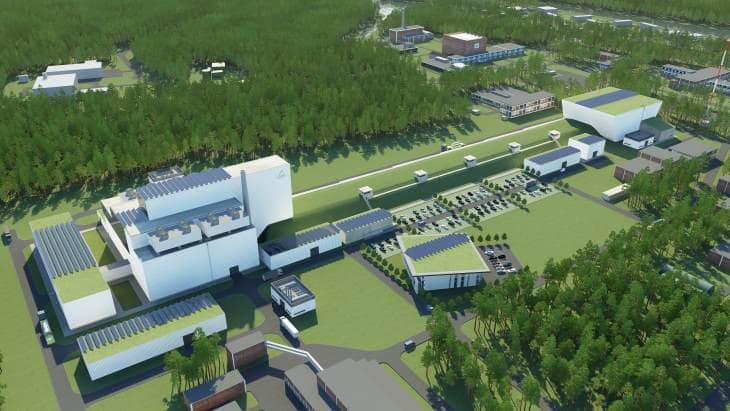
An accelerator-driven transmuter would be a facility consisting of such a spallation neutron source, with the target surrounded by a blanket containing a core. This would consist largely of transuranic elements from spent fuel. The external source would provide high neutron fluxes in the blanket. This would be possible because the entire system would be deeply subcritical, as the fission chain reaction would be sustained solely by the external neutron source. The high neutron fluxes would then enable highly efficient transmutation of transuranic elements through neutron capture into those that are fissile and can be fissioned following neutron capture.
The advantage of a subcritical system is that the fission chain reaction stops immediately in the event of any malfunction. From this perspective, the system is very safe. If such technology begins to be used, its main purpose will be the efficient burning of transuranic elements in spent nuclear fuel from conventional reactors. This would dramatically reduce both the volume and hazard of nuclear waste. Transuranic elements are the part of it with long half-lives and high radiochemical risk.
To prevent the capture of excess neutrons during irradiation in the core, continuous separation of nuclides that are stable, short-lived or suitable as fuel for conventional reactors is desirable. Liquid fuel in the form of molten salts is therefore often considered for the core. This is also the type considered for one category of Generation IV reactors. Another advantage of such a system is that radionuclides do not accumulate in it, eliminating the problem of removing heat generated by radioactive decay.
If the system operates as a power plant, conversion of heat to electricity will be the same as in conventional reactors. Part of its electricity will be used to operate the accelerator and other equipment, with the remainder supplied to the grid.
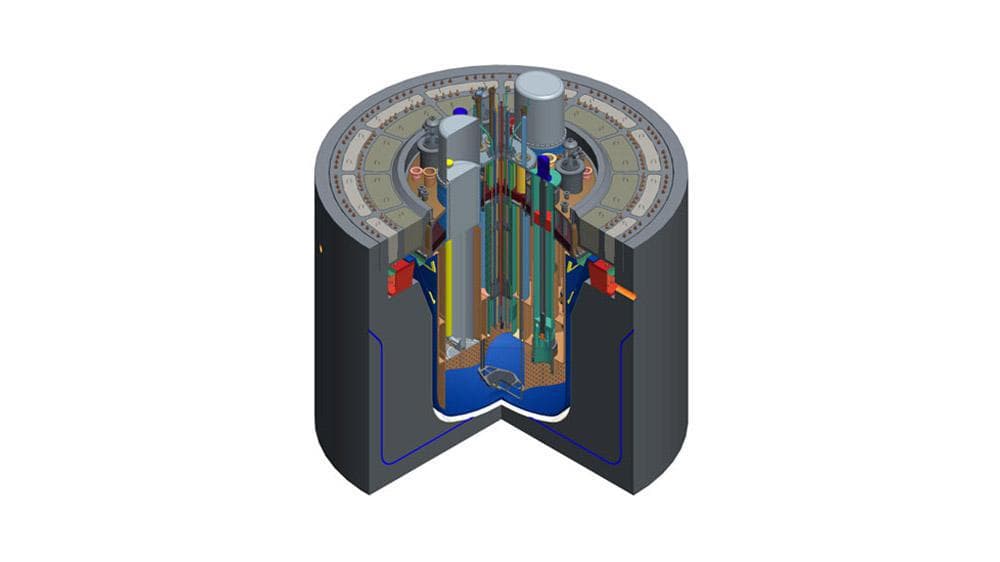
MYRRHA experimental reactor
The MYRRHA (Multi-purpose hYbrid Research Reactor for High-tech Applications) experimental reactor is intended to test the potential of accelerator-driven transmutation systems. The project began to be implemented at the Belgian Nuclear Research Centre SCK CEN in Mol, Belgium. It is to be a fast-spectrum research reactor that can operate in both critical and subcritical modes. When operating in subcritical mode, its external neutron source will be a proton accelerator providing protons with a kinetic energy of 600 MeV. The protons would strike a liquid bismuth-lead eutectic target. The reactor itself is to be of a pool-type design. Its reactor vessel is to be seven metres high with an internal diameter of 4,4 m. It will use MOX fuel assemblies enriched with up to 30 % plutonium. The core will also be cooled by liquid bismuth-lead eutectic. The reactor’s thermal output will be 50–100 MWt.
In September 2018, funding was approved for the initial phases of the project. Its implementation schedule is also beginning to take clearer shape. It is to be divided into four stages. The first stage is to deliver a 100 MeV proton accelerator with high beam intensity. It was expected to be operational in 2026, while implementation of its second stage, enabling a 600 MeV proton beam, was to begin at the same time. In parallel with this second stage, the third stage—the construction of the reactor itself—was to begin in 2026. Full completion and integration of the MYRRHA subcritical system will then form the fourth stage, expected to be completed in 2033, when the complete installation should enter operation. Apart from the international Jules Horowitz Reactor being built in Cadarache, France, which was expected to start up in 2021, this was at the time the only genuinely prepared and under-construction research reactor project in the European Union.
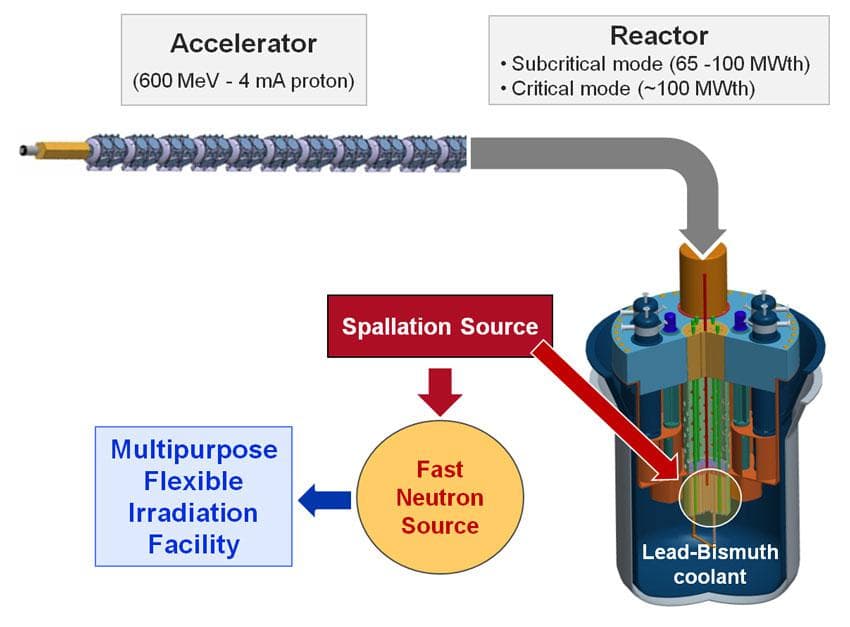
The facility is to provide intense proton and neutron beams for research in nuclear and atomic physics, materials research, and medical diagnostics and therapies. This primarily concerns the efficient production of new radionuclides important for cancer diagnosis and treatment. At the same time, it will study technologies needed for Generation IV reactors, accelerator-driven transmutation technologies and fusion reactors. This chiefly involves research into materials with high resistance to thermal and radiation stress.
Other countries are also preparing projects simulating accelerator-driven transmutation technologies. Work is focused primarily on advances in proton accelerators with very high beam intensity and corresponding targets for spallation neutron sources. China in particular is working intensively to open up the possibility of using accelerator-driven transmutation technologies. It is developing the ADANES (Accelerator-Driven AdvaNced Energy System), which would include the ADB (Accelerator-Driven system Burner), enabling the burning of transuranic elements, and the ADRUF (Accelerator-Driven Recycle Used Fuel), enabling the recycling of spent fuel from conventional nuclear units. The second stage on the path towards such a system for using and burning spent fuel from conventional reactors is the CIADS (China Initiative Accelerator-Driven System) experimental prototype, consisting of a proton accelerator to energies of 500 MeV with an intensity of 5 mA and a 10 MWt fast reactor cooled by lead-bismuth eutectic. Completion was planned for 2024. It is quite likely that the planned dates may be delayed. Even so, China could be the first country to build an industrial-scale accelerator-driven transmuter.
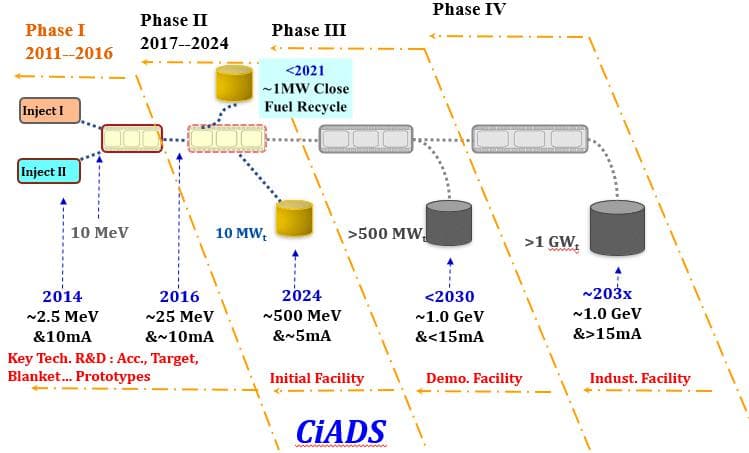
Synergies between different fields
In an article on the current state of the path towards fusion energy, I wrote about synergies in research and the future use of fusion and fission energy. Naturally, this also applies to the research needed to pave the way for accelerator-driven transmutation technologies. Work on reliable, high-intensity accelerators for relativistic ions is important for facilities using hadron beams to treat cancer. Spallation neutron sources will find application in a range of materials research fields and applications. We have already written in the previous article on fusion about the need for highly accurate measurements of neutron production probabilities and their reactions with materials, which are important for these neutron sources and for fission and fusion nuclear technologies. How such measurements using quasi-monoenergetic neutron sources are performed is described in an older article, while a useful overview and an example of current work can be found in this year’s research project by one of our graduate students.
As described above, for a core in accelerator-driven transmuters it is advantageous to use liquid fuel from which some nuclides that have already been transmuted into a suitable state can be continuously separated. This draws on experience gained from research into Generation IV reactors based on liquid fuel composed of molten salts.
Testing of various models and software describing neutron production and transport, as well as radionuclide production, is also very important. They are tested using simple setups that mimic components of future accelerator-driven transmuters. Different types of targets are irradiated with relativistic protons or deuterons. Various materials are placed in the resulting neutron field. Different neutron detectors are then used to study neutron production and transport. Induced radioactivity is also measured. The measured data are compared with predictions from the aforementioned software used to design nuclear facilities. We also conduct precisely such measurements and experiments with students at the Joint Institute for Nuclear Research in Dubna.
Conclusion
Accelerator-driven transmuters could become an important component of nuclear power in the future. They would enable the efficient burning and use of transuranic elements from spent fuel from conventional reactors. They are naturally more complex facilities than conventional reactors, and their use only makes sense at a certain level of nuclear power deployment. In this respect, they have some similarity to fast reactors. Here too, research and consideration of a demonstration unit have recently shifted to China, which envisages rapid nuclear power development. This is also the country where the first demonstration unit could appear, as early as the 2030s.
Europe is seeking to exploit synergies through the MYRRHA multipurpose research reactor project in Belgium, which can also operate in subcritical mode. Work on its implementation has already begun, but it remains largely at the preparatory stage. The pace of progress will be determined by support for the facility from European countries. The MYRRHA reactor could help test all the important components of a future accelerator-driven transmuter. This would prepare the conditions for the technology to be used in the future if needed.
Written for oEnergetice and Osel.
An older lecture on accelerator-driven transmutation technologies:
https://slideslive.com/38904833/rndr-vladimir-wagner-csc-ujf-av-cr-jaderne-transmutace-budeme-spalovat-jaderny-odpad-pomoci-urychlovace?ref=speaker-9919-latest
Translation disclaimer
This article is a machine translation of the Czech original and has not yet been fully reviewed. In case of any doubt, please refer to the Czech version.
Sdílejte článek prostřednictvím:
You might also like
23 October 2026, 11:01

23 October 2026, 06:34