23 October 2026, 14:38
Loading...
Current state of small modular reactors
Vladimír Wagner
24 February 2020, 14:12
Last year, small modular reactors were once again widely discussed. In reality, the first ones were completed or were under construction in Russia and China. However, these are often specific cases designed for special conditions. The floating nuclear power plant Akademik Lomonosov is one such example. Other projects remain predominantly only on paper for now.
Completed projects and projects under construction
At the end of 2019, the Akademik Lomonosov floating nuclear power plant was commissioned. The plant began supplying electricity and heat to the town of Pevek in northern Siberia. It is one of the few small modular reactor projects to have been put into practice. Following an analysis of the experience gained from its construction and operation, Rosatom is preparing commercial offers for foreign markets. Although several potential customers have expressed interest, no specific order has yet been placed.
More advanced floating power plants should be built in the future on the basis of operational experience. They will use the new RITM-200 reactors, which are being installed in new icebreakers. Unlike the KLT-40S reactors at the Akademik Lomonosov plant, their fuel is replaced once every 8 to 10 years rather than once every 3.5 to 4 years. Options are also being sought for using these small reactors on land in Yakutia and elsewhere in the Far North. Rosatom would like to offer them abroad, both on land and in the form of floating power plants; the Philippines, Brazil, Saudi Arabia, other Middle Eastern states and India are considering this option.
China is also working on the actual deployment of small modular reactors. In March 2019, preparations began for construction of the ACP100 small modular reactor with an environmental impact assessment for the project. It is a scaled-down version of the ACP1000 pressurised water reactor. This project is sometimes referred to as Linglong One. It will have only 56 fuel assemblies, passive safety systems and will be located underground. The actual launch of the project was then announced in July. Concrete pouring for the nuclear island was expected to begin at the start of 2020 at the Changjiang plant, where two CNP600 units already operate. Two Hualong One units are also planned for the site.
The small modular reactor HTR-PM at the Shidao Bay plant is also nearing completion. It is a high-temperature gas-cooled reactor using spherical fuel containing uranium TRISO particles. The combined output of the two modular reactors, which share one turbine, will be 210 MWe. In addition to electricity, it will supply industrial heat at a temperature of 750˚C. Work is under way on its larger HTR-PM600 variant. Its spherical fuel will also be tested in Russia.
In March 2019, a contract was signed for construction of the first demonstration unit of a nuclear heating plant in the city of Baishan. It would use the DHR-400 (District Heating Reactor), a low-temperature pool-type reactor. If it proves successful, it would be an ideal replacement for fossil-fuel sources for district heating.
China is likewise working on a floating nuclear power plant project, although it will not be implemented before 2021. China is also working on the design of its first nuclear icebreaker, which should be similar to the Russian ones.
Planned small modular reactor projects
Interest in SMR (Small Modular Reactor) technologies has intensified in recent years. However, most projects remain only on paper. For some, licensing has already begun and locations for the first prototype facilities are being sought. Small modular reactor projects can be divided into two groups.
The first comprises reactors derived from conventional large reactors, most commonly pressurised water reactors. The NuScale project is one example. These projects have the greatest chance of being deployed soon. However, their economic competitiveness remains uncertain.
The second group includes projects for sometimes highly innovative reactors, whether various types of fast reactors using liquid metals as coolant or reactors using liquid fuel in the form of molten salts. An example of a highly innovative reactor is TerraPower's traveling wave reactor. However, the approach to assessment by nuclear safety authorities is a major question. There is no experience in licensing such designs for civil and commercial use, and the rules have yet to be established.
Light-water small modular reactors
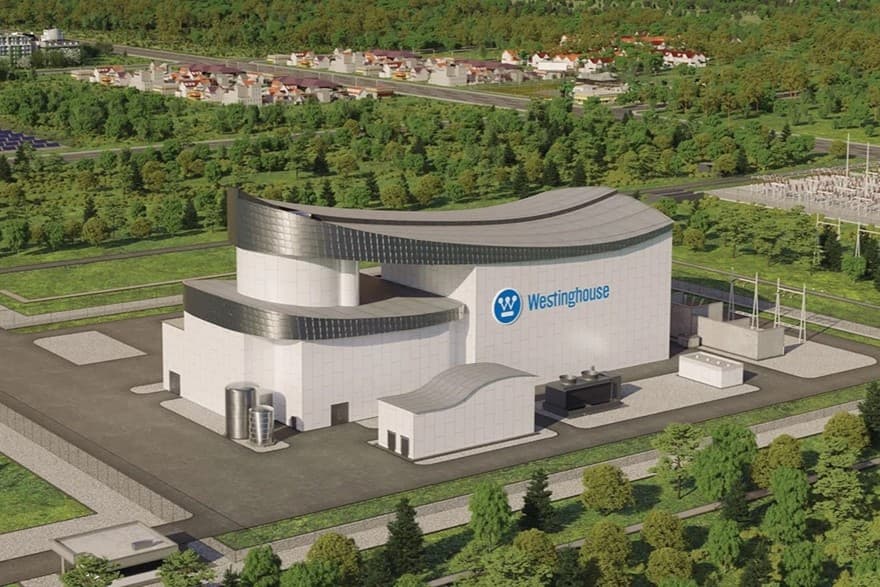
An example of a reactor from the first group that is closest to deployment is the US NuScale project. It is a small modular pressurised water reactor incorporating the core, pressuriser and steam generator inside a single vessel that serves as containment. One module has thermal output of around 200 MWt and electrical output of between 50 and 60 MWe. The module is 25 m long, 4.6 m in diameter and weighs 450 tonnes. Up to 12 modules can be assembled together. In this case, the total thermal output can be converted into up to 720 MWe. The reactor could also be used for heat production and desalination.
Enfission, a joint venture between Lightbridge Corporation and Framatome, will work on developing fuel assemblies using metallic uranium for this reactor. So far, modified HTP2 fuel assemblies using ceramic uranium dioxide have been tested by Framatome. They are shorter than standard fuel assemblies.
In April 2018, the first stage of licence review by the US Nuclear Regulatory Commission (NRC) was completed. Assessment of the reactor's safety parameters was expected in September 2020. The first prototype power plant with twelve modules is to be built at INL (Idaho National Laboratory) in Idaho Falls. Construction was expected to begin in 2021, with commissioning planned for 2027. Pre-licensing assessment of the reactor also began in Canada in 2019.
A number of countries are considering the use of this reactor, including Canada, Romania, Jordan and Saudi Arabia. South Korean company Doosan Heavy Industry is also participating in cooperation on the reactor's development and deployment. ČEZ is also interested in cooperating on the development and use of this reactor.
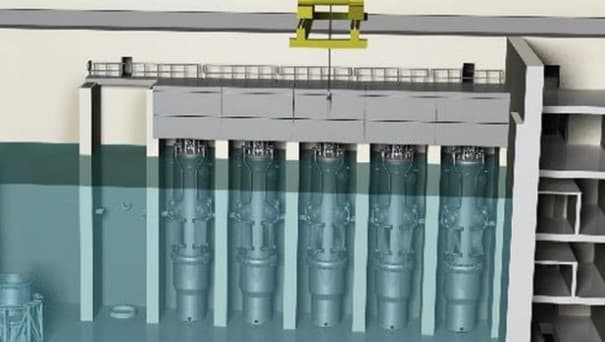
Similarly, Holtec's SMR-160 system falls into this category. Other companies cooperate with it, including Exelon, SNC-Lavalin and Mitsubishi Electric. It is again a pressurised water reactor with an electrical output of 160 MWe, all of whose safety systems are passive and have no moving parts. Cooling can operate for an extended period without human intervention. It will be located underground.
It passed the first stage of a three-stage safety parameter review by the Canadian nuclear safety regulator. The first prototype should also be available in the middle of the 2020s. Ukraine has had very good experience with Holtec, including in building dry storage facilities for spent nuclear fuel at the Chernobyl nuclear power plant site. It therefore wants to participate in the development, manufacturing and deployment of this reactor.
Another small pressurised water reactor is SMART (System-integrated Modular Advanced Reactor), which is being developed by South Korean company KHNP. It has thermal output of 330 MWt and electrical output of 100 MWe. South Korea is negotiating its construction with Saudi Arabia. It should also be available in the second half of the 2020s.
The final example of a pressurised water reactor is a project by UK company Rolls-Royce. As shown in the overview, the United Kingdom is interested in using nuclear energy in its transition to low emissions. Rolls-Royce will therefore use the concept of the reactor it installs in submarines and develop a modular reactor design with electrical output of 440 MWe. However, this capacity places the reactor more in the medium-sized category. The target date for starting the first units in this case is 2029.
The BWRX-300 boiling water reactor offered by US-Japanese company GE-Hitachi is in a similar position. It is again a modification of the company's large conventional boiling water reactors, with an output of 300 MWe. Estonia and Poland are interested in building the first such unit. Estonia began selecting a location for a small modular reactor in 2019. The company promises that the first study will be available in 2020 and the reactor in the second half of the 2020s. ČEZ is also holding preliminary talks with this company on possible cooperation.
Innovative types of small modular reactors
Probably the most interesting and best-known example of an innovative small modular reactor is Bill Gates' TerraPower TWR (Traveling Wave Reactor). It is intended to be a sodium-cooled fast small modular reactor. Its very high fuel burn-up would enable it to operate for up to 60 years without fuel replacement. The fuel would burn progressively like a candle. It could therefore be located underground. However, it should be recalled that a number of technological challenges still need to be resolved for this reactor. These are mainly related to the durability of materials and the entire technology during extremely long operation without external intervention. Bill Gates had planned research on the reactor and its first deployment in China. However, this was prevented by the trade war between the US and China. The project's implementation has therefore become highly uncertain.
The Energy Well innovative small modular reactor project is also being developed by Centrum výzkumu Řež, a subsidiary of ÚJV a.s. in Řež. The 7.5-metre-high unit could be transported to its destination in a standard shipping container. It would use TRISO spherical fuel in a carbon matrix, enriched to 15%. The carbon matrix serves to moderate neutrons. This is the same type of fuel used in high-temperature gas-cooled reactors. However, Energy Well would use FLiBe/NaBF4 molten salts as coolant. It would therefore operate at atmospheric pressure and temperatures of around 700˚ C, with natural coolant circulation and a high degree of passive safety. The fuel replacement interval should be seven years. Its output should be 20 MWt. The design of this Generation IV reactor should be completed in roughly five years.
Colleagues at ÚJV a.s. and CVŘ s.r.o. have been researching the use of molten salts both as reactor coolant and in reactors with liquid salt fuel containing uranium or thorium for a very long time. As this is also an important area for progress in accelerator-driven transmutation technologies, I worked on some aspects with my former graduate student. Details on the use of molten salts in various types of reactors can be found in an earlier article.
Canada is probably the furthest advanced in this field so far. It has a state programme supporting small modular reactors, the “Canadian Small Modular Reactor Roadmap”. In 2018, research organisation CNL (Canadian Nuclear Laboratories) also offered the possibility of building an experimental nuclear reactor at its sites. The reactor would therefore be built at the Chalk River Laboratories site. Around 20 interested parties came forward, of which four have so far advanced to the second round of preparations.
The first of these, Global First Power (GFP), submitted an official application for a licence to build and operate a small nuclear reactor at the end of March 2019. The reactor is called MMR (Micro Modular Reactor). It is a high-temperature gas-cooled reactor with thermal output of 15 MWt and electrical output of 5 MWe. Another reactor is offered by StarCore: a high-temperature gas-cooled reactor with electrical output of 14 MWe. The third is offered by Terrestrial and is a compact IMSR (Integral Molten Salt Reactor) using molten salts, with electrical output of 195 MWe. The fourth is the U-Battery project, again a high-temperature gas-cooled reactor with electrical output of 4 MWe. It is intended to use the aforementioned TRISO fuel. Another reactor on offer is a compact sodium-cooled fast reactor using metallic uranium fuel, designated ACR-100. Its output should be 100 MWe. There is hope that at least a prototype of one of them will be built. The nuclear safety authorities of the US and Canada have agreed to proceed jointly in assessing the safety of some of these projects.
Summary of the small modular reactor situation
As this overview shows, there is currently considerable activity around small modular reactors. The problem, however, is that this is still predominantly a field of visions and paper projects. Projects that are under construction or even nearing completion can be counted on the fingers of one hand, and they are only in Russia and China.
Scaled-down versions of conventional light-water reactors are closer to being realised. Their developers mostly expect them to overcome the financing problems facing today's large reactors. My personal view is that they may not meet this expectation. The financing model depends on the purpose for which a reactor is built. If the objective is a transition to low-emission energy and ensuring a long-term stable electricity supply, a different financing model can be used than when a private investor builds the facility to make a profit in a relatively short time.
In the first case, if political and state support is ensured, radically reducing the cost of insurance and loans and not requiring a rapid return on investment, the cost of the electricity produced is relatively low. The gradual transition to ever larger units was not accidental. If financing costs are set aside, a larger unit is more efficient and the cost per unit of electricity generated is lower.
In the second case, the cost of financing and insurance against risks of non-completion, for example due to political factors, is high. At the same time, a rapid return on investment is the priority. In that case, dividing construction into several modules that are commissioned gradually can also have a considerable financial effect.
In my view, however, small modular reactors will be successful if they penetrate the field of smaller local power plants and heating plants. An important condition is the establishment of factory-based production in large series. Another condition is that their licensing process must be simpler than for large nuclear units. When commercial and competitive models will be available on the market therefore remains an open question.
The licensing process for innovative reactor types is an even bigger question. Most projects here are only at the development stage. The regulatory conditions for them are also still “in development”. Here there is an opportunity to approach the concept of a compact, long-lasting “battery” that is replaced only once every many years. This could bring a breakthrough in the potential for decentralised use and in economics. However, the first commercial models will probably take much longer to arrive.
Personally, however, I believe that even with the successful deployment of small modular reactors, they will not displace large Generation III reactors. The two types will complement each other and, together with renewable energy sources, should contribute to the transition to a low-emission society.
Translation disclaimer
This article is a machine translation of the Czech original and has not yet been fully reviewed. In case of any doubt, please refer to the Czech version.
Sdílejte článek prostřednictvím:
You might also like
23 October 2026, 11:01
23 October 2026, 06:34