Czech community charging: how to drive cheaply without your own source
Few photovoltaic owners now dispute the benefits of an electric car. But what if you cannot have photovoltaics? Surprisingly simple solutions exist for these users too.
In previous articles, I discussed ways of using a home photovoltaic system to charge electric vehicles. As of 30 June 2025, there were nearly 230,000 such installations, with thousands more being added, meaning that almost every tenth house is now equipped with a small photovoltaic system. Although this number will continue to grow, it cannot be expected that every building will be equipped with such a system. Whether it is impossible to cover a roof with panels for financial, technical or legislative reasons, there are still countless ways to gain at least partial access to cheap electricity without the need for an installation.
Community energy
One solution is community electricity sharing. The most common model is that of an active customer, in which a group of photovoltaic owners typically joins several consumers in a small community. This is a group of up to eleven metering points that generate electricity jointly and share it among themselves. To use this type of sharing effectively, participants need to be able to plan at least part of their consumption for times when other members of the group are generating electricity – scheduling appliances such as dishwashers, washing machines, boilers or air conditioning for around midday. However, even this shifting may not be sufficient when larger installations are involved. If the group includes 3-4 active generators with what is now a common 10kWp installation, ordinary household appliances cannot consume such a volume of energy. An electric vehicle user, ideally one able to work from home, can therefore become a highly sought-after “match” for a group of active customers, as they can very effectively store some of the surpluses that would otherwise go unused.
As for the price of sharing, this is set by the community participants themselves and can be around 1-2 Kč/kWh. Consumers can therefore save a similar amount per kWh compared with standard tariffs. It should be stressed that this applies only to the energy commodity component of electricity. Consumers pay the distribution component in the same way as under a conventional tariff.
Community charging
Sharing through community energy is simple and convenient. However, as noted above, consumers pay standard distribution charges, ranging from around 0.8 under electric-heating tariffs to around 4 Kč/kWh under standard D01/02d tariffs. With various storage tariffs, or the Electric Mobility Tariff, sharing can create complications concerning the switching of the low tariff, which does not necessarily coincide with generation within the community.
This is where an alternative way of sharing electricity, in the form of “community charging”, comes into play. Unlike household appliances, an electric vehicle can be driven somewhere or easily connected with a charging cable. If, for example, a photovoltaic owner lives next door to an electric vehicle user, there is little point in sharing electricity through community energy and paying transmission charges when the car can simply be charged at the neighbour’s house, or a heavy-duty extension lead can be run over the fence. Newer buildings in particular also commonly have their main circuit breaker located in a pillar at the property boundary, making it easily accessible from the street. These pillars are often fitted with a three-phase socket, or one can easily be installed on them. We therefore have de facto hundreds of thousands of charging points on our streets; we just do not know about them yet. Community charging can thus often be arranged simply by moving the car within the street, without having to drive into someone’s yard. Various social media groups already exist for community charging, where generators connect with potential charging users.
Summer with community charging
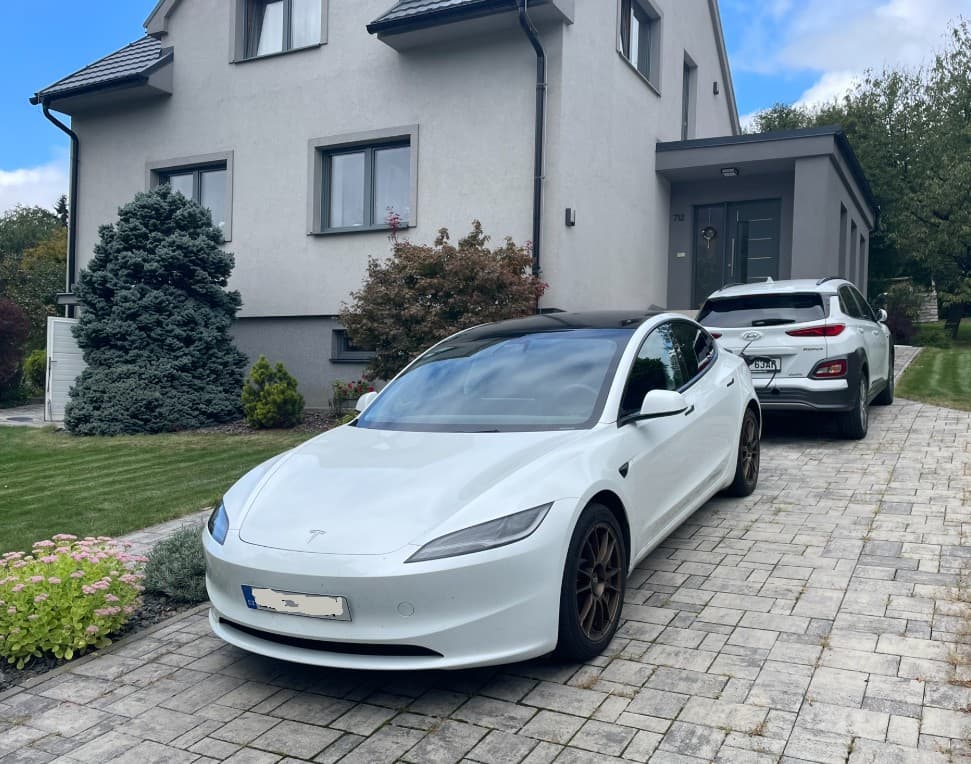
As I described in this article, electricity purchase prices around midday during the summer months are very low. Negative prices, especially at weekends, are not unusual. As a photovoltaic owner, community charging is therefore an attractive way for me to use otherwise unwanted surpluses. In spring 2025, I decided to try offering charging to someone else. At weekends, I have an arrangement with an acquaintance who comes to charge his car. If the sun is shining, charging takes place directly from the system; if not, the car is charged from the grid at spot prices. The only condition is charging roughly between 10 am and 4 pm, when electricity prices from March to October rarely exceed 2Kč, including distribution and other charges. If prices are occasionally higher, we agree on another day. In practice, this means that about once a week, by arrangement, the driver takes the car to be charged, usually combining it with a walk in the area. In return for this “inconvenience”, they can drive for up to 50 haléřů per km. In practice, around 600 kWh of electricity was charged between May and September, enough for the particular model to travel 4000 km. The driver typically takes away around 40-50 kWh of charged electricity, with some weekends missed, so average consumption reaches around 30 kWh per week. Given that the car owner does not live right next door, the total volume is relatively high. In short, driving a few hundred metres has not proved to be a major obstacle. If it does not work out on a particular weekend, the user still has the option of charging at home. The price is higher than with community charging, but still significantly lower than driving on petrol.
A shared wallbox in the yard
With the charging described above, there is still the option of charging the vehicle at home. Residents of apartment buildings, who rely solely on more expensive public chargers, have an even greater incentive. Particularly in smaller towns, apartment buildings and family homes stand in close proximity, so the possibility of charging nearby can be very attractive for apartment residents. With public charging prices around 8 Kč/kWh, the community charging price can be set at 4-5 Kč, while no photovoltaic system can achieve such high purchase prices during the day. For owners of family homes, community charging can be a good financial opportunity to increase the efficiency of their home installation.
Homeowners’ associations (SVJ) can proceed in the same way. The image below shows a typical apartment building in a smaller town. Its large south-west-facing gable roof provides space for dozens of kWp of panels. There is also enough room in the yard to establish a community wallbox. Technical allocation among individual users is possible using chips. In such a case, a very favourable price per kWh can be set, for example during the day. Community charging can then significantly improve the economics of the shared photovoltaic system for the given homeowners’ association.
A similar situation arises with public buildings. An example is a primary school, where the school campus and adjacent swimming pool are equipped with a 120kWp PV system and a cogeneration unit of the same capacity. The school’s electricity consumption and available roof space would allow for a larger PV system. However, an increase in capacity is held back mainly by economic reasons, because operations at the site are significantly limited when the system’s generation is at its peak – there are no classes, canteen operations are reduced to a minimum, and pool operations are also limited due to summer maintenance. While increased system capacity would contribute to greater self-sufficiency in winter, it would also generate unusable surpluses in summer, significantly reducing the overall efficiency of the investment. If community charging were established at this site with preferential prices during school holidays and weekends, these surpluses could be largely utilised and the overall PV capacity could be increased substantially.
The examples also show that taxation of electric vehicle operation will not be able to work on the principle of fuel taxation, and another form will need to be found. Some form of road tax appears most likely. This form of taxation has further advantages, such as the possibility of setting the tax according to vehicle size, which would favour smaller vehicles that take up less space on the streets.
Translation disclaimer
This article is a machine translation of the Czech original and has not yet been fully reviewed. In case of any doubt, please refer to the Czech version.