
23 October 2026, 14:38
Loading...
Earth Day – 45 years of false predictions
Vítězslav Kremlík
28 April 2016, 18:22
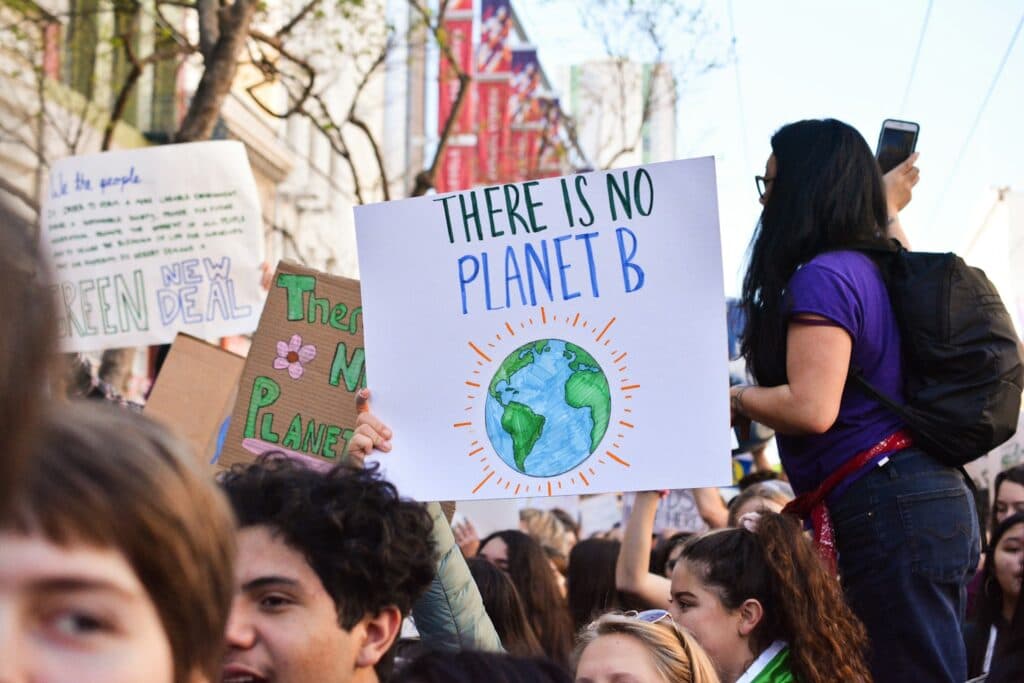
On Earth Day 2016, representatives of more than 170 countries signed the international climate agreement negotiated in Paris in December. US representative John Kerry brought his tiny granddaughter along with his pen to sign it, seemingly as a hostage. Using defenceless small children – who cannot defend themselves – to emotionally blackmail the public is a tried-and-tested method.
UN Secretary-General Ban Ki-Moon said: “It is a race against time. The era of consumption without consequences is over.” In reality, the opposite is true. Fossil fuels are cheaper and more accessible than ever before. Even though we have for years heard predictions from people like him that fossil fuels would become scarcer and their prices would rise.

When, in 1970 – on the hundredth anniversary of Lenin’s birth – left-wing activists declared the first Earth Day, they predicted a terrible future for the planet. They warned that unless we handed power and money over to the comrades, things would end badly for us.
Ronald Bailey gives a number of examples in his extensive article “Earth Day Then and Now” (Reason, 2000):
- Harvard biologist George Wald estimated that “civilisation will end within 15 or 30 years unless immediate action is taken against problems facing mankind.”
- “We are in an environmental crisis which threatens the survival of this nation, and of the world as a suitable place of human habitation,” wrote Barry Commoner, a biologist at Washington University, in Environment magazine.
- The day after the first Earth Day, a New York Times editorial warned: “Man must stop pollution and conserve his resources. Not merely to enhance the quality of life but to save the race from intolerable deterioration and possible extinction.”
- “Population will inevitably and completely outstrip whatever small increases in food supplies we make,” Paul Ehrlich declared in April 1970. “The death rate will increase until at least 100-200 million people per year will be starving to death during the next ten years.”
- Ehrlich published his most frightening scenario in The Progressive magazine on Earth Day 1970. He warned that some 4 billion people, including 65 million Americans, would perish in a great wave of famines between 1980 and 1989.
- “It is already too late to avoid mass starvation,” Denis Hayes, the chief organiser of Earth Day, declared in The Living Wilderness magazine in the spring of 1970.
- Peter Gunter, a professor at North Texas State University, wrote in 1970: “Demographers agree on the following grim outlook: widespread famines will begin in India by 1975; by 1990 famine will have spread to all of India, Pakistan, China and the Near East, Africa. By 2000, or sooner, widespread famine will engulf South and Central America… By 2000, in thirty years’ time, the entire world, with the exception of Western Europe, North America and Australia, will be starving.”
- In January 1970, Life magazine wrote: “Scientists have solid experimental and theoretical evidence… to support the following predictions: In a decade, urban dwellers will have to wear gas masks to survive air pollution… by 1985 air pollution will have reduced the amount of sunlight reaching Earth by one half…”
- Barry Commoner predicted that biodegradable organic pollutants would use up all the oxygen in US rivers, causing freshwater fish to suffocate.
- Ecologist Kenneth Watt declared: “If present trends continue, we will be using up oil at such a rate that there will be no more by the year 2000. You will drive up to the filling station and say, ‘Fill ’er up, buddy,’ and he will say, ‘I am very sorry, there isn’t any.’”
- Harrison Brown, a scientist at the National Academy of Sciences, published a chart in Scientific American analysing that humanity would run out of copper reserves shortly after 2000. Lead, zinc, tin, gold and silver would be exhausted by 1990.
- Dr S. Dillon Ripley, head of the leading natural history museum, the Smithsonian Institution, expressed the opinion in 1970 that 75 to 80 percent of animal species would become extinct within 25 years.
- Kenneth Watt warned of an approaching ice age. “The world has been steadily cooling for the past twenty years. If present trends continue, the world will be about four degrees colder by 1990. By 2000, it will be eleven degrees colder. That is twice what it would take to trigger a new ice age.”
Let us remember these false predictions from the first Earth Day in 1970 whenever we hear today’s scientists and their “guaranteed true” prophecies.
This, for example, is from the Earth Day 2015 website:
“Scientists warn that climate change could accelerate out of control. It would then threaten our survival and that of our loved ones. We therefore urge you to keep the rise in global temperature below the dangerous level of 2°C. By bringing carbon pollution down to zero. This requires the urgent adoption of global and national commitments to radically transform society and the economy to 100% clean energy by 2050.”
Let us consider how our descendants might view these statements in fifty years’ time. They will most likely find them laughable. Even if fossil fuels continue to be used, the world will still be a safer place, with less poverty and less malnutrition. The number of undernourished people in developing countries has fallen by nearly half since 1990, from 23,3 percent in 1990-1992 to 12,9 percent today (2014-2016). Is this supposed to be the „catastrophe“ in the era of global warming?
One thing will not change, however. There will still be a highly influential group of doomsayers who will keep predicting the end of the world. Scare people to death and then – for a hefty sum – offer them a “solution”. It is a tried-and-tested model for extracting money from people. So why change it, right?
In May, the documentary satire “Climate Hustle” will be released in US cinemas, poking fun at precisely those “guaranteed predictions” fed to us by the media and so-called experts.
More at www.klimaskeptik.cz
Translation disclaimer
This article is a machine translation of the Czech original and has not yet been fully reviewed. In case of any doubt, please refer to the Czech version.
Sdílejte článek prostřednictvím:
Topics:Opinion
You might also like


23 October 2026, 11:01


23 October 2026, 06:34