
23 October 2026, 14:38
Loading...
Finally, nuclear reactors are being built without delays—at least in China
Vladimír Wagner
3 June 2019, 17:15
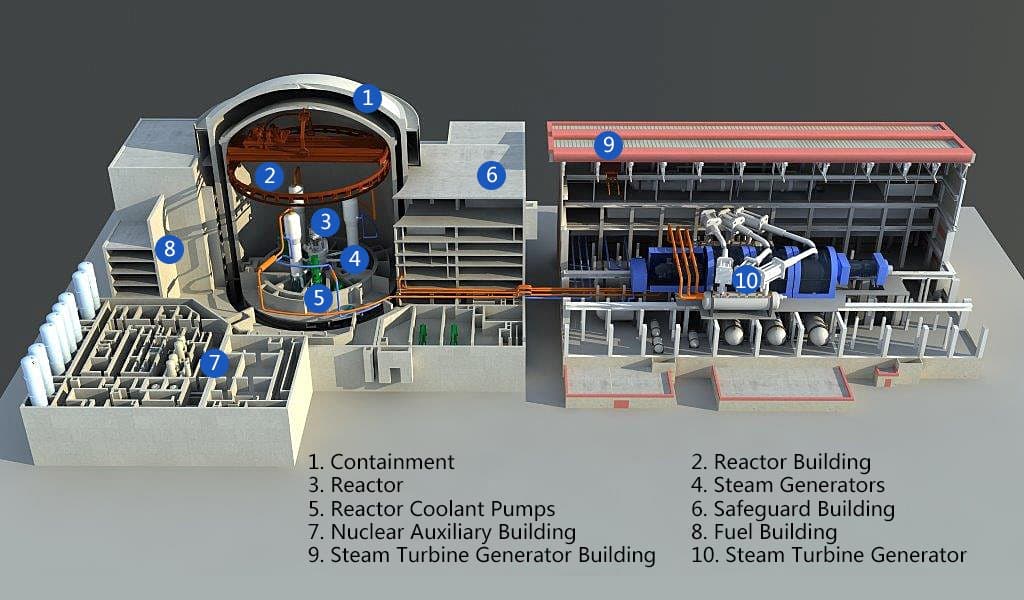
In China, cold testing has begun at the first reference HPR1000 (Hualong One) unit. Construction of this reactor is ahead of schedule, and work on the other units of this type is also progressing very well so far. The HPR1000 appears set to become China’s flagship Generation III reactor.
The advanced pressurised water reactor is the culmination of efforts to develop a unified Chinese design. Primary cooling is provided by three cooling loops with reactor coolant pumps and steam generators. The core consists of 177 fuel assemblies, with refuelling outages at intervals of 18 to 24 months. Thermal output is around 3100 MWt, gross electrical output around 1160 MWe and net output 1090 MWe. Efficiency is therefore roughly 36%. With its double containment, emphasis on passive features and expected service life exceeding 60 years, the reactor meets all the requirements for a Generation III+ facility.
It is a national project bringing together the designs of two major Chinese companies, CGN (China General Nuclear Power Corporation) and CNNC (China National Nuclear Corporation). The resulting HPR1000 (CGN) and Hualong One (CNNC) units differ slightly. CGN is building two units of its version at Fangchenggang 3 and 4. These are also intended to serve as reference units for the Bradwell B plant. Construction of Fangchenggang 3 began in December 2015. CNNC used its version for the Fuqing 5 and 6 units. Construction of the first of these began in May 2015.
Initial projections from 2016 were that fuel would be loaded into the Fuqing 5 reactor in January 2020. However, the current progress ahead of schedule suggests this could happen as early as this year. Cold testing began 50 days earlier than planned. That would mean completing the reactor in 4.5 years. If developments at Fuqing 6 are equally successful, as they appear to be so far, this would be quite an exceptional situation for the first reference Generation III reactor units.
CGN initially faced problems and delays with concrete pouring during construction of Fangchenggang 3 and 4. This was because the work was awarded to a company new to this field. Although the delay has gradually been reduced, it still amounts to roughly half a year. On the other hand, China, which plans to step up construction of nuclear capacity at home and abroad, needs to bring new capabilities into the sector. It will be interesting to see how soon the Fangchenggang units start up after the Fuqing units. In any event, they too are likely to have construction periods close to five years. If such construction times can be achieved as standard, that is precisely what Generation III reactors should deliver.
That such speed should also be achievable abroad is demonstrated by the progress of construction on two Hualong One reactors at Pakistan’s Karachi plant. Construction of units 2 and 3 is progressing very well there; work on the second unit began in August 2015 and on the third in May 2016. Greater time demands can be expected when commissioning the first units abroad. If the second unit could be completed as early as next year, it would be a major success. Construction of another Hualong One reactor is being prepared at Pakistan’s Chashma plant.
In China itself, construction of HPR1000 (Hualong One) reactors is being prepared at several locations. Concrete pouring for no fewer than four new units should begin this year or at the turn of 2019 and 2020. These are Zhangzhou 1, Changjiang 3 and 4, which will be built by CNNC, and Huizhou/Taipingling 1, to be developed by CGN. A number of units of this type are also planned and under preparation, including Fangchenggang 5 and 6, Zhangzhou 2, 3 and 4, and Ningde 5 and 6. After the successful completion of the reference units, the launch of construction on new ones could accelerate.
An important step in China’s expansion into Europe is the recent start-up of the second EPR reactor at the Taishan plant. The fission chain reaction began there on 28 May 2019. The two EPR units were completed through cooperation between France’s EDF and China’s CGN. They are the first two reactors of this type to enter operation. It should be added that two other units under completion could start up by the end of the year or at the turn of 2019 and 2020. Fuel should be loaded into the core of the Olkiluoto 3 reactor in June, provided asphalt vibration dampers can be installed in time. It could begin producing electricity in October 2019, although this is more likely to happen at the turn of 2019 and 2020. Fuel could be loaded into the Flamanville unit by the end of 2019.
The cooperation between EDF and CGN also involves another pair of EPR units at Hinkley Point C. Once the project in China is completed, attention can turn to projects in the United Kingdom. There, the companies would also like to develop two EPR units at Sizewell C and two Hualong One units at Bradwell B. Intensive work is under way to prepare both projects, and their successful implementation could open the way for the Hualong One reactor into the European energy market.
The UK licensing process moved from the second to the third phase at the end of 2018. The first and second phases assessed fundamental safety characteristics and environmental impacts. No problems were identified in these areas. The design therefore advanced to the third phase of the Generic Design Assessment (GDA). In the third phase, the design will be assessed in greater detail, and the public will again be able to comment on individual steps of the assessment. Completion of the entire GDA process is expected in 2021. Work is also under way on EUR (European Utility Requirements) certification for the reactor.
Hualong One translates as Chinese Dragon 1. It seems that the new Chinese reactor has a fitting name and could become a fast dragon in both the Chinese and global context, helping to launch a renaissance of nuclear energy. China is one of the largest emitters of carbon dioxide. The success of Chinese Dragon 1 in China and other rapidly developing countries, together with the development of other low-emission sources, could be key to sharply reducing the use of fossil fuels. It could also improve the overall environmental situation, access to electricity and living standards in these countries.
Note: We recently had a discussion with Honza Horáček from the Institute of Plasma Physics about the future of nuclear energy use at Science Café. First Honza spoke about fusion, followed by me on fission reactors. The recording is available here: https://slideslive.com/38916074/co-prinese-nova-era-jaderne-energie .
Written for oEnergetice and Osel
Featured photo: Taishan plant now has two EPR units in operation (source: CGN)
Translation disclaimer
This article is a machine translation of the Czech original and has not yet been fully reviewed. In case of any doubt, please refer to the Czech version.
Sdílejte článek prostřednictvím:
You might also like
23 October 2026, 11:01

23 October 2026, 06:34