23 October 2026, 14:38
Loading...
Fukushima Daiichi at the start of 2024
Vladimír Wagner
17 February 2024, 12:22
Approval and the start of discharging tritiated water into the ocean are crucial for the next steps in addressing the consequences of the accident at the Fukushima Daiichi power plant. This will help empty and dismantle the wastewater tanks, freeing up space for facilities needed to begin decommissioning the damaged reactors. Knowledge of the situation inside their containments is gradually becoming more precise. This makes it possible to refine the account of the first hours and days of the accident and develop a procedure for decommissioning the destroyed reactor cores.
In the middle of last year, the latest overview of the progress in dealing with the consequences of the accident at the Fukushima Daiichi nuclear power plant was published. In our long-running series, which follows both the accident and efforts to address its consequences, let us look at how the work has progressed.
Discharge of tritiated water
The article mentioned above, published at the beginning of July 2023, reported that the International Atomic Energy Agency had approved the methodology for discharging tritiated water from the Fukushima Daiichi plant site. The procedures used are discussed there in detail. Their use ensures that no health limits are exceeded during discharge and that annual tritium releases do not exceed the levels reached by the plant during normal operation.
In July 2023, the International Atomic Energy Agency (IAEA) opened an office at the plant site. It will continuously monitor the tritiated-water discharge process. The discharge also has a dedicated IAEA webpage. Preparations for the discharge began at the end of August 2023. First, one tonne of water was mixed with around 1,200 tonnes of seawater. After verification that tritium activity was below 1,500 Bq/l, it was released into the sea.
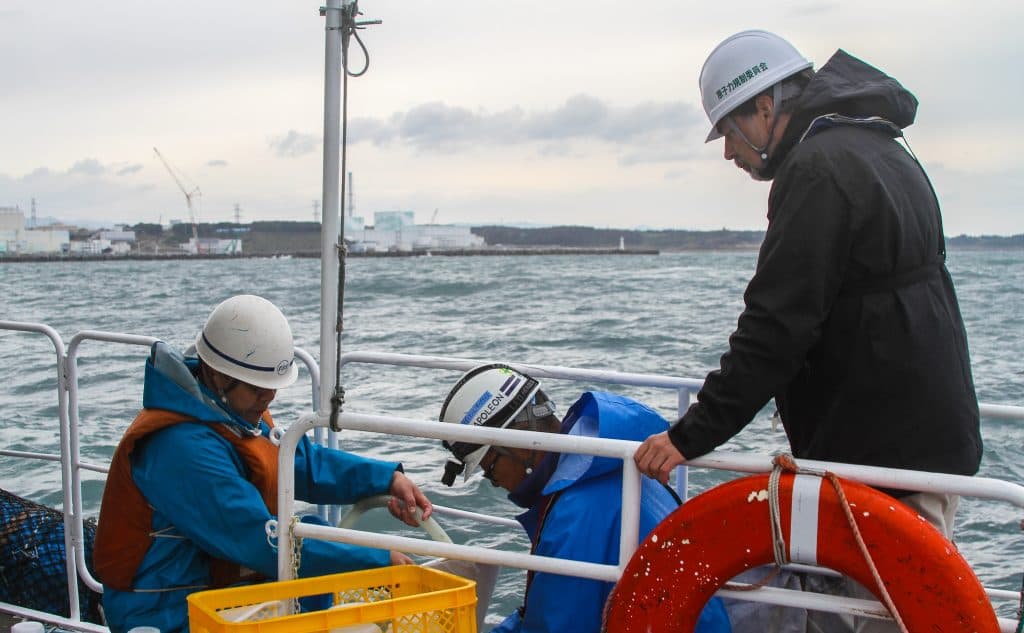
On 24 August, the first continuous discharge of tritiated water into the sea began under close IAEA supervision. During it, IAEA representatives and TEPCO employees collected and checked seawater samples from around Fukushima Daiichi. All samples were found to be satisfactory from a health perspective, and tritium levels did not increase during the discharge.
The second period of tritiated-water discharge began on 5 October 2023. It lasted 17 days, during which around 7,800 tonnes of tritiated water were diluted and discharged. Tritium activity in one tonne of this water was 140 kBq. Around 9 million tonnes of seawater were used for dilution. A total of 1.1 GBq was thus discharged. Extensive sampling in the vicinity of the discharge location was carried out before it began.
To date, three discharges have been carried out, with the third ending on 21 November 2023. A total of 23,400 tonnes of tritiated water have been removed from the tanks. IAEA staff recently presented inspection results showing that the process fully complies with all international standards and health regulations. It should be recalled that not only tritium is monitored, but also other radionuclides, namely 14C, 54Mn, 55Fe, 60Co, 63Ni, 79Se, 90Sr, 90Y, 99Tc, 106Ru, 125Sb, 125mTe, 129I, 134Cs, 137Cs, 144Ce, 147Pm, 151Sm, 154Eu, 155Eu, 234Eu, 234U, 238U, 237Np, 238Pu, 239Pu, 240Pu, 241Pu, 241Am and 244Cm.
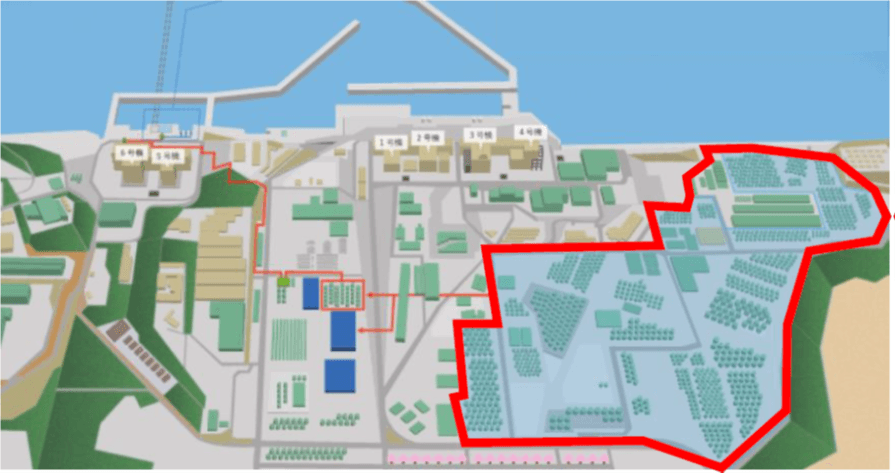
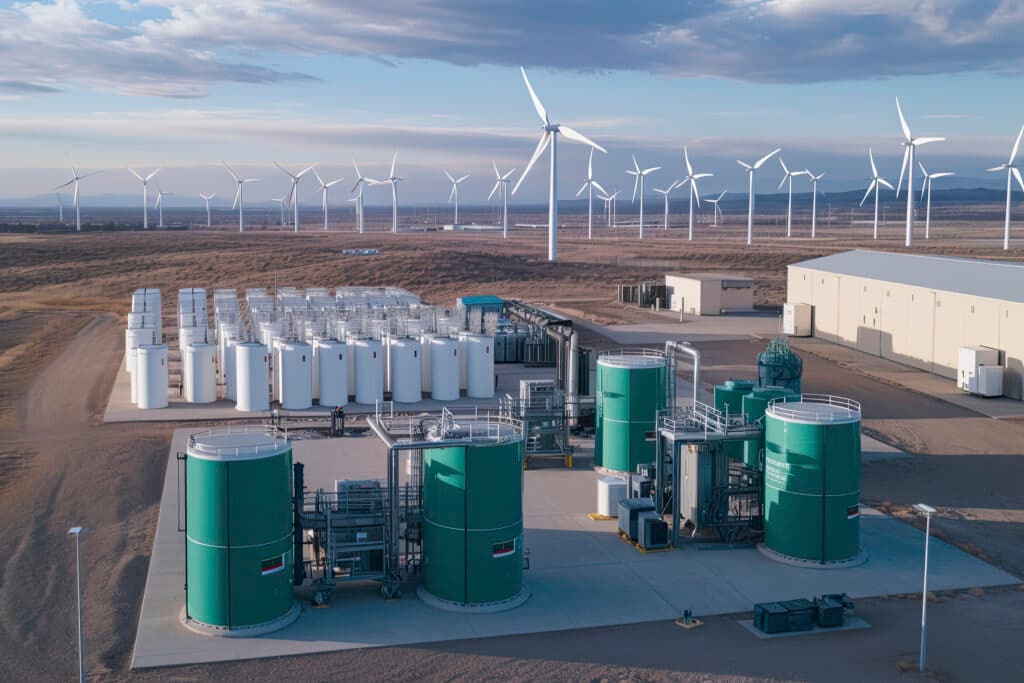
Area containing the tritiated-water tanks, which could be freed up for other uses by the discharges (source: TEPCO).
It is interesting to compare the volume of discharged water with the volume being generated. It should be recalled that this is not only water from reactor cooling; the dominant component is groundwater that enters heavily contaminated areas near the damaged reactors. In 2014, around 540 tonnes of contaminated water per day had to be pumped out and stored. Thanks to a number of measures, including the ice wall, this was reduced to around 90 tonnes per day by 2022. The target for 2028 is between 50 and 70 tonnes per day. The discharge of the aforementioned 23,400 tonnes took place over roughly five months, although actual discharges took place for around 50 days. Around 13,500 tonnes of new contaminated water accumulated over five months. It is clear that the volume of water discharged so far is comparable to the volume being added. However, this is still testing, and the continuous ongoing discharge regime has yet to be established.
A fourth discharge period could take place as early as February 2024. It should again last 17 days and involve around 7,800 tonnes of tritiated water.
Overall, the site has 1.37 million cubic metres of tank capacity, which was almost completely full in 2023. At the end of June 2023, 35% of this volume had been fully treated and prepared for discharge. For 65%, the water still exceeded health limits for radionuclides other than tritium. This water will have to pass through the ALPS (Advanced Liquid Processing System) again to remove the contamination. The early start of discharges was critical given the near-full capacity of the available tanks. In addition, preparations are gradually being made for a period when the interior spaces of the damaged reactors will be intensively decontaminated, their highly radioactive components removed and the gradual decommissioning of the destroyed cores begun. More extensive areas are therefore needed to handle radioactive material, sort it and place it in containers for further processing and disposal.
It is very important that TEPCO and the Japanese authorities are making intensive efforts to explain the safety of the discharges, while the entire process is also monitored by fishermen. At the end of the year, Satoshi Nozaki, chairman of the Fukushima Fisheries Association, was able to state that the fishing industry had not been affected by the tritiated-water discharge and that customers had not lost confidence in seafood from waters around Fukushima.
Two incidents show that it is necessary to maintain a constant focus on safety when handling radioactive materials and that accidents cannot be entirely avoided. The first occurred at the end of October 2023 during cleaning of ALPS facility piping, when four employees of a contractor were splashed with radioactive liquid after a hose came loose. At the beginning of February 2024, radioactive liquid leaked from piping in a system transporting radioactive water. Around 5 tonnes of water leaked, but it remained contained beneath the pipework. Following the clean-up, soil at the site is also being checked.
Survey work and preparations for decommissioning damaged reactors
We now have extensive knowledge of the condition of the damaged reactors and, consequently, a better idea of how their destruction unfolded during the accident.
Unit 1 was the most severely damaged. Almost the entire melted core flowed not only to the bottom of the reactor vessel, but melted through it, with the corium reaching the floor of the primary containment. The absence of the core from its expected location was confirmed by a study using cosmic muons in 2015. In this case, the findings confirm very rapid progression of the destruction during the first day of the accident. We wrote in detail in this series about robotic surveys of the containment interior. The first survey took place on a grating floor at an intermediate level, where damage and deposits originating from the accident were found. Subsequent sampling of the deposits showed the presence of uranium and corrosion products. Examination of the concrete pedestal supporting the reactor vessel showed substantial damage and deposits up to one metre deep. In boiling-water reactors, the control-rod drive mechanism is located at the bottom of the reactor vessel. In Unit 1, it was severely damaged by corium from the reactor core. Parts of it are also located in the lower part of the pedestal supporting the reactor vessel. Significant damage to the concrete pedestal, including exposed steel reinforcement, observed during the survey in March 2023, was described in the previous overview. In this reactor, water in the primary containment reaches a height of around 2 m, and the suppression chamber is almost full of water.
In Unit 2, melting occurred three days after the tsunami struck. Most of the core is assumed to have melted. Very little material remained at its original location, and this is around the original edges, where cooling during emergency water injection was somewhat better. This is also indicated by the survey using cosmic muons. If any fuel assemblies did not melt completely, they are located at the periphery of the core. A large part of the solidified corium, mostly in the form of oxides, is in the lower part of the reactor pressure vessel, with the rest on the floor of the primary containment. Robots have even touched it there (here). Samples of deposits were later successfully collected. Part of the control-rod drive system was preserved, and its external parts were observed during containment surveys (here). Part of the grating floor at the intermediate level has holes, indicating that holes melted through the reactor vessel. Damage to the reactor's concrete pedestal is limited in this unit. A number of structures and facilities in these areas have remained largely intact, as confirmed by surveys of the inner sections of the containment. Water in its primary containment reaches only around 0.3 m, while the suppression chamber is half full of water.
In Unit 3, melting occurred less than two days after the tsunami. In this case too, the dominant portion of the core melted. Some of its remnants are at the original location; if any fuel assemblies survived, they are at its edge. Part of the corium reached the bottom of the reactor vessel, while part is on the floor of the primary containment. The location of some core remnants at the bottom of the reactor vessel is also indicated by cosmic-muon studies. The lower part of the reactor vessel melted through in several places. Surveys showed that the concrete pedestal was damaged more than in Unit 2 but far less than in Unit 1. There is a pile of debris in the central section. In this reactor, water in the primary containment reaches a height of around 4 m, and the suppression chamber is full of water.
Damage to the reactor-vessel pedestal is greatest in Unit 1, less severe in Unit 3 and least severe in Unit 2. This is also why the removal of solidified corium from the containment is expected to begin with Unit 2.
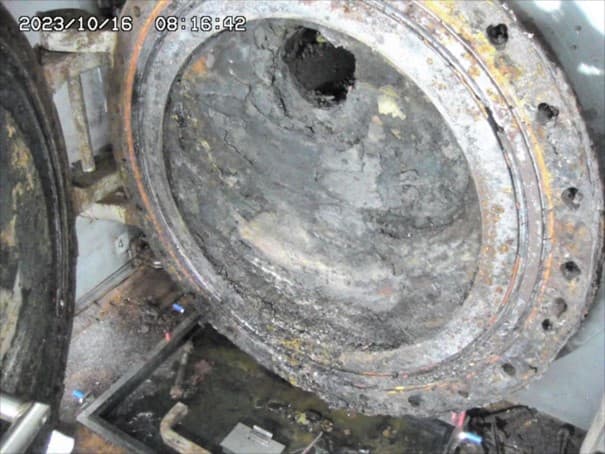
X-16 containment penetration blocked by deposits. A hole punched through them is visible (source: TEPCO).
Removal of molten-core remnants, initially test samples, could begin at the aforementioned Unit 2 as early as this year. In October 2023, the X-6 penetration into the containment, through which a robotic arm was to enter, was inspected. The penetration, with a diameter of around 55 cm, was found to be almost completely filled with deposits. It was therefore necessary to clear the deposits from the penetration. In January 2024, a water-pressure device capable of low-pressure and high-pressure modes was used for this purpose.
Robots are used extensively in addressing the consequences of the Fukushima Daiichi accident. In the second half of January 2023, several types of drones intended to operate at the site and inside buildings and containments were tested. There were two types. One is a small drone equipped with a high-resolution camera that can map conditions even in very confined spaces. The other robot is snake-shaped and provides communication with the first drone. Their combined system is expected to investigate conditions inside the Unit 1 containment. So far, they have been tested at the research centre in Naraha, which we have covered in our overviews. High radiation resistance is crucial for them.
The Naraha robot research centre also hosted the 8th annual competition of creative robots for nuclear facility decommissioning at the end of 2023, for students from technical schools across Japan. A total of 17 teams from 13 technical colleges participated. The competition simulated decontamination of a highly radioactive area in a Fukushima nuclear power plant reactor building. In the contest, each robot moves to a designated location, climbs over set obstacles and performs assigned tasks.
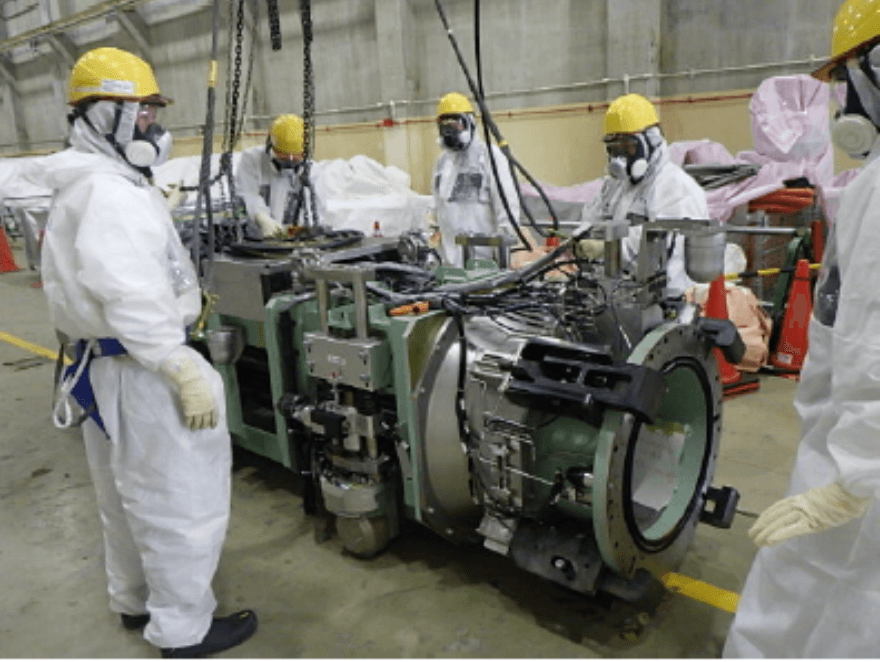
Equipment for clearing a penetration using pressurised water (source: TEPCO).
Reconstruction of affected areas
By the end of 2024, standards should be developed for the final disposal and recycling of soil accumulated during decontamination, allowing it to be used and stored outside Fukushima Prefecture as well. This is an important element in completing the revitalisation of decontaminated areas and the final management of the accident's consequences.
Reconstruction continues in the heavily affected areas of the three worst-hit towns of Okuma, Futaba and Namie. The town of Tomioka also has a larger residential area in the heavily affected zone. At the end of 2023, specific areas designated for residents' return began to be expanded in the heavily affected parts of these towns. The focus is mainly on the reconstruction and construction of residential areas, as well as necessary infrastructure. They build on the reconstruction bases discussed in the previous instalments of this series. These are the seeds of people's return to these areas. Maximum resources are now being directed towards revitalising these areas, as well as developing fisheries and agriculture. Entry restrictions and mandatory evacuations have gradually been lifted at reconstruction bases in six towns and villages (Tomioka, Okuma, Futaba, Namie, Katsurao and Iitate). Residents are now beginning to return permanently, though initially only very slowly. By November 2023, fewer than 300 people had done so.
As areas close to the sea are reopened and people return, evacuation centres need to be prepared in the event of another tsunami. One such centre has been completed in Namie, at the Murohara reconstruction base, which is intended to be a seed for the return of residents to these heavily affected places. It is located near the Joban Expressway. The new evacuation centre will accommodate 500 people if needed, while its car park will hold 250 vehicles. In normal times, it is intended to serve as a meeting place and venue for social events. The centre is expected to open in April 2024.
The town of Namie has also proposed opening further areas in heavily affected zones for priority revitalisation. These were selected with regard to residents who want to return. In total, 710 ha were selected, representing around 30% of the habitable area in Namie's heavily affected zones. This concerns not only residential buildings but also infrastructure and facilities. Decontamination should begin in the first quarter of 2024.
This should be followed by the construction of an academic campus and education centre, housing a number of educational institutions that would provide facilities for international research centres focused on robotics, decontamination and nuclear facility decommissioning, which have already been discussed in this series. Alongside fisheries and agriculture, this will support technological and industrial development in revitalised areas.
Okuma was the second town most heavily affected by the accident after Futaba. The Fukushima Daiichi plant is located on the border between these towns. At the beginning of February 2024, it was decided to expand the area undergoing reconstruction and revitalisation in the town's most heavily affected areas by a further 380 ha, bringing the total to 440 ha. This is the first expansion of these return-designated areas in the town's most heavily affected zones. Wherever possible, efforts were made to prioritise places with properties belonging to people who want to return, along with the necessary facilities.
A sign of the return is the reopening of Sai Shrine, located in Okuma's heavily affected areas. It was damaged in the earthquake, reconstructed in recent years, and in November 2023 drums sounded there again for the first time in thirteen years during the traditional Nenbutsu dance. This too is a sign that life is returning even to the worst-affected places.
Likewise, the first rice harvests in the Kuma area of Okuma, which have now moved from the trial phase to a demonstration phase. Trials have been underway since 2020. In the demonstration phase, grain may be sold for consumption after radioactivity testing, provided that radioactivity health limits are met. A transition to a standard harvesting and sales regime is expected in 2025.
A major problem is the availability of jobs for returning people. This makes the opening of an industrial park at the existing reconstruction base in Shimonokami a very important development for Okuma. The approximately 9 ha site contains 12 plots. Two companies, one in communications and the other in agriculture, have already begun preparations to use them. The industrial park has good connections to the expressway network and will make a significant contribution to expanding employment opportunities. It is another step towards the return of people to the worst-hit towns.
In the aforementioned town of Futaba, the Shohatsu Shrine reopened, and the Kagura dedication festival was held there at the beginning of 2024 for the first time since the earthquake and accident. This is another sign of the gradual return of people to this worst-hit town.
The town of Tomioka has drawn up a plan to extend revitalisation and reconstruction work to the entire Oragahama and Fukaya districts, so that residents can return to them.
Another symbol of return is the restoration, in early February 2024, of the bean-throwing festival tradition at Hosenji Temple in Tomioka, 13 years after the accident. Soybeans are thrown to drive away evil spirits and invite good fortune. Until the accident, the event had taken place every year on the first Sunday in February. Hosenji Temple is known for its weeping cherry tree, estimated to be 900 years old. The current festival, intended to bring good fortune to participants, was attended by 50 residents. The temple's main hall was damaged by the earthquake and affected by the power plant accident. It was rebuilt in 2021 and the temple is now operational.
Agriculture is also being restored in Tomioka. This is being closely linked with the development of photovoltaics into agrivoltaics. Solar PV is a very important element of revitalisation in affected areas, as they contain vacant land that has few better uses.
At the end of 2022, the area in the former evacuation zone returned to agricultural production was around 8,015 ha, representing 46.3% of the agricultural land that had originally been abandoned. As already mentioned, agriculture in this case is very often combined with photovoltaics.
Japanese nuclear power
The restoration of Japanese nuclear reactor operations is proceeding slowly. The eleventh reactor returned to operation at the end of July 2023. It was Takahama Unit 1, a pressurised-water reactor with an electrical capacity of 780 MWe. It entered commercial operation at the end of August. At the time of the earthquake and tsunami, the unit had already been in a scheduled outage since January 2011. Takahama Unit 1 was shut down in November 2011. The first two units at Takahama were commissioned in 1974 and 1975. They therefore first had to obtain permission to operate beyond 40 years under the new rules.
Takahama Unit 2 resumed operation on 15 September 2023, becoming the twelfth reactor in Japan to restart following the 2011 tsunami. It entered commercial operation in mid-October 2023.
The newer pair of reactors at the plant, each with an electrical capacity of 1,180 MWe, have been operating since February 2016 and June 2017. These units began operation in 1985, and last year their operator applied to use the pair for more than forty years. This should mean another twenty years of operation.
To date, 17 reactors have met the conditions set by the new safety requirements. Twelve of them are already operating: the four Takahama units, Oi Units 3 and 4, Genkai Units 3 and 4, Sendai Units 1 and 2, and Ikata Unit 3 and Mihama Unit 3. Kashiwazaki-Kariwa Units 6 and 7, Shimane Unit 2, Onagawa Unit 2 and Tokai Unit 2 must still meet certain conditions before starting operation, especially obtaining operating approval from local authorities. A further 15 reactors are at various stages of efforts to develop and implement plans to meet conditions for their possible restart. However, it is far from certain how many will ultimately return to operation. Three further units are under construction.
At the beginning of November 2023, Japan's nuclear safety regulator authorised Sendai Units 1 and 2 to operate for a further 20 years. These pressurised-water reactors, each with an electrical capacity of 890 MWe, will reach 40 years of operation in 2024 and 2025. These reactors were the first to restart after the Fukushima Daiichi accident, in 2015.
At present, in addition to the aforementioned Takahama Units 1 and 2 and Sendai Units 1 and 2, the Mihama Unit 3 pressurised-water reactor has also been authorised to operate for up to 60 years. The Tokai Unit 2 boiling-water reactor has likewise been approved for continued operation after 40 years. However, it has not yet restarted, as work is still under way to meet all necessary conditions.
The Onagawa Unit 2 boiling-water reactor is also being prepared for restart. In 2020, Japan's Nuclear Regulation Authority (NRA) approved the final roadmap for meeting all safety requirements. The plant operator has been working very intensively to fulfil them. In January 2024, it reported a delay, with the restart to take place several months later.
In 2023, the Japanese government approved rules intended to speed up the restoration of operation at units that remain shut down and, provided all safety requirements are met, permit reactors to operate beyond 60 years.
Japan is also returning with increasing intensity to the development of advanced nuclear reactors. Japan's Ministry of Economy, Trade and Industry selected MHI (Mitsubishi Heavy Industries) as the key company for developing a future high-temperature gas-cooled reactor, or HTGR. High temperatures are crucial for efficient large-scale hydrogen production, and Japan wants to use hydrogen extensively, particularly in transport. This is why it is focusing on the development of high-temperature reactors. It would like to commission a demonstration unit in the 2030s.
The selection of MHI is no coincidence. The company has been working on high-temperature gas-cooled reactor development since the 1970s. In September 1998, a fission chain reaction began in the HTTR (High Temperature Engineering Test Reactor) test unit. This is a graphite-moderated, helium-cooled reactor with a thermal capacity of 30 MWt. Full output was reached in 2001, and in 2010 it demonstrated the ability to operate stably for 50 days at a temperature of 950ᵒC. The reactor was shut down from February 2011 and resumed operation in July 2021. It uses low-enriched ceramic fuel enriched to 6%.
MHI is also intensively examining options for hydrogen production using high-temperature reactors. It is therefore working on the future installation of a hydrogen-production demonstration unit.
The same company, together with Mitsubishi FBR Systems, is involved in preparing a project for a sodium-cooled fast reactor to be built in place of the decommissioned Monju reactor. Its construction is planned for the 2040s.
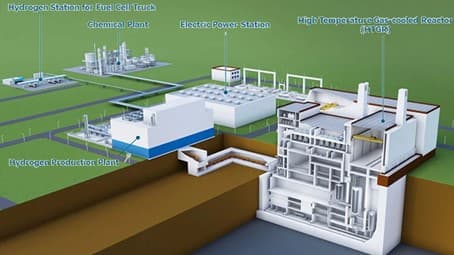
Diagram of a proposed hydrogen production plant using a high-temperature gas-cooled HTGR reactor (source: MHI).
On 2 January 2024, Japan's Ishikawa Prefecture experienced its strongest earthquake since 2011, measuring magnitude 7.6. The Shika nuclear power plant was closest to the earthquake's epicentre. No deviations from normal operations occurred there. No effects of the earthquake were observed at any other power plants either.
Conclusion
The start of tritiated-water discharge into the ocean is a key step towards decommissioning the damaged reactors. Effective cooperation has been established with the IAEA and fishermen. Monitoring shows that health limits are being met and that customer confidence in Fukushima fishermen's products is not declining. There are therefore good prospects for establishing a standard regular discharge regime that will enable the gradual reduction in the number of tanks and free up space for facilities and equipment for decommissioning the damaged reactors.
Conditions are currently being prepared to begin removing core remnants from the containment of Unit 2, which is the least damaged. One step towards this is clearing deposits that blocked the X-16 access route into its containment. The first material samples could begin to be taken from Unit 2's containment this year. This would mark the actual start of decommissioning the destroyed reactor cores.
Major progress is also being made in the return of residents to affected areas. As noted a year ago, decontamination and revitalisation of the most heavily affected locations are accelerating. At the same time, the restoration of communities in these areas is progressing.
The restoration of Japanese nuclear power is also accelerating. It is clear that Japan cannot manage without intensive use of nuclear energy, and has no chance at all of achieving a transition to low-emission energy without it. It is therefore planning a faster restoration of existing reactor operations as well as the development of advanced nuclear technologies. Japan plans to use hydrogen intensively, which is why it is focusing on high-temperature reactors.
For interest and comparison of what is proceeding as expected and what is delayed, you can watch a lecture for Pátečníci from more than seven years ago:https://www.youtube.com/watch?v=_vMzfEBy3cI
Translation disclaimer
This article is a machine translation of the Czech original and has not yet been fully reviewed. In case of any doubt, please refer to the Czech version.
Sdílejte článek prostřednictvím:
Topics:Opinion
You might also like
23 October 2026, 11:01
23 October 2026, 06:34