
23 October 2026, 14:38
Loading...
Global warming and reclamation of Czech mining-affected areas – Part 2
Stanislav Štýs
10 December 2015, 12:17
If there is no consensus on the causes and consequences of climate developments, it is logical that there are diametrically opposed views on how to address the situation.
The social contentiousness of the global warming issue stems primarily from the fact that the scientifically unverified greenhouse hypothesis concerning human CO2 production and its effect on rising temperatures has become something of an axiom, on the basis of which states and supranational organisations are mandating that CO2 producers implement extraordinarily costly countermeasures. This is despite the fact that the situation is changing significantly as scientific findings demonstrate natural climate oscillations independent of human activity. Although Russia signed the Kyoto Protocol in 2005, bringing it into force, the world’s largest CO2 producers still remain outside it.
Thus, it is essentially Europe that remains compliant with “Kyoto”; it currently produces 10 % of global CO2 emissions, and this share continues to decline. Nevertheless, in its Green Paper (2013), the European Commission imposes unrealistic targets: to reduce EU greenhouse gas emissions by 40 % by 2030 and by 80 to 95 % by 2050, and to increase the share of renewable energy sources to 30 % by 2030. This is despite the European Commission stating in the Green Paper that “ … concerns have been expressed that the EU’s commitment to fighting climate change has not been fully reciprocated outside the EU, which has an impact on competitiveness. …”.
Europe nevertheless continues to support this trend through its economically demanding directives, even though the requirement to limit the global temperature increase to a maximum of 2 °C by 2100 has not yet been scientifically substantiated by anyone. It is a product of “climate designers”. The IPCC assumes that limiting the temperature increase to a maximum of 2 °C by 2100 is possible if greenhouse gas emissions, especially CO2, can be reduced by 40 to 70 % compared with 2010 levels by 2050, and if zero emissions are achieved by 2100 through the complete decarbonisation of the energy sector, on the assumption of the mass deployment of CO2 capture and storage technologies.
Given that the dominant share of the world’s CO2 emitters has either not yet ratified the conclusions of the Kyoto Protocol or is withdrawing from them, it is entirely clear that compliance with EU directives has a very negative impact on the competitiveness of European states. Nevertheless, the European Commission has set itself the goal of earmarking 20 % of its budget for addressing climate change by reducing CO2 emissions.
As a result of the scientifically unproven conclusions of the IPCC as a political body, the legitimate scientific debate on climate change has been drowned out by political and media noise. Under these circumstances, various instructions are being proposed for operating the Earth’s thermostat, envisaging the establishment of a global Orwellian-style climate control commission with powers to intervene in the affairs of sovereign states, the creation of a world court, international armed forces authorised to enforce decisions on carbon-free energy, and the introduction of a carbon dictatorship to save humanity. All this at a time when no one knows whether temperatures will rise or fall (global temperatures have not risen for 17 years).
In 1979, the world-renowned J. Lovelock (Gaia) assumed that “If humanity were to interfere with Gaia’s ability to function to such an extent that it put her out of operation, it might one day wake up to find that it had a permanent lifelong job as a planetary maintenance technician … We would then finally be managing this strange invention, spaceship Earth.” The same author, a guru of the green movement, in his new publication The Vanishing Face of Gaia: A Final Warning (Academia 2012), having been informed by rational considerations, came to the conviction that: “If we cannot predict even what has already happened, how can we trust predictions for the next forty or ninety years? Yet political actions and government initiatives to combat climate change suggest that everyone accepts the IPCC’s estimates as reliable and authoritative. (14)
If we proceed from the demonstrable fact that CO2 concentrations are not the cause but the consequence of naturally influenced warming, then the model calculations of the IPCC’s climate designers are not credible. Arguments based on consensual agreement belong to politics, not science; it is expedient to direct the fight against climate change not towards a fight against carbon, but towards effective adaptation measures to strengthen the resilience and productivity of agricultural and forest ecosystems and to remedy the anthropogenic sins committed against our landscape and environment. In that case, 20 % of the EU budget would be put to effective use.
As humans, we are essentially a subtropical species that later spread across the entire planet. We have always felt closer to warmth than to cold and winter. Evolutionarily, we adapt better to warmth than to cold. It is therefore surprising that current efforts to stabilise the climate are significantly directed against warming. This is despite the fact that warm periods of the Holocene (climatic optima) were always favourable to the development of civilisations, whereas cold periods were accompanied by crop failures, disease and war. This alone shows that fighting CO2 emissions at any cost is misguided. It would be rational to prepare for climate change, primarily through measures that can optimally manage precipitation moisture in Czech conditions.
Czechia is geographically situated in such a way that almost all precipitation water flows away. This alone demonstrates the extraordinary importance of water. It is therefore essential that we manage it responsibly, so that it does not run off over the surface without benefit but instead infiltrates the soil to the greatest possible extent. Its rapid surface runoff should be transformed as much as possible into slow subsurface runoff, enabling water to be used by vegetation and replenishing groundwater reserves. Hydrologically effective methods of forestry, agricultural and water management serve this purpose.
Examples of the first historically documented successful adaptation to climate change are known from Mesopotamia. Between 10,000 and 4,000 BC, the Earth’s orbit entered a position in which solar energy input in the Northern Hemisphere increased by 7 to 8 % compared with the Dryas period. This made the surface greener, vegetation evaporated more water, and the small water cycle increased precipitation by 25 to 30 %. Former deserts turned into savannahs, stimulating the development of an agricultural population. Around 3800 BC, however, the Earth’s orbit changed and precipitation declined. Irrigation was then only possible by using river water and building irrigation canals – the first human adaptation to drought. Subsequently, however, people failed to manage the problem of soil salinisation.
None of the past civilisations, however, was able to cope successfully with radical climate fluctuations. Our civilisation has significantly more effective means than past ones. Yet even these are not sufficient for the arrogant “management of the Earth’s thermostat”. In this respect, one can agree with V. Klaus and strategically focus on “... the incredible ability to adapt to new, unexpected events.”(8)
Reclamation as an adaptation measure
In the mining-industrial agglomeration of north-western Bohemia, lignite extraction is currently carried out exclusively by large-scale open-pit mining. This method excels in capacity, extraction rates and economic efficiency. Its technological consequence is the total destruction of the landscape in the form of pits and external spoil heaps. This results in radical transformation of the subsystems of geology, soil, water, climate and biota – including phyto-, zoo- and microcenoses – the destruction of ecosystems and, locally, the social components of the landscape.
For the uninformed and dilettantes, this is an irretrievably ruined area. Their only alternative is to reduce or halt mining, thereby also ridding ourselves of the greatest spectre of climate warming, since burning coal is the largest source of CO2 emissions and these are the cause of destructive warming. This is entirely irrational, disregarding the reality of replacement options for ensuring energy security.
However, sixty years of reclamation practice have demonstrated that ecologically and socially effective reclamation methods have not only been conceived but are already routinely implemented, resulting in the creation of areas that even surpass the pre-mining landscape. We do not simply eliminate socially necessary mining; we carry out reclamation as remediation, and in this case also as preventive adaptation to climate change.
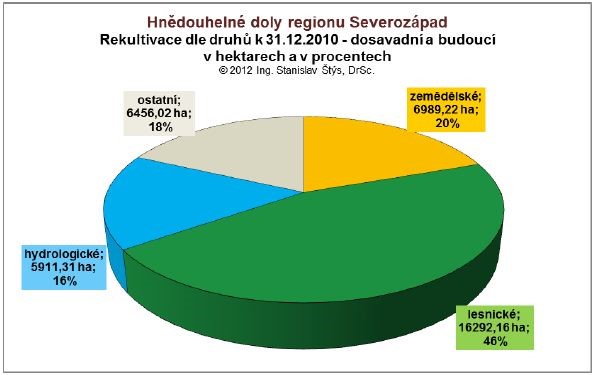
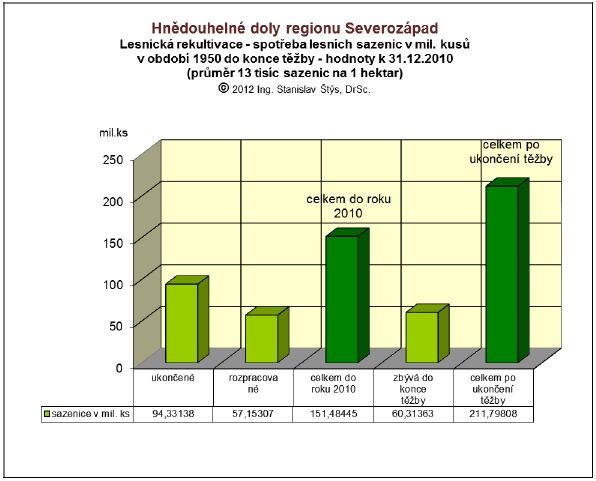
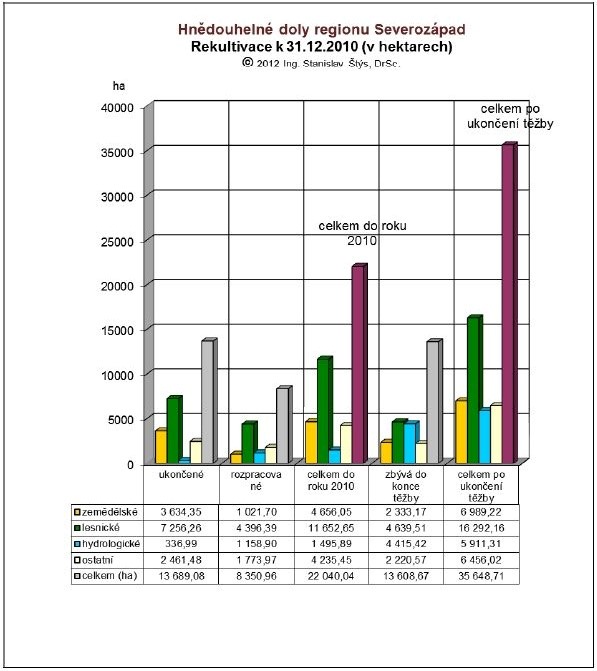
The reclamation concept has evolved not only in line with the level of scientific knowledge, but also depending on changes in social conditions. We have passed through the initial greening period and the preferential restoration of agricultural land resources, which were rapidly declining in the country. The current period is characterised by efforts to achieve an optimal mix of agricultural, forestry, hydrological and recreational approaches, which already takes account of the assumption of global warming. This can be documented by the following graphical overviews, which show an extraordinarily high share of forestry (46 %) and hydrological (16 %) reclamation (charts 7, 8 and 9)(19).
This reclamation strategy takes account of new findings on temperature trends and assumes that future warming will necessarily be accompanied by increased precipitation, particularly in the neighbouring Ore Mountains area. In this context, the Most and Sokolov basins offer an extraordinarily elegant solution not only ecologically but also socially and economically, consisting of using the residual pits and spoil heaps in the sub-Ore Mountains accumulation area for maximum water retention and storage (see diagram 10)(19). This will enable us to turn the threat of warming into an advantage, as one can agree with the belief that water availability will be the dominant condition for sustainable environmental, economic and social development as early as this century.
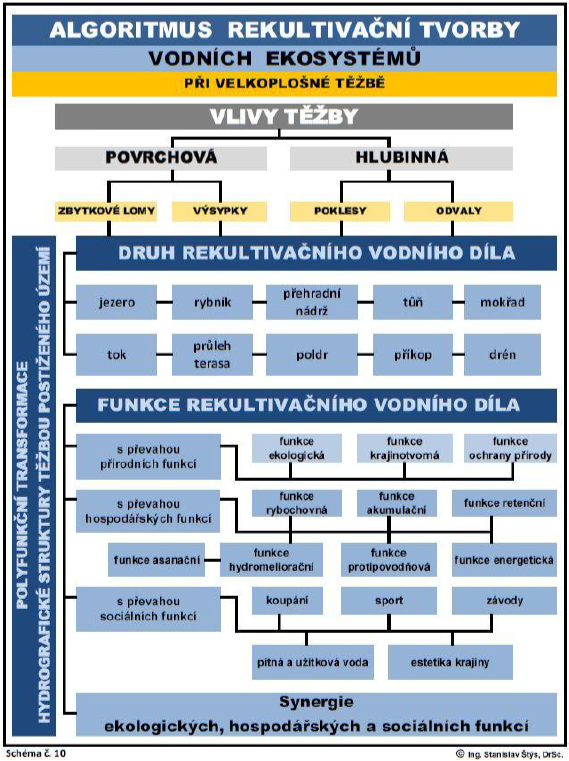
Every crisis situation generally has another side to the coin. This is also true of the sub-Ore Mountains area. Mining-related destruction of the landscape also has the advantage of making extraordinarily large areas available after mining, providing a starting point and potential benefit for many ways of using the landscape in line with prospects for the development of nature and society. Until now, the tendency has been to minimise the volume of residual mine pits.
In line with knowledge about warming, it is expedient to change this view and, in the final phases of mining, seek to ensure that a residual mine pit of maximum volume remains after extraction ends. It is highly likely that the value of the water accumulated there will exceed the value of the coal extracted. It will be valuable not only in quantity, but also in its versatile usable quality, ensured not only by its source but also by the depth of the pits. These will exceed 200 m in the Most Basin, which is a prerequisite for the self-purifying capacity and oligotrophic nature of the lakes.
The absolutely unique importance of this hydrological reclamation concept stems from the geographical location of two neighbouring orographic units: the Ore Mountains massif, as a protected area of natural water accumulation, where the source is high precipitation and the main storage environment consists of forest ecosystems valuable for water management; and the sub-Ore Mountains basins, with their natural storage characteristics, which can be significantly enhanced through reclamation, particularly by constructing pit lakes. The importance of this concept, which is currently approved without conflict (apart from uncertainty over the further development of the ČSA mine) and already substantially under development (see table), is clear.
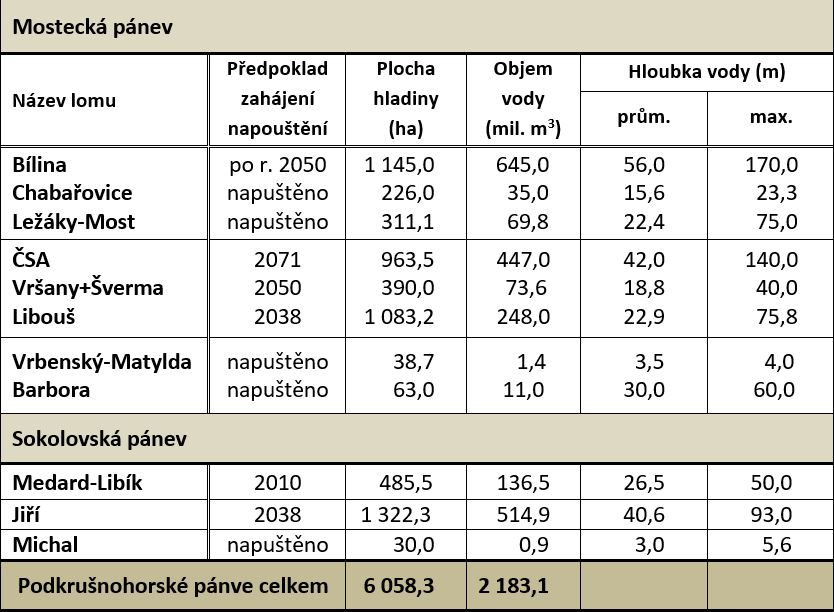
This strategy is part of a legislatively and financially guaranteed reclamation programme. Its importance is primarily evident from the following data:
- According to statistical data, the Czech Republic currently has 24 100 water reservoirs and ponds with a total volume of approximately 5.5 billion m3
- Following the end of mining and reclamation, water bodies with an area of approximately 6 060 ha and a volume of approximately 2.2 billion m3 of high-quality water will be created in the Most and Sokolov basins.
Note: The volume of residual space in some pits can still be increased so that the resulting volume of these pit lakes reaches 2.5 billion m3, representing 45 % of the current storage capacity of water reservoirs and ponds in the Czech Republic!
Alongside a comprehensive nationwide programme to intensify agricultural, forestry and water management, this reclamation programme in the Most and Sokolov basins should also be regarded as an adaptation measure in the event of significant climate change – for both alternatives: warming and cooling. Both trends would also be associated with increased energy demand. Given that the difference in elevation between the sub-Ore Mountains basins and the plateau areas of the neighbouring Ore Mountains is 500 to 600 metres, it is entirely realistic to use the pit lakes to build an entire system of pumped-storage power plants.
In conclusion, it is expedient to emphasise that supranational and state financial resources intended to address climate strategy should be directed primarily towards adaptation programmes aimed at increasing the landscape’s water retention and storage capacity, erosion-control and flood-protection programmes, restoring sustainably viable methods of agricultural land use, and enhancing the hydrological functions of forests, with priority given to rehabilitating and restoring mountain forest ecosystems affected by air pollution. Overall, this means increasing the productivity and diversity of ecosystems so that they best correspond to the natural characteristics and sustainable use of the territory, in the knowledge that we are not exploiters but stewards of the Earth, and that our civilisation too will be judged by future generations not only according to what it provided to its contemporaries, but above all according to what it left to future generations in the form not only of material and spiritual assets, but primarily in the comprehensive sphere of the environment.
References:
- Armstrong J. S., (2010) : Let’s Deal in Science and Facts – Onlinehttp://www.klimaskeptik.cz/osobnosti/armstrong/
- Climate Change Reconsidered II: Biological Impactshttp://www.nipccreport.org/reports/ccr2b/ccr2biologicalimpacts.html
- Dvořák M., (2014) : Climate: EU saves the climate and destroys Europe, Neviditelný Pes, 7. 4. 2014 – Online: http://neviditelnypes.lidovky.cz/klima-eu-zachranuje-klima-ale-nici-evropu-fp4-/p_klima.aspx?c=A140406_161002_p_klima_wag
- Flanery T., (2007) : We Are Changing the Climate. Dokořán, Prague, p. 270
- Humlum O., Stordahl K., Jan-Erik Solheim J.-E. (2013): The phase relation between atmospheric carbon dioxide and global temperature Global and Planetary Change, Vol. 100, pp. 51-69.
- IPCC – Assessment Reports of the Intergovernmental Panel on Climate Change (I to V) – Onlinehttp://cs.wikipedia.org/wiki/Glob%C3%A1ln%C3%AD_zm%C4%9Bny_klimatu
- King A., Schneider B., (1991) : The First Global Revolution: A Report by the Council of The Club of Rome. – Pantheon Books, 286
- Klaus V., (2007) : Blue Planet, Not Green, Dokořán, Prague, p. 164
- Kremlík V., (2014) : Climatologists still do not understand the climate – Onlinehttp://kremlik.blog.idnes.cz/c/415338/Klimatologove-klimatu-jeste-nerozumeji.html
- Kremlík V., (2014) : Professor Tol left the IPCC in protest against climate alarmism. 2. 4. 2014 – Online http://kremlik.blog.idnes.cz/c/403580/Profesor-Tol-vystoupil-z-IPCC-na-protest-proti-klima-alarmismu.html
- Kutílek M., (2008) : Rationally About Global Warming. Dokořán, Prague, p. 185
- Kutílek M., (2012) : The Holocene climate versus the greenhouse hypothesis, Vesmír, 2012/May, pp. 298-300
- Lomborg B., (2006) : The Skeptical Environmentalist. Dokořán – Liberal Institute Prague, p. 587
- Lovelock J., (2012) : The Vanishing Face of Gaia: A Final Warning, Academia
- Ložek V., (2007) : Mirror of the Past – The Czech and Slovak Landscape in the Quaternary. Dokořán, Prague
- Patočka J., (2013) : Carbon dioxide emissions help green the Earth, Vesmír, Vol. 92, p. 597
- Štýs S. et al., (1981) : Reclamation of Areas Affected by Mineral Extraction, SNTL Prague
- Štýs S. et al., (2014) : Transformations of the North-West, Czech Statistical Office Prague
- Štýs S., (2013) : Hydrological reclamation as a subsystem of the reclamation transformation of the landscape, Vodní hospodářství, 2013/4, pp. 121-124
- Štýs S., (2014) : Landscape of Hope. Publisher St. Srnka, pp. 222-230
Translation disclaimer
This article is a machine translation of the Czech original and has not yet been fully reviewed. In case of any doubt, please refer to the Czech version.
Sdílejte článek prostřednictvím:
Topics:Opinion
You might also like

23 October 2026, 11:01
23 October 2026, 06:34