23 October 2026, 14:38
Loading...
How realistic are German climate strike organisers' demands?
Vladimír Wagner
18 April 2019, 15:35
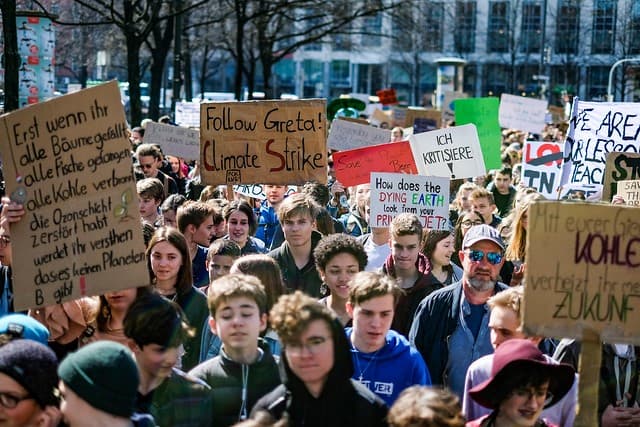
In Germany, activities surrounding student climate strikes are the most extensive. It is therefore interesting to look at the specific demands recently published by the students.
The organisers of the secondary school strikes have set out three basic demands. The first is the immediate shutdown of a quarter of coal-fired generating capacity, the second a complete phase-out of coal use in 2030, and the third a transition to a 100% share of renewable sources in the energy sector by 2035. Let us recall the basic parameters of the German energy sector at present. As regards electricity generation, renewables produced roughly 40% of German electricity last year, nuclear power still accounted for 13.4%, coal for almost 39%, and gas for 7.5%. It should be stressed that during the nearly 20 years of the Energiewende, the increase in renewable generation has roughly matched the total output of nuclear reactors at the start of this millennium – that is, what will disappear entirely within three years. Replacing fossil-fuel sources with renewables will now be much more difficult and costly. And this is not only because the extra-high-voltage transmission line from north to south has still not been built. Germany is still a significant electricity exporter, but this is also due to its surplus fossil-fuel capacity needed to regulate the grid as the share of fluctuating renewable sources rises.
Available capacity will become the critical issue in the event of a massive closure of fossil-fuel sources. Installed hard coal capacity is 23.7 GW, lignite capacity is 21.2 GW, and gas capacity is 29.4 GW. Installed hydropower capacity is 4.8 GW and biomass capacity is 7.7 GW. The capacity of operating nuclear units, mainly in Bavaria, is still 9.5 GW (source: Fraunhofer ISE).
Let us look at the impact of meeting each of the secondary school students' demands. First, the demand to close a quarter of coal capacity. Total installed coal-fired capacity is roughly 45 GW, a quarter of which is around 11 GW. Given that Germany will also lose all of its nuclear capacity in the near future, this would mean a total loss of more than 20 GW of capacity. Germany would thus retain roughly 34 GW of coal capacity, have 29 GW of gas capacity and 13 GW of biomass and hydropower capacity. In the winter months, Germany commonly experiences peaks when more than 80 GW of capacity must be secured, while photovoltaics and wind deliver minimal output. If this first student demand were met, the remaining fossil-fuel sources and weather-independent renewables would provide only 76 GW of capacity. Dry years, when hydropower sources are unable to run at full capacity, must also be taken into account. A certain portion of capacity is also usually offline due to maintenance, outages or other problems. Even a simple calculation thus shows that, if even the students' first demand were met, Germany would be unable on its own to ensure sufficient electricity supplies for its industry and population in a number of periods. It is absolutely unrealistic that sufficient gas-fired capacity could be built over the next two to three years to replace this lost capacity.
Let us now look at the second demand. It is not entirely clear whether it also calls for a complete phase-out of coal in heating. That would be even more challenging than a phase-out solely in electricity generation. But even the latter is difficult to imagine. If, by 2030, Germany were to close all coal-fired plants in addition to its nuclear units, it would mean the loss of around 54.4 GW of capacity. Of today's weather-independent capacity, 29 GW of gas capacity and 13 GW of renewable capacity would remain, for a total of just 42 GW. If a winter temperature inversion occurred and demand exceeded 80 GW, half of the required capacity would be missing. It should also be recalled that green activists are calling for a transition to electric mobility by 2030, which would mean a further fairly substantial increase in required capacity, especially in winter months when cars also need heating. Hypothetically, it would be possible to build gas-fired plants with a total capacity of several tens of GW within ten years. However, given that these projects are mostly not yet even being prepared, implementing such replacement within such a short period is very difficult to envisage and would certainly be extremely costly.
The third demand is a complete transition to renewable energy sources by 2035. Again, it is not entirely clear whether this includes heat and transport, but it is highly likely that these areas are also intended. Yet even in the electricity sector, I dare say that this is inconceivable for physical and technological reasons. Even hypothetically. Within fifteen years, it is simply impossible to achieve the radical breakthrough in energy storage that meeting this demand would require.
It is clear that meeting the three demands mentioned is inconceivable for Germany. On the other hand, there will be very strong ideological and political pressure to move towards them. So far, Germany, with its surplus installed capacity, has helped maintain the regional grid and has tended to export electricity. This will change in any case. Germany too is moving into a position where it relies on electricity imports. Yet in the coming years, apart from France, there may be no country in Europe able to export electricity during a winter inversion, when there is neither sunshine nor wind. If we do not want to face fatal problems, we must not allow ourselves to lose the ability to secure the required capacity even at such times.
The demands announced by the German organisers of the secondary school climate strike confirm my concerns (expressed here, here and here) that this is another purely ideological propaganda campaign that has no interest in genuinely addressing environmental problems. Students call on politicians to listen to scientists, yet then announce targets that have nothing in common with scientific knowledge or technical reality. If the German secondary school students organising climate strikes really wanted to contribute to a rapid and radical reduction in carbon dioxide emissions in their country, they would demonstrate against the premature shutdown of nuclear units by 2022 and for using their full operational lifetime potential. And, if it is still technically possible, for restarting at least some units that have already been shut down. This would create room to close the older coal-fired plants and establish a rationally designed scenario for a gradual transition away from fossil fuels.
However, under pressure from green activists, Germany will first shut down nuclear units that have already incurred their carbon footprint and could still safely supply electricity for several decades. In their place, it will build new coal-fired plants, often even ultra-modern supercritical ones. These should now be quickly shut down and replaced by gas-fired plants, which should then also be quickly shut down by 2035. This highly bizarre energy concept entails extreme costs, which are already making the price of electricity in Germany the highest in Europe. Moreover, in the coming years it should be determined predominantly by the cost of gas-fired plants. Gas also produces carbon dioxide emissions, roughly one-half to one-third of those from coal. However, if another demand of the secondary school students is met – an emissions price eight times higher than the current price of emission allowances – the wholesale electricity price determined by gas-fired plants will rise dramatically. I doubt that even Germany's wealthy economy and society can sustain such an irrational ideological experiment. And it should be remembered that the electricity price in Czechia is also set by the German market.
Lead photo: Secondary school student demonstrations are by far the most numerous in Germany (Photo: FfF Deutschland, flickr.com).
Written for oEnergetice, Neviditelný pes, Osel and iUhlí.
Translation disclaimer
This article is a machine translation of the Czech original and has not yet been fully reviewed. In case of any doubt, please refer to the Czech version.
Sdílejte článek prostřednictvím:
You might also like
23 October 2026, 11:01
23 October 2026, 06:34