23 October 2026, 14:38
Loading...
International Atomic Energy Agency approves discharge of tritiated water at Fukushima Daiichi
Vladimír Wagner
15 July 2023, 08:00
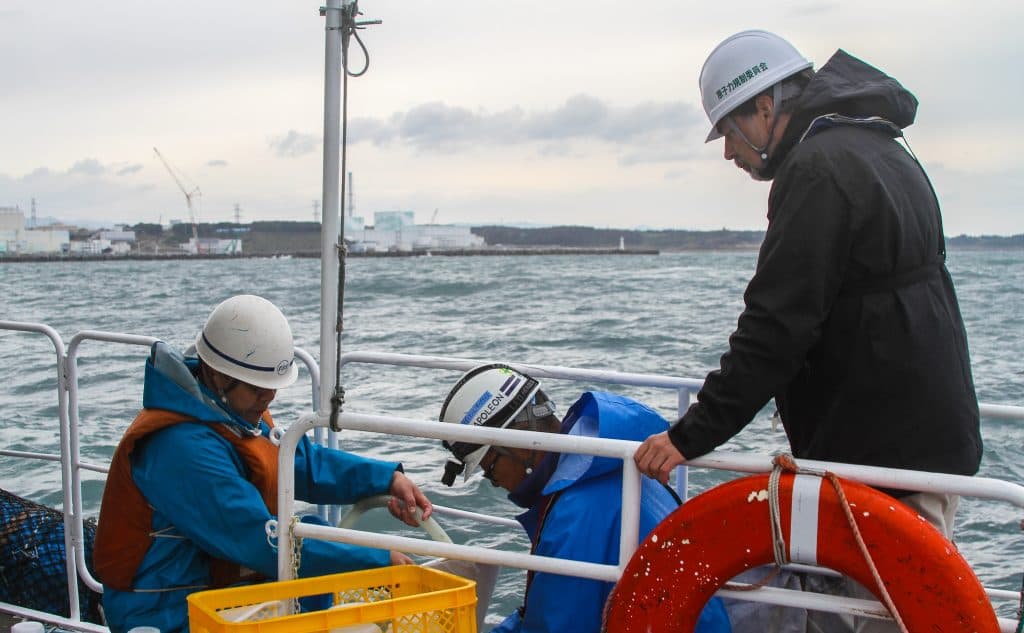
The International Atomic Energy Agency has assessed the proposed procedure for discharging tritium-containing water at Fukushima Daiichi. It confirmed that its implementation would ensure negligible environmental impacts. Based in part on this organisation's decision and an analysis by its own experts, South Korea has also agreed to this method.
Almost a year ago, in the latest instalment of our long-running series on dealing with the consequences of the Fukushima accident, we wrote about the Japanese Nuclear Regulation Authority (NRA) approving TEPCO's plan and methodology for discharging treated water containing only tritium. The plan was sent to the International Atomic Energy Agency (IAEA) for assessment. At the beginning of July, it issued a comprehensive report assessing the proposed methodology. As the analysis of the proposal had already been under way before its exact description was submitted, IAEA experts examined it very carefully for around two years in total. They also carried out several visits to the Fukushima Daiichi plant site to assess the situation directly on site. They have now issued the detailed document in question, which clearly demonstrates that the proposed procedures fully comply with international environmental standards. The proposed limits on radioactivity are lower than those which water discharged from nuclear power plants during operation, and even drinking water, must meet.
Recap of the basic facts on radioactive water decontamination
There are currently around 1.37 million tonnes of water in a thousand tanks at the Fukushima Daiichi nuclear power plant site. By the turn of 2023 and 2024, all remaining reserve tanks could be filled. Contaminated water is generated during the cooling of the damaged reactors, but predominantly through groundwater entering the heavily contaminated areas around the damaged reactors. Rainwater also contributes to the inflow to a lesser extent. In recent years, the inflow of groundwater into these areas and its contamination have been reduced through barriers, including an ice wall, and by pumping groundwater upstream of the site towards inland areas. The pumped groundwater is checked and, if it meets health standards, discharged into the sea. Representatives of fishermen also oversee this process. The experience of negotiating this arrangement with fishermen and cooperating with them could also help now.
Contaminated water accumulating in the underground spaces of the damaged reactors in the manner described is treated at the ALPS (Advanced Liquid Processing System) facility to remove all radionuclides except tritium. This is a heavy isotope of hydrogen with two neutrons. Different isotopes cannot be separated chemically and, naturally, hydrogen cannot be removed from water. It can be separated using physical methods, but these are extremely costly on such a large scale.
Moreover, tritium is produced through interactions of high-energy cosmic radiation in the atmosphere and is a normal part of the natural environment. Therefore, if the tritium concentration is close to the natural background level, it has no environmental impact whatsoever. In addition, tritium beta decay does not emit gamma radiation, but only a very low-energy electron, and tritium does not accumulate in living organisms. It therefore has very limited biological effects on organisms. Only extremely high concentrations of tritium pose a risk. However, the discharged water will have tritium content many orders of magnitude lower.
Contaminated water at the plant site
Let us look in more detail at the contaminated water situation at the plant site. Before the accident, around 850 tonnes of groundwater per day entered the site of the four damaged units. This water was drained by the sewerage system and pumped out by a set of pumps. These were destroyed during the tsunami and the accident. Following the initial measures and the immediate stabilisation of the site, a whole series of measures were implemented over more than ten years to reduce daily contaminated water production. These included pumping groundwater upstream of the site, constructing an ice wall around the damaged reactor site and walls towards the sea. These measures reduced average contaminated water production from around 540 to approximately 90 tonnes per day.
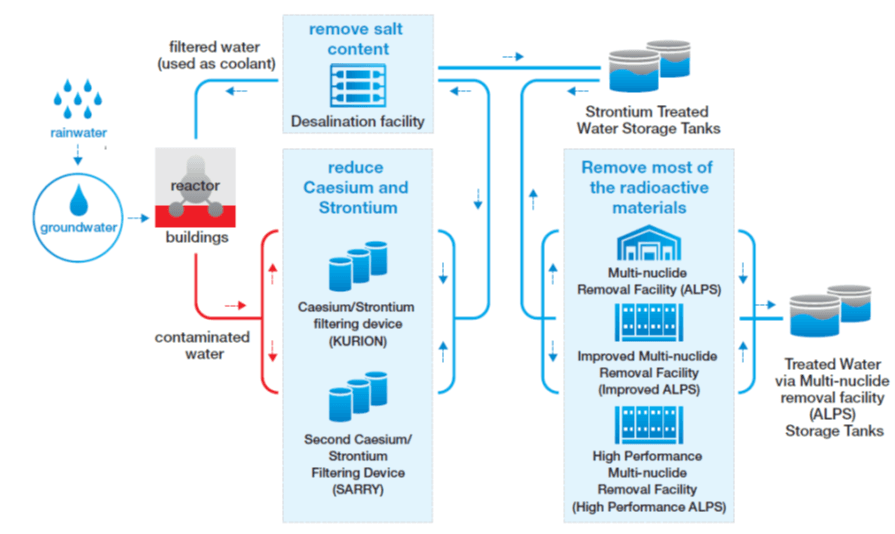
Diagram of contaminated water treatment at the ALPS facility, which removes almost all radionuclides except tritium (source: IAEA).
The aforementioned ALPS facility is used to treat contaminated water. It operates in three stages. First, it removes salt. Saltwater would cause problems in the subsequent treatment stages. This was particularly important at the beginning, when a significant portion of the contaminated water came from the sea. It is now predominantly freshwater groundwater. In the first stage, caesium and strontium—the most intense sources of radioactivity in contaminated water—are removed at the Kurion and SARRY facilities. Water treated in this way can be used for cooling. If this water is not intended for cooling, it is sent to the next stage, where a total of 62 radionuclides are removed. Tritium is not removed at all. No treatment process is completely perfect, so the water still contains a very small amount of residual radioactivity after treatment, but this is well below health and environmental limits. This is the water held in the aforementioned tanks.
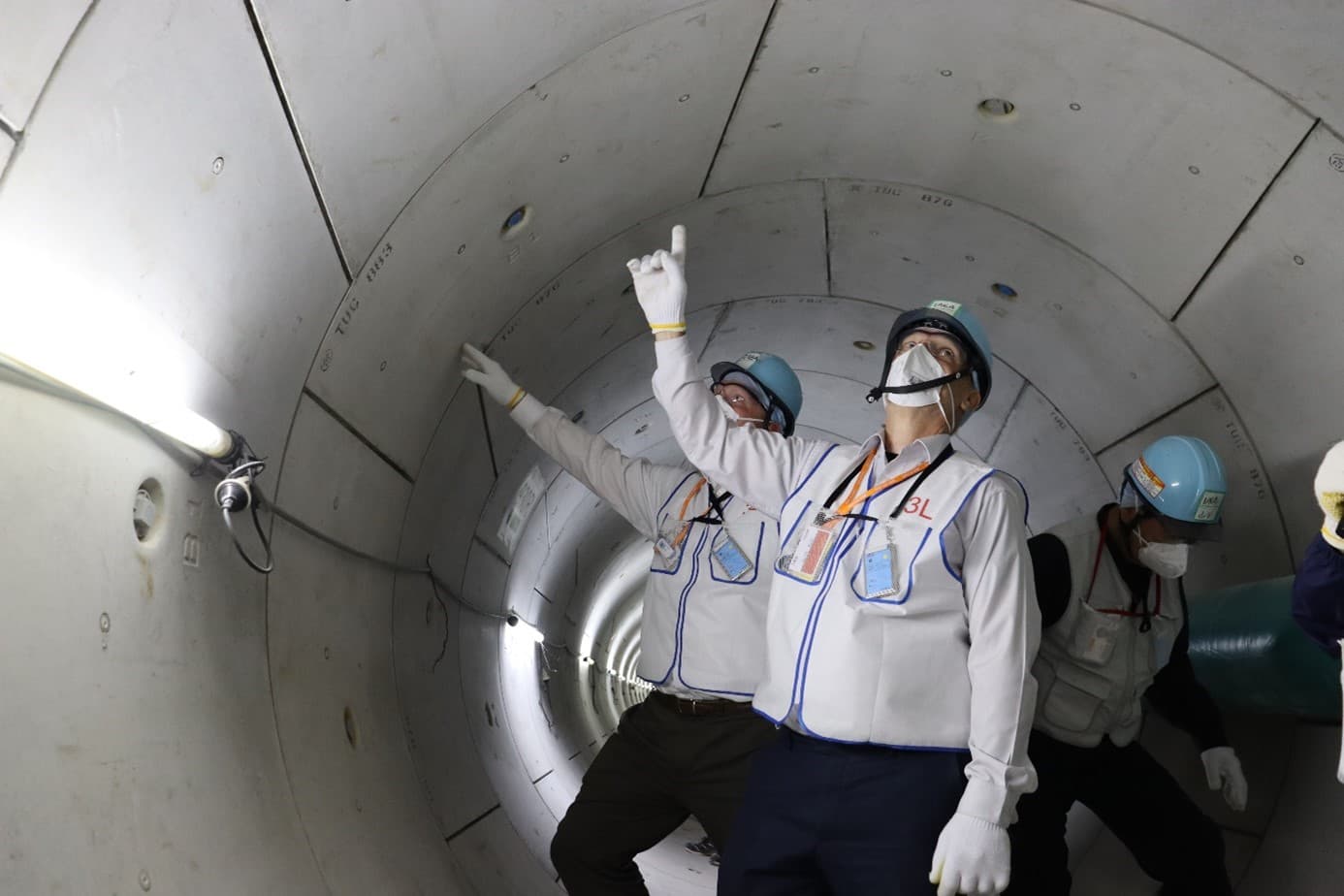
Inspection of the discharge facility for releasing tritiated water, specifically the tunnel, before its completion and commissioning (source: TEPCO).
The tritiated water discharge facility consists of four parts. The first is a facility for measuring activity and checking contaminated water. Here, water prepared for discharge is homogenised and samples are tested for the activity of various radionuclides to verify that it does not exceed permitted limits. This is followed by a transfer facility, which uses pumps to transport the checked water to the dilution facility. At the dilution facility, contaminated water is mixed with seawater. This is drawn from the intake channel of Unit 5 and transported to the dilution facility through three pipelines. The mixed water, whose tritium activity does not exceed permitted limits, proceeds to the discharge facility. Its one-kilometre tunnel exits on the seabed, where the water is released. It was completed in June 2023. The entire facility is now available and ready for commissioning.
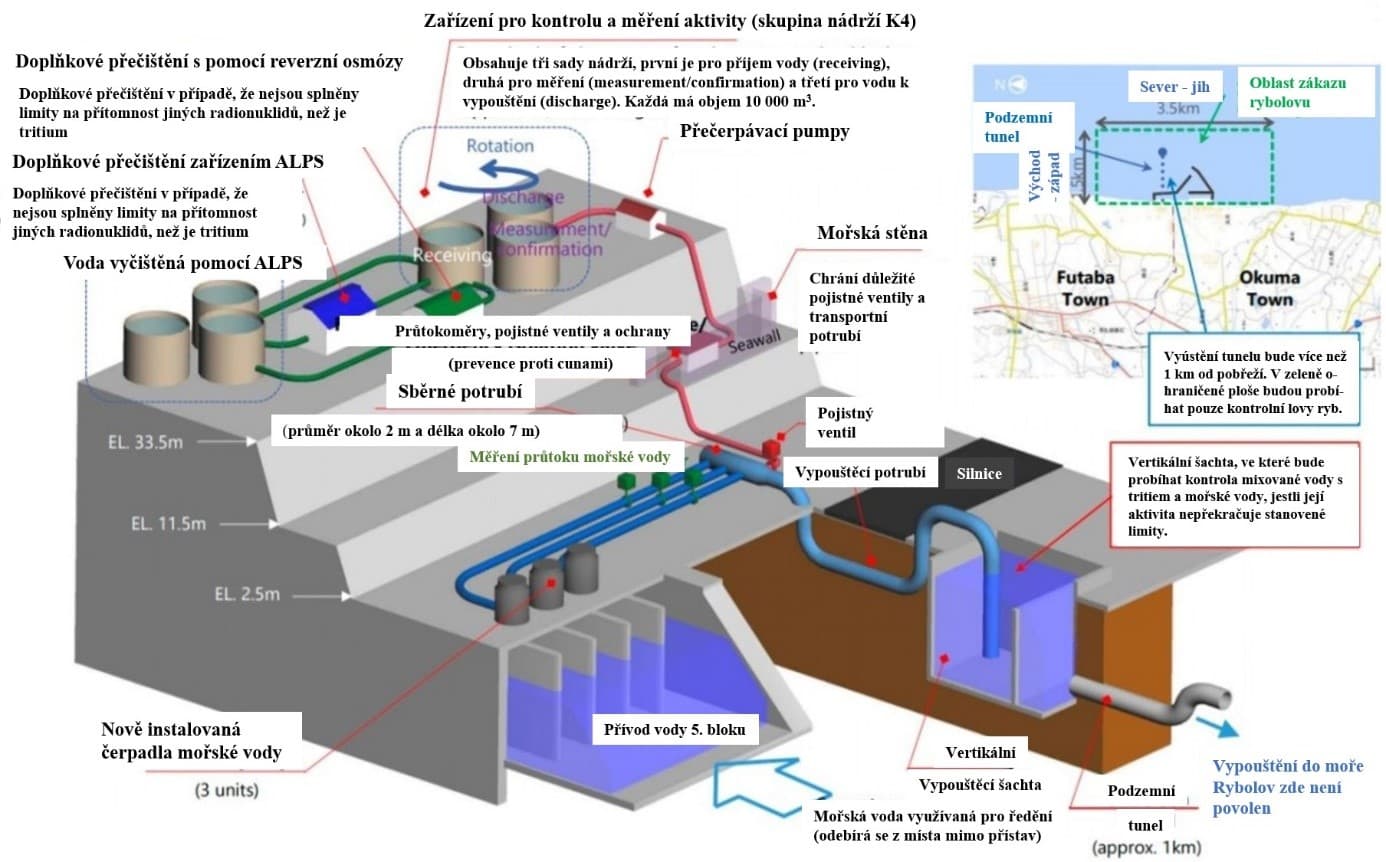
Diagram of the tritiated water discharge facility (source: TEPCO)
The volumetric activity of tritium must not exceed 1500 Bq/l, which is a lower limit than the standard limit for discharging such water into the environment and the limit for drinking water. The natural tritium background in the Pacific Ocean is between 0.1 and 1 Bq/l. Models simulating the dispersion of discharged water in the ocean show that, at the expected discharge rate, natural background levels will be exceeded only within 3 km of the discharge channel outlet. Beyond this, the impact of the discharged activity will decline very rapidly, and at a distance of hundreds of kilometres its contribution will be several orders of magnitude lower than the natural background. The annual limit for the total activity of discharged water is 22 TBq, which was also the value set for normal operation of the Fukushima Daiichi nuclear power plant. At the stated limit for tritium volumetric activity, this allows the discharge of just over ten million tonnes of water per year. However, because the water stored in the tanks will have to be substantially diluted to reach the required volumetric activity, discharges will need to be spread over several decades.
IAEA experts very carefully analysed the models used to assess the dispersion of radioactivity in the environment, particularly the marine biosphere, and its potential biological effects. They concluded that the work fully corresponds to current scientific knowledge. It also shows that, if the set limits are met, the doses received are several orders of magnitude below generally accepted limits, even in the worst conceivable cases.
As mentioned, the course of the discharges and compliance with the established limits will be continuously monitored under international oversight. Marine fauna and flora around the plant will also be checked. The IAEA is also involved in analysing various monitoring samples and methodologies.
Societal and social impacts
While discharging water with low tritium content poses no real problems from an environmental perspective, and experts who understand the issue agree with it, opposition has emerged within some parts of society. Fishermen are particularly opposed. The reason is not genuine concern about health or environmental risks; they fear the reaction of customers and lower sales due to public concerns. The situation is also negatively affected by its use in commercial and political disputes, while anti-nuclear activists exploit exaggerated risks in their campaign against nuclear energy. In this respect, the authority of a respected organisation such as the IAEA could help. For example, official representatives of South Korea, who had been strongly opposed to water discharges from Fukushima Daiichi, responded positively to IAEA assurances of negligible environmental impacts from this procedure. The paradox of China's still negative position is that Chinese nuclear units produce and discharge far more tritium into the sea during operation. The only possible way to overcome public opposition to discharging water with low tritium content is patient explanation of the actual impacts, explanation of the precise discharge process, and the most open possible approach to overseeing its implementation. The IAEA and representatives of fishermen should take part in this oversight. Over the past two years, TEPCO has also invited representatives of neighbouring countries on the shores of the Pacific to visit Fukushima Daiichi. It is seeking to explain to them in as much detail as possible the water discharge methodology and that the environmental impacts will be negligible.
It was precisely these visits, along with the authority of the international IAEA and its conclusions, that contributed to South Korea officially agreeing on 7 July to Japan's plan to discharge tritiated water into the ocean. It also relied on a careful analysis by its own experts, which found that contamination of the ocean around the Korean Peninsula would be negligible.
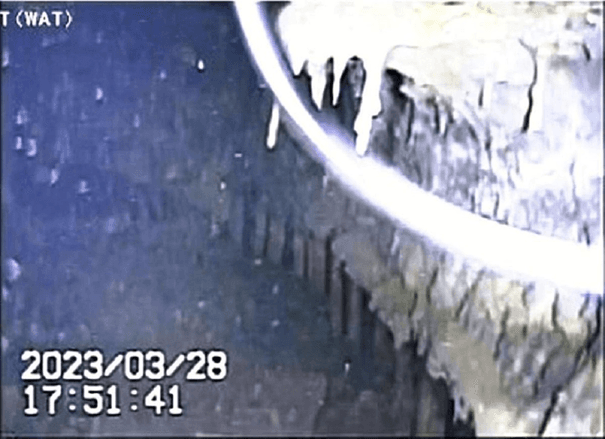
Image from an underwater robot's inspection of the interior of the supporting foundation within the containment of Unit 1 (source: TEPCO)
Further work at the plant site
At the end of March 2023, another survey of the interior spaces of the Unit 1 containment was carried out. It followed up on investigations from the first half of the previous year, described in the previous overview. This time, it focused on the concrete foundation on which the reactor pressure vessel sits. It has a cylindrical shape, a diameter of six metres and wall thickness of 1.2 m. While previous inspections could only see the outer walls of the concrete structure, an underwater robot has now reached its interior spaces and conducted a detailed inspection. It found that flowing molten reactor core material had severely damaged it in a number of places. The surface layers of concrete are heavily damaged and reinforcing steel has been exposed. The structure's seismic resistance has therefore been weakened. There are also deposits on the floor that could be solidified remnants of the molten reactor core.
Removal of fuel assemblies from the Unit 1 pool should begin in 2027, and all pools should be empty by 2031. After that, everything will focus on dismantling the damaged reactor cores. This year, delayed sampling of solidified melt from the second reactor is planned.
TEPCO and Hitachi have established a joint venture to manufacture containers for spent fuel and for storing remnants of reactor cores removed from the damaged reactors. The factory should begin operating in 2025 in the Hamadori area of Fukushima Prefecture. This is another step in preparations to begin work on removing the damaged reactor cores. TEPCO is cooperating with French company Orano to find methods for extracting smaller pieces of solidified melt.
Developments in affected areas
The previous overview wrote about plans to open further reconstruction bases in heavily affected areas in spring 2023. On 1 April, such a seed of revitalisation of a heavily affected area was opened in the town of Tomioka, taking a step towards a full return to all parts of the town. So far, only 54 residents intend to return, representing just 2 % of those who lived in the reconstruction centre area before the accident. A two-kilometre section of road with a long avenue of cherry trees, a symbol of Tomioka, was also opened. Following the start in previous years, the reopening of the most heavily affected areas is continuing successfully. However, it is clear that their decontamination and revitalisation will not be quick and will take time.
Japanese nuclear energy
Japan, too, is strongly affected by the impact of the war in Ukraine on the energy market and the rise in fossil fuel prices. The country is heavily dependent on their imports. Even with strong support for renewable energy sources, it has not managed to change this situation. Japan is therefore placing increasing emphasis on nuclear energy and restarting shut-down units. It is even considering lifting the ban on building new nuclear units. Importantly, public attitudes are also changing in this respect. This is also why Mitsubishi Heavy Industries is developing a new version of its advanced SRZ-1200 pressurised water reactor with a capacity of 1200 MWe, incorporating all enhanced requirements introduced based on lessons from the Fukushima Daiichi accident. Some Japanese utilities are considering using it should Japan's approach to new construction change.
Japan had a total of 54 nuclear reactors before the Fukushima Daiichi events. Twenty-one are now in the decommissioning process, leaving 33 considered operable. Their restart under new safety rules is proceeding very slowly, so only 10 currently have operating approval. Even fewer are actually operating, as some are suspended at various times to complete required safety upgrades or undergo inspection after exceeding forty years of operation. Only another 17 have applied for approval to restart under the new rules. In 2021, nuclear sources supplied only 7.2 % of total electricity generation. Before the Fukushima Daiichi accident, this was over 30 %.
The Japanese parliament has approved the removal of the 60-year limit on operating nuclear reactors. Until now, a unit could operate for 40 years and, following assessment, could receive a licence for a further twenty years of operation. The new rules set an initial licence of thirty years. A licence for a further ten-year operating period will then be sought, without a limit on the total operating lifetime.
In mid-June 2023, Japan's Supreme Court rejected a lawsuit by several families living near the plant seeking to halt operation of Ikata Unit 3 on grounds that the estimated impact of a major earthquake had been underestimated. The reactor can therefore be returned to operation after its outage. In March 2023, following lengthy analyses, it was found that a fault near the Shika 2 reactor is not active and that unit can be returned to operation.
Kyushu Electric Power has applied for inspections of the Sendai 1 and 2 reactors so that it can operate them for more than 40 years. The reactors entered operation in 1984 and 1985. Kansai Electric Power is preparing to submit the same application for Takahama Units 3 and 4, which began operation in 1985.
Japan's Mitsubishi Nuclear Fuel Co plant in Tokai, which manufactures fuel for pressurised water reactors, received permission to start production in August 2022. Conversely, the start-up of the Rokkasho reprocessing plant was postponed from 2022 to 2024.

Change in public attitudes towards restarting nuclear reactors in Japan (source: Asahi Shimbun).
Conclusion
The key conclusion of the IAEA study published at the beginning of July is that TEPCO's project for the long-term discharge of ALPS-treated contaminated water containing tritium fully complies with all international safety standards and will pose a negligible risk to the environment, the Pacific Ocean and human health. IAEA representatives also stress that the decision on discharging tritiated water and its implementation fall entirely within Japan's competence, and that regular IAEA missions could contribute to the transparency and oversight of this decades-long process if it goes ahead. Discharges could therefore begin as early as late summer. The gradual discharge of water and removal of tanks will free up space needed to store containers of radioactive waste that will begin to accumulate after work starts to dismantle the reactor cores of the damaged reactors. Progress in examining the interior parts of containment structures using robots brings us closer to this activity.
Translation disclaimer
This article is a machine translation of the Czech original and has not yet been fully reviewed. In case of any doubt, please refer to the Czech version.
Sdílejte článek prostřednictvím:
Topics:Opinion
You might also like
23 October 2026, 11:01
23 October 2026, 06:34