23 October 2026, 14:38
Loading...
Korean nuclear programme: history, current state and potential for Czechia
Vladimír Wagner
6 May 2019, 07:56
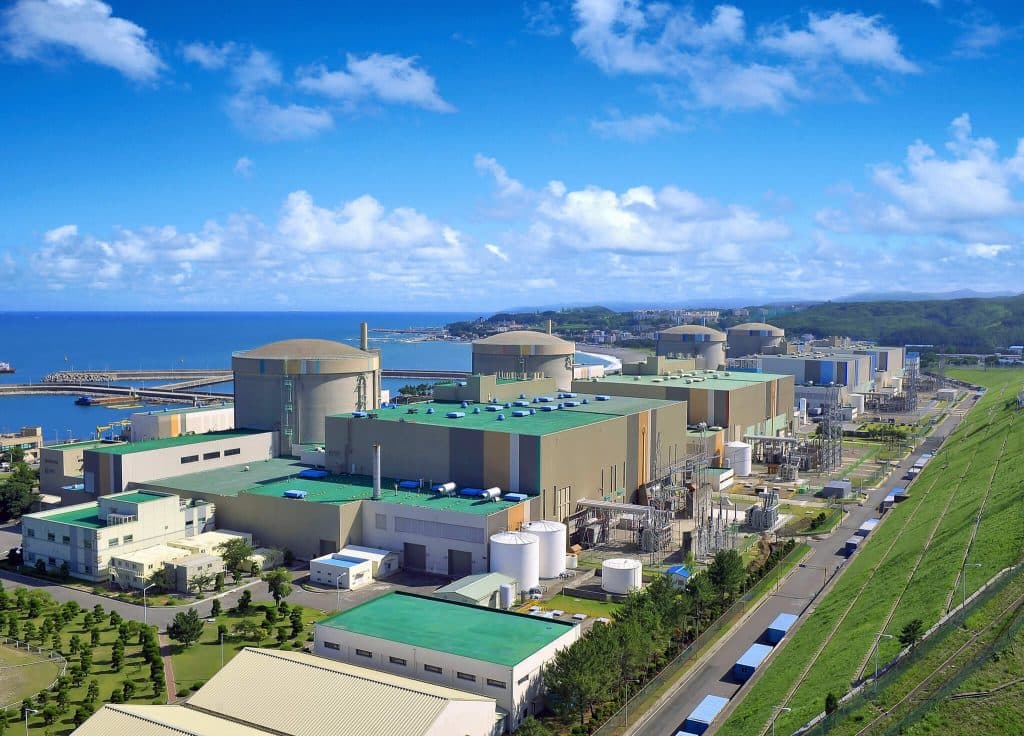
One of the possible reactors that could be used to build nuclear units in Czechia is the South Korean model. It is therefore interesting to recall the history and current state of nuclear power in this country, as well as its potential for exporting nuclear technologies.
In recent years, the average capacity factor of Korean nuclear units has exceeded 95%, among the best figures in the world. Construction of Korean Generation III units in the United Arab Emirates has so far progressed relatively successfully. A major challenge there is that the country is starting virtually from scratch with nuclear power, the use of nuclear technologies, nuclear regulation and education in this field. This is also one of the main reasons for the delays that have emerged recently.
History of South Korean nuclear power
South Korea suffers from a lack of fossil fuels and must import them. This was why it began developing the peaceful use of nuclear energy at the turn of the 1950s and 1960s. In 1962, a fission reaction began in the first small Korean research reactor. Construction of the first nuclear power unit at the Kori plant began in the early 1970s. It was a Westinghouse pressurised water reactor. It was completed in 1977 and entered commercial operation in 1978. The drive for self-sufficiency and to limit energy commodity imports led to rapid development of the sector. By the beginning of the 1980s, seven more units were under construction and rapidly nearing completion. These were Westinghouse and Framatome models. Based on the experience gained, South Korea began work on its own reactor model.
Two reactors based on the US System 80+ design, with a large share of domestic companies and development, were built as Hanbit units 3 and 4 (the plant was formerly called Yonggwang), with an electrical output of around 990 MWe. This was the start of the path towards developing the standard Korean Generation II reactor, the OPR-1000 (Optimum Power Reactor 1000 MWe), ten of which were completed from the late 1990s to 2015. A total of twelve domestic Generation II reactors were thus commissioned. In addition, four Canadian CANDU heavy-water reactors were built at the Wolsong plant in the 1980s and 1990s.
The experience gained with Generation II reactors enabled the rapid development of the nuclear industry, concentrated primarily in the Doosan corporation, and the development of the domestic Generation III APR1400 reactor with an electrical output of 1400 MWe. The first two reactors of this type were built at the Shin Kori plant as units 3 and 4. Shin Kori 3 received its construction licence in April 2008. Concrete pouring for its nuclear island, usually considered the official start of construction, began in August 2009. For Shin Kori 4, this was in August 2009. Shin Kori 3 became the first reactor of this type to begin commercial operation in 2016. Due to delays caused by problems with cable certification and the need to test and replace them, this was roughly three years later than planned.
Fuel was loaded into Shin Kori 4 in February, and the fission chain reaction began on 19 April 2019. It began supplying electricity to the grid on 22 April. Following the commissioning of this reactor and the shutdown of the two oldest units, Kori 1 and Wolsong 1, South Korea currently operates 24 reactors with a total capacity of 23.2 GWe.
Two further APR1400 units, Shin Hanul 1 and 2, are close to completion. Their construction officially began in July 2012 and June 2013, and completion is expected this year and next year. Two further units, Shin Kori 5 and 6, are under construction. Their construction began in April 2017 and September 2018, with completion planned for 2022 and 2023.
First major success abroad
The first major overseas success for a South Korean supplier came in the tender for a contract in the United Arab Emirates. The French EPR unit and the ABWR boiling-water reactor from Japan's GE-Hitachi were also submitted. In December 2009, KEPCO received a contract to build four such units at the Barakah plant, located at the northwestern tip of the United Arab Emirates near Qatar. Excavation work at the future construction site began on 14 March 2011, followed by construction of the first unit on 18 July 2012. Concrete pouring for the nuclear islands of the other units began successively in May 2013, September 2014 and September 2015. Construction of the first unit was completed in March 2018. However, fuel loading and commissioning of the unit were postponed.
This reflects the fact that the United Arab Emirates is starting nuclear power entirely from scratch. It was necessary to establish a reliable independent nuclear safety authority, FANR (Federal Authority for Nuclear Regulation), and train all future nuclear power plant staff, especially reactor operators. The need to ensure training and reliably verify the competence and teamwork of future staff is one of the main causes of the delay in starting operations. The first unit was then expected to start up at the beginning of 2020.
The second unit is nearing full completion and cold hydrostatic tests have been completed at the third. All concrete works and the installation of all heavy components have also been completed at the fourth unit. The overall completion rate of the entire plant has already exceeded 90%. Cracks in the concrete of the second and third units were discovered in mid-2017 and had to be repaired. However, this should not affect construction completion dates.
Declaration of a nuclear phase-out
President Moon Jae-in came to power in May 2017 and declared South Korea's exit from nuclear power. The first step was to rule out any extension of reactor operation beyond 40 years. The oldest reactor, Kori 1, was therefore shut down in June 2017. The second reactor to be shut down was the oldest CANDU unit, Wolsong 1, which entered operation in 1983. In June 2018, the company decided not to restart the reactor after its May 2018 outage. The next unit to reach 40 years of operation will not be Kori 2 until 2023. There is therefore still plenty of time to change the decision not to extend operation beyond 40 years.
The president also declared that no new reactors would be built. Work on Shin Kori 5 and 6, which was at an early stage, was also suspended. In this case, however, a public commission made up of 471 residents randomly selected by the government was formed. After several months of debate, it decided by vote that construction should continue. However, preparatory work for Shin Hanul 3 and 4 was suspended and preparations for the new Cheonji plant were cancelled altogether.
As mentioned, South Korea has no fossil fuel reserves. It must import both coal and natural gas by sea. It is a peninsula and has no possibility of importing electricity or relying on assistance with balancing. South Korea's area is only one-fifth larger than that of the Czech Republic, but it has five times as many inhabitants. Moreover, its interior is considerably mountainous. This results in a very high density of inhabited areas. The number of sites suitable for renewable energy sources is therefore very limited, particularly as parts of the coast drop very rapidly into deep water and are unsuitable for offshore wind farms. In 2017, coal generated 43.2% of electricity, gas 20.8% and fuel oil almost 3%. Fossil sources thus produced almost 67% of electricity. Nuclear power supplied 27.5% and renewables around 6%. If South Korea is genuinely to seek to reduce its dependence on fossil sources, it is difficult to imagine it can do so without further development of nuclear power. At least in my view, this industrial country will therefore be forced to reverse its decision to exit nuclear power.
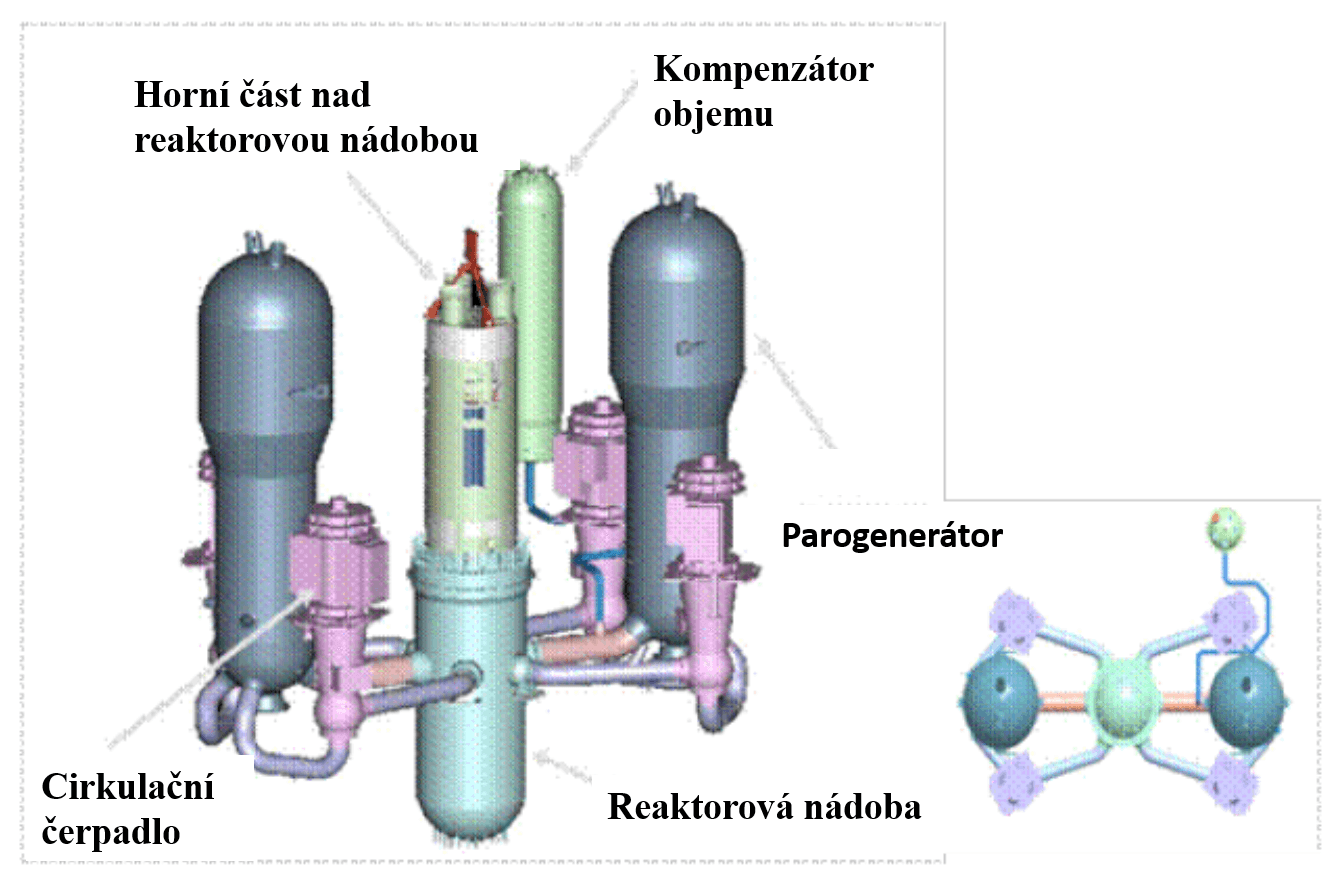
The APR-1400 reactor
The APR-1400 reactor is an advanced pressurised water reactor with a thermal output of 4000 MWt. It uses one turbine with one high-pressure and three low-pressure sections, rotating at 1800 revolutions per minute. It achieves a gross electrical output of 1455 MWe. Net electrical output is therefore around 1400 MWe, corresponding to an efficiency of 35.1%. The design annual capacity factor should exceed 90% and the minimum operating lifetime should be 60 years. The standard interval between refuelling outages should be 18 months.
The new reactor was developed based on experience gained with OPR-1000 reactors. Given its origins in the US System 80+, it also has a number of similarities with Westinghouse's AP1000 reactor. The primary circuit has two cooling loops. It is characterised by two large steam generators, each served by two circulating pumps. Pressure in the primary circuit is 15.5 MPa. The coolant temperature at the reactor inlet is 290.6˚C and at the reactor outlet 323.9 ˚C.
There are 241 fuel assemblies in the core. Each has 236 fuel rods. Uranium dioxide with average enrichment of 4.09% is used. Up to 33% of the core can use mixed oxide MOX fuel without major modifications.
The reactor is also designed for load-following, allowing output to be varied from 100% to 50% during the day. It allows output changes of 5% of rated power per minute. The reactor can therefore be used quite effectively for balancing.
Like other Generation III reactors, it has reinforced passive safety features and can cope with beyond-design-basis accidents involving core melt. Existing APR1400 reactors do not have a core catcher; its function is performed by flooding the reactor cavity with water. The containment has a single wall, but it is thicker and other safety system elements replace the protective functions of the double wall used in other designs.
An improved APR+ model was prepared, which was due to be built first at the new Cheonji plant. However, the plan for this project was cancelled. It is therefore a question of where and when the more advanced variant will be deployed.
Work is also under way on a modified, lower-output APR1000 design that could be attractive for Czechia. This would be a modified APR1400 scaled down to lower output.
Very importantly, with the assistance of Czech companies, the APR1400 reactor obtained EUR (European User Requirements) certification. It also recently obtained a construction licence in the United States. This has significantly increased its chances of winning contracts in the developed world.
Tour of APR1400 plants and Korean nuclear facilities
During the last week of March, I was invited, together with colleagues involved in educating nuclear specialists in Czechia, on a tour of South Korean nuclear technologies. The event was also attended by Igor Jex, dean of the Faculty of Nuclear Sciences and Physical Engineering at the Czech Technical University in Prague, my colleague Jana Jiřičková from the Faculty of Electrical Engineering at the University of West Bohemia in Plzeň, and colleagues Václav Dostál from the Faculty of Mechanical Engineering at the Czech Technical University in Prague and Kamil Števanka from the Faculty of Electrical Engineering and Communication Technologies at Brno University of Technology.
We first visited the Barakah nuclear power plant in the United Arab Emirates. I was also at Temelín shortly before its completion, and that is the best time to inspect it from top to bottom, enter the containment by the reactor vessel and see other areas that are difficult to access during normal operation. The Barakah plant was at a similar stage, so I was very much looking forward to the visit. And I was not disappointed. Unit 1, to which the organisers took us, was already completely finished and awaiting permission to load fuel. The guides really tried to show us as much as possible. We were able to inspect the inside of the containment, the turbine hall and the reactor control room in detail. The control room was then being used to train future operators. Even during our visit, a crew of young men was preparing there for their future work. Next to the control room was a break room, where the next crew waited over coffee for its time. Interestingly, they were women dressed in accordance with local custom.
In addition to the control room of the first unit, we were also able to see the simulator, which is an exact replica and where all kinds of emergency situations can be practised. We were guided there by a Canadian who has been involved in simulator development for a long time. Since the Emirates were starting from scratch, most experienced specialists had to come from abroad initially to train local staff. All communication during plant operation is, and will remain, exclusively in English. Verifying that all local and foreign employees are prepared for the conditions is one of the requirements for granting an operating licence.
The lunch was also interesting. It took place in the local canteen at a time when it was full of workers involved in the construction. Since most are from Korea, Korean food is served to remind them of home. Given their demanding work assignment in desert conditions, I consider this very important. And I must admit that the lunch was excellent. The only blemish on the whole plant visit was dust in the atmosphere following the previous day's sandstorm. For understandable reasons, we were not allowed to take photographs inside the plant. Photographs from a distance, where restrictions no longer applied, were affected by the dusty haze.
The following day, we moved on to Seoul in South Korea. It is in the northwest of the country, close to the border with North Korea. The Kori and Shin Kori plants, on the other hand, are on the southeastern coast, which we reached by train travelling at more than 300 km/h. Before reaching the plant, we toured the Doosan factory. Right at the entrance, we were greeted by a wind turbine blade, which is also manufactured there for turbines up to 3 MW. We visited the forge, where one of the world's largest forging presses operates, brought from Škoda Plzeň. We were able to see it in action. From there, we headed to a huge hall intended mainly for the nuclear business, where there was a large number of turbines at various stages of completion and different parts of reactor vessels. There were also crankshafts for large ships. A huge advantage of the factory is its own port, where two cranes operate, each with a lifting capacity of 800 tonnes, enabling them to load a component with a total weight of 1600 tonnes onto a ship.
At the Shin Kori plant, it is possible to see all stages of construction of the AP1400 reactor. Shin Kori 3 had already been operating for more than two years, while fuel had been loaded into Shin Kori 4 at that time and it was preparing to start up. Shin Kori 5 and 6 were at different stages of construction. We first visited the construction sites of the reactors being built. At both, the containment walls were gradually rising. One of the world's largest cranes was being used, capable of lifting up to 2100 tonnes. Activity at the construction site indicated that these reactors should be completed in the first half of the 2020s.
We then visited Shin Kori 4, where fuel had already been loaded. The reactor was thus preparing to begin the fission chain reaction. There we were able to see the control room and turbine hall. Finally, we toured the APR1400 unit that had already been supplying electricity to the grid for more than two years. We were also able to see the spent fuel pool with its characteristic bluish Cherenkov light produced by beta-decay electrons moving faster than the speed of light in water.
Directly beside the plant is KINGS University (KEPCO International Nuclear Graduate School), which focuses on enhancing the qualifications of workers, particularly in nuclear power. It therefore offers only master's-level education. The possibilities for cooperation between Czech universities providing education in nuclear fields and this university were discussed there. We also met the first two students from Czechia who were there for a semester-long stay. They were students from Brno University of Technology.
A very interesting visit was to the new low- and intermediate-level radioactive waste repository, WLDC (Wolseong Low and Intermediate Level Radioactive Waste Disposal Center), run by the Korean radioactive waste management agency KORAD. The waste comes from hospitals, industry, agriculture and research. Its radioactivity has a limited half-life of tens to hundreds of years. Although intermediate-level waste needs to be placed in an underground repository, its activity falls to the level of rocks with natural radioactivity in a relatively short time. The disposal site was selected in 2005. Construction of the first phase, comprising the underground part of the repository with six silos for 100 000 drums of radioactive waste, began in 2007. The first drums of radioactive waste arrived in 2010. Incoming waste must be checked and prepared for disposal. The first containers of drums were placed in a silo in 2015, when the first phase was completed. The hill containing the entrance to the underground repository resembled a beautiful park, with its greenery and large number of flowering cherry trees.
A major problem at present is activists blocking the transport of radioactive waste from the facilities where it arises to the repository. KORAD makes great efforts to reach the public, not only through its visitor centre. It is therefore surprising that its promotional materials do not emphasise the existence of natural radioactivity and comparison with the activity of low- and intermediate-level radioactive waste. Above all, they do not stress the fact that a large part of this waste comes from medical diagnostics using radionuclides and radiation therapy. Anyone demanding that artificial radioactivity not be produced would therefore have to forgo, for example, effective cancer treatment using proton therapy.
At the end of our stay in South Korea, we were able to look into the control room at KHNP's headquarters, which provides support for the operation of the company's nuclear and hydroelectric facilities. It also provides support to plants in the event of problems. Very experienced operators with many years of practice at power plants are available there, when needed, to consult and advise colleagues at specific plants.
The entire week-long event was perfectly organised and made it possible to gain a comprehensive picture of the development of nuclear technologies in South Korea and the potential for cooperation.
South Korea as a potential supplier for the Czech Republic
There are six potential nuclear reactors for Czechia: ROSATOM's Russian VVER1200 reactor, EDF's French EPR reactor, possibly the ATMEA reactor from EDF and Mitsubishi Heavy Industries, Westinghouse's US AP1000 reactor, China's HPR1000 reactor, and KEPCO's Korean APR1400 reactor or its smaller modification. In every case, these are Generation III reactors which meet Czech requirements from a general safety perspective. Safety, economic and geopolitical considerations will be assessed in detail in selecting and evaluating the individual options. Each of the suppliers mentioned has strengths and weaknesses in this respect.
A very strong point of the APR1400 reactor is the existence of several reference units in South Korea and abroad, as well as the rapid and relatively trouble-free progress of their construction. If at least the first unit in the United Arab Emirates is launched in the near future, this advantage will be even more pronounced. The existing presence of Korean investors and industry in Czechia could also be an advantage. Korean company Doosan bought part of Škoda Plzeň, so Doosan Škoda Power is one of the companies that could participate in building new units at Dukovany and Temelín. The potential and willingness to maximise the involvement of Czech industry in building units in Czechia and in the supplier's subsequent activities abroad will be among the important factors in its selection. From a geopolitical perspective, a South Korean supplier could be less controversial than a potential supply from Russia or China.
On the other hand, a weakness is that a 1400 MWe unit is too large for the size of the Czech economy and the needs of the Czech electricity grid. A smaller unit would be more advantageous. Its size could also pose a problem in transport. A reduced 1000 MWe variant of this reactor could be a solution in this regard. It is being considered, although the stage of preparation for such a project is unclear. It also remains a question whether completed APR1400 units could be regarded as reference units for this variant. Existing APR1400 reactors do not have double-walled containment, which has been seen as a shortcoming in Europe. This disadvantage is largely offset by the previously mentioned EUR (European Utility Requirements) licence obtained for a modified version of this reactor in 2017. In April this year, it was certified by the US regulator NRC for use in the United States.
South Korea could significantly improve its chances if it sought to offer its nuclear technologies and negotiate with potential customers in a coordinated way across Central Europe. European central authorities are putting growing pressure on Poland to replace its coal units. Nuclear power is one realistic option for replacement on a larger scale. Poland is therefore increasingly considering the construction of nuclear power plants. So far, it has not taken concrete steps to prepare construction and select a supplier, merely completing the selection of a site for its first nuclear power plant. Given Poland's size, it will need a larger number of units and reactor size is not a disadvantage. This also applies to transport, as Polish nuclear power plants will mostly be on the coast. Slovakia, too, will have to replace reactors at Jaslovské Bohunice, similarly to those at Dukovany in Czechia. With a comprehensive joint approach and a larger-volume offer, it would be possible to offer a better price. It would also make sense to efficiently localise a large part of the necessary component production in the region. For Czechia, which has considerable experience in nuclear power and a number of companies with potential in this field, this could be a significant opportunity. In connection with Poland's involvement, South Korea's chances would also rise because Poland would find it very difficult to use Russian reactors for geopolitical reasons.
Conclusion
Within a relatively short period, South Korea managed to move from purchasing turnkey nuclear units to developing its own reactor model, and it now has its own Generation III reactor. It has been able to build these units not only in South Korea but also abroad. The current technological level of Korean industry in this field is high. The anti-nuclear stance of the president and part of the political elite has become a certain handicap. Nevertheless, it still has great potential for exporting nuclear technologies and cooperation in this field. From the Czech perspective, the Korean reactor offer has a number of advantages, the greatest being the very good progress so far in constructing units in South Korea and the United Arab Emirates. Naturally, there are also weaknesses, which were discussed in the previous section.
In my view, however, cooperation in this field between the two countries is highly advantageous, regardless of which supplier of units for Czechia is selected. Under current globalisation, a wide range of different subcontractors is used in every project. If Europe is serious about the path towards low emissions and replacing fossil fuels, it cannot do without intensive use of nuclear sources. At present, capacity, and particularly human resources, among all potential suppliers and subcontractors is very limited, and every opportunity for cooperation and synergies between them will need to be used. I have tried to outline South Korea's potential; we will look at other possible suppliers of nuclear technologies another time.
A detailed overview of developments in nuclear power in 2018, including links to previous parts summarising developments in earlier years, is available here; an overview of current Generation III reactors is available here, here and here. A comparison of the financial requirements of different types of electricity sources is available here.
Acknowledgements: I would like to thank all the Korean organisers of our tour of the Barakah and Shin Kori nuclear power plants, the Doosan factory, KINGS University, KORAD's low- and intermediate-level waste repository, and KHNP headquarters. I particularly appreciate the excellent organisation, the maximum effort to show us as much as possible and to answer every question.
Written for oEnergetice and Osel.
Opening photograph: The first Korean nuclear units, from right Kori 1 and 2 (source: Igor Jex).
Translation disclaimer
This article is a machine translation of the Czech original and has not yet been fully reviewed. In case of any doubt, please refer to the Czech version.
Sdílejte článek prostřednictvím:
You might also like
23 October 2026, 11:01
23 October 2026, 06:34