
23 October 2026, 14:38
Loading...
New Chinese fusion record promises to speed up the arrival of fusion power plants
Vladimír Wagner
22 February 2025, 08:13
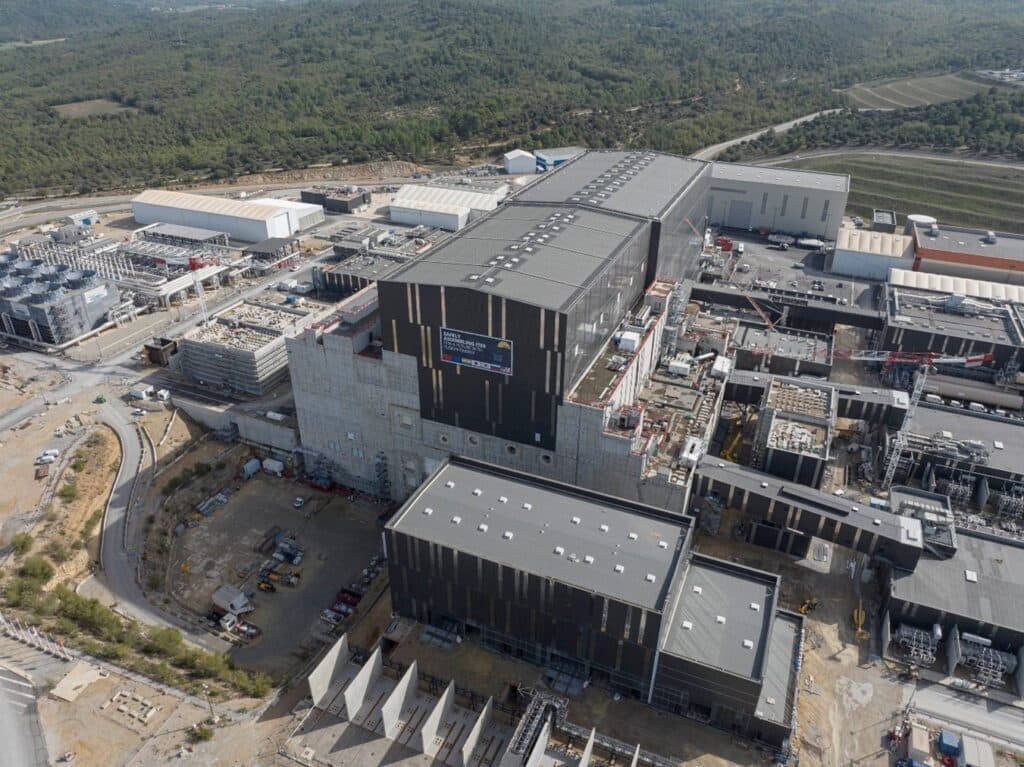
At the start of 2025, China’s EAST tokamak surpassed its previous world record for the duration of fusion plasma confinement. For the first time in history, the thousand-second mark was exceeded. This is another step bringing the use of fusion energy closer. China is working intensively on further facilities and is taking the lead in this field as well.
A detailed review of the current state of thermonuclear fusion research and the records achieved was published at the beginning of last year.
On 20 January 2025, China’s EAST (The Experimental Advanced Superconducting Tokamak), operated by ASIPP (The Institute of Plasma Physics under the Chinese Academy of Sciences) in Hefei, achieved plasma confinement in so-called H-mode for 1066 s. It thus improved on its own record of 403 s, which had surpassed the previous record of 390 s achieved in 2003 by the French TORE Supra tokamak. These records were discussed in the aforementioned review. During them, electron temperatures reached and exceeded the 100 million degrees required for tritium-deuterium fusion reactions.
The EAST tokamak is a medium-sized tokamak built entirely using superconducting magnets. Its magnetic field configuration is similar to that of the future ITER tokamak. The experience gained from it is therefore highly useful for this facility under construction. It is simply smaller. Its major radius is 1.85 m, minor radius 0.45 m, plasma current 1 MA and toroidal magnetic field strength 3.5 T. The tokamak focuses on long-term plasma confinement while achieving the transition from low confinement (L-mode) to high confinement (H-mode), with L standing for Low and H for High.
As temperatures rise, ohmic heating by the plasma current becomes increasingly less effective. This is because plasma conductivity rises very rapidly as its temperature increases. Other methods of heating the plasma must therefore be used. One is microwave radiation, while another is the injection of neutral atom beams, which transfer their kinetic energy to the plasma through collisions and raise its temperature. They must be neutral in order to penetrate deep into the plasma before losing their electrons in collisions and transferring their energy through ionisation. Acceleration uses electric fields, so only charged ions can be accelerated. The ions must therefore be accelerated and then neutralised before entering the plasma.
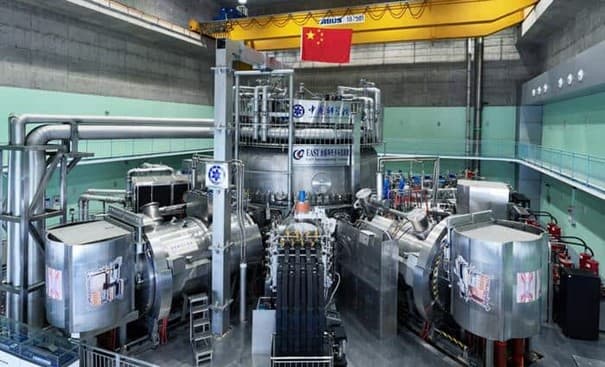
The superconducting EAST tokamak, which achieved a new record for plasma confinement duration in January 2025 (source: Hefei Institute).
In the 1980s, various methods of supplementary plasma heating were tested at the ASDEX tokamak in Garching, Germany. It was found that at a certain heating power, a spontaneous transition to a specific plasma confinement mode can occur. Turbulence and instabilities are suppressed, and the plasma is better separated from the vessel walls, leading to more effective confinement. This is the already mentioned high-confinement H-mode. The transition from low confinement in L-mode to high confinement in H-mode became a breakthrough discovery on the path towards ensuring long-term plasma confinement stability under conditions necessary for fusion reactions. The design and shape of the vacuum chamber, which can limit contact between the plasma and the chamber, are also important for enabling the transition. Designs with a so-called divertor and an optimised composition of the materials used for the inner chamber wall surface have an advantage. A divertor is a structure in the lower part of the vacuum vessel that uses specially shaped magnetic fields to remove impurities from the plasma. The transition from L-mode to H-mode need not be abrupt, and an intermediate confinement regime known as I-mode (I for Intermediate) may exist between them.
The transition from L-mode to H-mode plasma confinement is an important element of progress in plasma confinement research at the Chinese tokamak. Its design facilitates such a transition. At lower parameters, the EAST tokamak had already exceeded 1000 s of confinement, as mentioned in the earlier review. In that case, it reached 1056 s, but only in the transitional I-mode. It has now achieved long-term plasma confinement in H-mode. The key to success was precisely the improvement of microwave heating, which made it possible to double the thermal power supplied while ensuring stable plasma confinement. The focus is now shifting to studying intensive external heating and increasing its power. This enables the transition to H-mode and long, stable plasma confinement. Further improvements in the EAST tokamak’s parameters can therefore be expected.
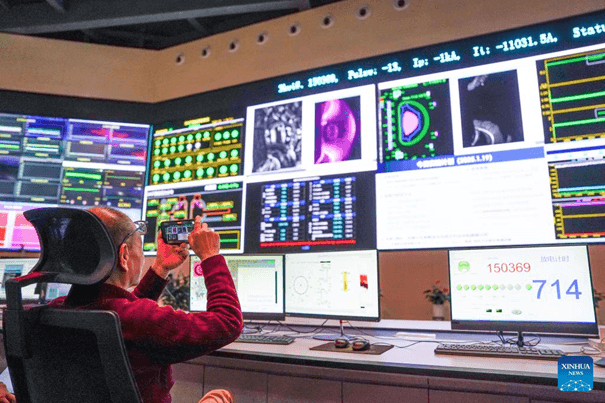
EAST tokamak director Gong Xianzu in its control room during the record-setting discharge (source: EAST Xinhua/Zhou Mu).
The pace of fusion research development in China is growing rapidly
China has two other tokamaks. These include the HL-2M (Huan-Liuqi-2M), a recently upgraded version of the HL-2A tokamak at SWIP (Southwestern Institute of Physics) in Chengdu. Its magnets are not superconducting. Its major radius is 1.78 m, minor radius 0.65 m, magnetic field strength 2.2 T and plasma current 3 MA. The HL-2A tokamak had been in operation since 2002, while its improved HL-2M version started up in 2020.
Another is J-TEXT at Huazhong University of Science and Technology in Huazhong. It has a major radius of 1.05 m and a minor radius of 0.29 m, with magnetic field strength of 2.0 T and plasma current of 0.2 MA.
China is also working intensively on further tokamaks and fusion facilities. The new BEST (Burning Plasma Experimental Superconducting Tokamak) is expected to be completed in Hefei in 2027. Like the decommissioned JET tokamak in the UK, it is expected to focus on studying deuterium-tritium reactions. Its planned fusion output is 130 MW. China is offering the international community participation in research using this facility.
The CFETR (The China Fusion Engineering Test Reactor) is intended to study engineering challenges associated with an actual thermonuclear power plant. Its major radius is expected to be 7.2 m and its minor radius 2.2 m, with magnetic field strength of 6.5 T and plasma current of 14 MA. The new tokamak is intended to bridge the gap between ITER, in which China is also participating, and the DEMO demonstration fusion power plant. Construction is expected to begin during the 2020s, with start-up in the 2030s. In its first phase, it should generate up to 200 MW of fusion energy, and in its second phase up to 1 GW. Its most important task, however, will be to study suitable materials with very high thermal and radiation resistance for the inner walls and to develop a blanket suitable for converting released energy into heat and producing tritium fuel. It is also to be located in Hefei. ASIPP in Hefei is thus gradually becoming one of the largest research centres focused on thermonuclear fusion.
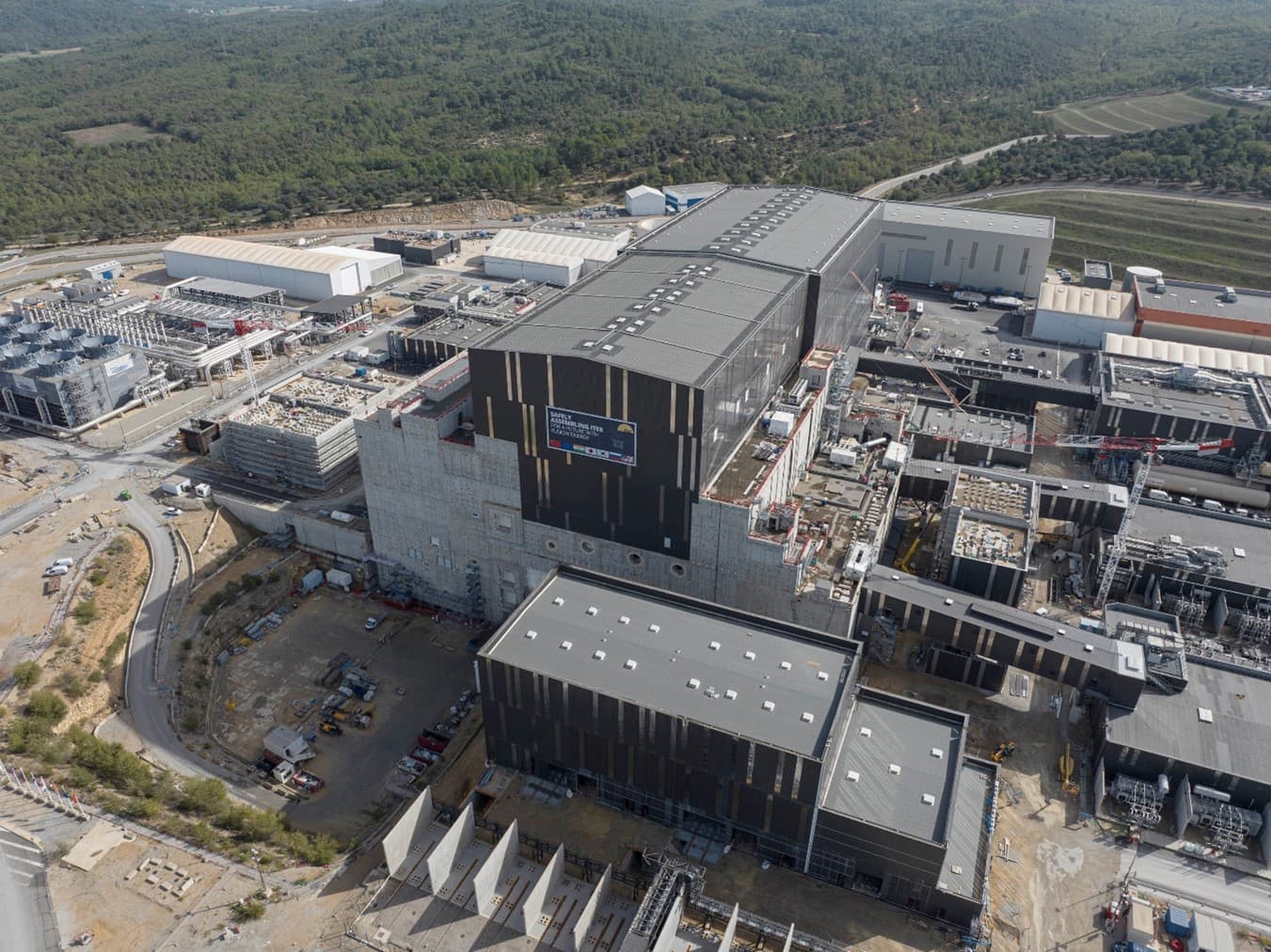
Aerial view of the ITER tokamak site from October 2024 (source: ITER).
China is involved in the ITER project
China is heavily involved in the ITER project, with a share of roughly 9 %. Its major radius is 6.2 m and its minor radius 2 m, magnetic field strength is 5.3 T, and plasma current will be 15 MA. Overall, it is expected to produce 500 MW in fusion reactions. The timetable for completing and operating the facility was recently reassessed. As reported in an article last year, the COVID-19 pandemic, management problems, the death of the project director in 2022, technical issues and design changes have caused considerable delays.
It is therefore clear that the planned first plasma will certainly not take place in 2025. There will be a major delay. The first plasma has been pushed back by almost ten years. At the same time, however, it was decided that tritium-deuterium mixtures should be used relatively soon afterwards. This would avoid the planned interruption and modifications, which will now be carried out during the current installation. The delay to tritium experiments should therefore be only a few years. Assembly and completion of the tokamak should continue until 2033. First plasma should be achieved in 2034 to 2035. Tritium experiments should begin in 2039.
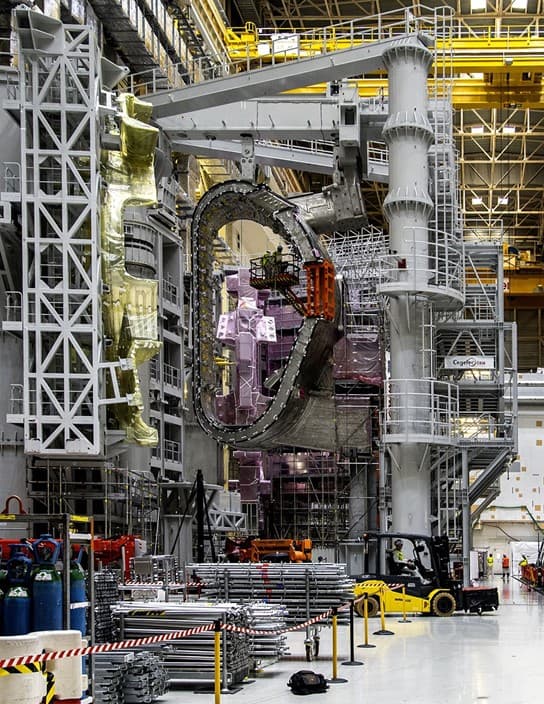
Following the dismantling and repair of the first installed vacuum vessel segments, their reassembly has begun (source: ITER).
Conclusion
As can be seen, China is determined to achieve a breakthrough in thermonuclear fusion and to be the first to ultimately build a fusion power plant. To this end, it is making very intensive use of strong support, not only financial support, within China itself, as well as international cooperation. It has become deeply involved in the construction of ITER and is inviting experienced colleagues from around the world to cooperate in using some of its facilities.
If ITER suffers further dramatic delays, China is, in my opinion, capable and determined to take the lead in fusion research on its own. In any case, it is preparing research facilities in parallel to study materials with very high thermal and radiation resistance. High neutron fluxes will be provided by new spallation neutron sources, which are also being developed to research advanced fission technologies in the form of accelerator-driven transmutation systems. An actinide blanket could be used to multiply the neutrons needed to produce tritium from lithium in a fusion power plant. Such hybrid fusion-fission systems could be used to dispose of spent fuel from fission reactors and to make fusion energy economically viable. It is, of course, a question whether a pure fusion power plant or a hybrid fission-fusion system would be preferable. However, China wants to be prepared for both options.
China ultimately wants to build its DEMO prototype fusion power plant as soon as possible, which would put it at the forefront of global development in this area as well. This is in line with China’s overall strategy of becoming a leader in global scientific and technological development. This is evident in artificial intelligence, biotechnology and the use of genetic engineering. I wrote in a recent article that the successor to the largest LHC accelerator will probably be built in China. It is increasingly likely that the Chinese may ultimately overtake the Americans in humanity’s return to the Moon. This issue is discussed in greater detail in an earlier article.
Thanks to the Institute of Plasma Physics of the Czech Academy of Sciences and its long-standing tokamak research, Czechia is at the forefront of European fusion efforts. It is very well established in the ITER project, and the COMPASS-Upgrade tokamak currently under construction, with a major radius of 0.894 m, minor radius of 0.27 m, magnetic field strength of 5 T and plasma current of 2 MA, will enable us to remain at the forefront of global efforts to build a fusion power plant. This is why there has been discussion of locating Europe’s DEMO prototype demonstration fusion power plant in Czechia. The country’s highly capable industrial base for nuclear technologies could also be used here. Let us keep our fingers crossed that both the European Union and Czechia retain their leading position in these technologies.
I sought to provide a popular explanation of the comparison between thermonuclear fusion in stars and fusion in terrestrial laboratories in an earlier lecture for the cosmology section.
Translation disclaimer
This article is a machine translation of the Czech original and has not yet been fully reviewed. In case of any doubt, please refer to the Czech version.
Sdílejte článek prostřednictvím:
Topics:Opinion
You might also like
23 October 2026, 11:01

23 October 2026, 06:34