23 October 2026, 14:38
Loading...
Nuclear energy in 2022 – Part 3: Small modular reactors in Czechia
Vladimír Wagner
19 February 2023, 08:21

Interest in small modular reactors is currently increasing dramatically. However, only a few are in operation or under construction, and it remains a very open question whether they will meet the expectations placed on them. Let us look at the current situation and progress in recent years.
Small modular reactors being commissioned
Russia and China are also the furthest ahead in this field. Russia is using reactors designed for icebreakers for its first small modular reactors. Let us therefore first look at what is new in this area.
The first serial nuclear icebreaker of the Project 22220 type, named Sibir, was officially commissioned at the beginning of 2022. The prototype icebreaker of this project, Arktika, was already operating in the Arctic Ocean at that time, escorting ships along the Northern Sea Route. It was joined by the icebreaker Sibir. The icebreaker Ural was also completed, with its reactor started up for the first time at the end of May 2022. By the turn of 2022 and 2023, all three were assisting ship convoys in northern Russia. These vessels are 173.3 m long, 34 m wide and 52 m high overall. Their crew numbers 53 people. They can break through ice up to 2.8 m thick.
Completion is continuing on further icebreakers in this series, Yakutia and Chukotka. Work was carried out on RITM-200 reactors for the icebreaker Yakutia during 2022, and in January 2023 the second reactor for the icebreaker Chukotka was already being assembled. The icebreaker Yakutia was launched at the end of November 2022. It should be completed in 2024, while Chukotka is due in 2026. At the end of 2022, funding was allocated for two further icebreakers of this type, which should be completed in 2028 and 2030.
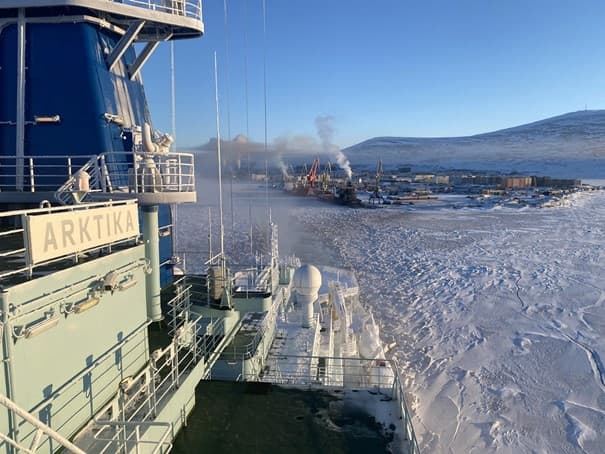
The icebreaker Arktika routinely escorts ships in northern Russia (source: Rosatom).
Production of specific components for the more advanced Project 10510 Lider icebreakers is beginning. Work has already started on the RITM-400 reactor for these icebreakers. Intensive work is already under way on the first of these vessels, which should be completed in 2027.
Russia intends to use the same RITM-200 reactors employed on nuclear icebreakers in floating nuclear power plants and land-based small modular reactors to be built in Siberian regions. These should later also use RITM-400 reactors. Specific projects are being prepared for gold deposits in Yakutia. Geological surveys in the Ust-Yansky District of the Sakha Republic should take place in 2022 to 2024. Such a power plant is expected to have two RITM-200 reactors. Kyrgyzstan is also interested in this type of plant.
Vessels for the first four serial floating nuclear power plants with RITM-200 reactors are being built in China. They are 140 m long, 30 m wide and weigh 9 549 t without equipment and 19 088 t with equipment. The first of them should be delivered to Russia in 2023.
The floating nuclear power plant Akademik Lomonosov has been successful and expanded heat supplies to further areas of the city of Pevek. In 2022, it therefore began supplying hot water to the entire city.
The start of construction of the ACP100 (Linglong One) small modular reactor at the Changjiang plant in July 2021 was covered in the previous overview. It should have a capacity of 125 MWe. At the end of February 2022, the lowest cylindrical metal section of the containment, 15 m high and weighing 450 t, was installed. Structures were then progressively installed and foundations built for the placement of the reactor vessel. At the same time, the foundations of the turbine hall were concreted. The upper section was installed in July 2022, 70 days ahead of schedule. Installation of equipment began in December.
The previous overview reported on the start-up of the HTR-PM200 high-temperature gas-cooled small modular reactor. It reached full rated output on 9 December 2023.
Conventional small modular reactors under development
Events in recent years have also accelerated efforts to deploy small modular reactors in the West. The US NuScale project changed its name to NuScale VOYGR, but it is still generally referred to by its original name. It has now moved from 50 MWe modules to 77 MWe modules. In August 2022, the project became the first small modular reactor to pass certification by the US nuclear safety authority, NRA. However, it should be noted that the design certified was for 50 MWe modules. The first plant is to be built with the number of modules reduced from twelve to six at Idaho National Laboratory. Preparatory work is already under way there, primarily geological and seismological surveys as well as a comprehensive analysis of the specific construction site and all potential risks. In principle, plant configurations with four, six and twelve modules are envisaged for future offerings. In addition to the US supply chain, components should also be manufactured by South Korean company Doosan Enerbility.
Construction of these plants is being considered in a number of locations across the US. These include Dairyland, which owns the site of the decommissioned La Crosse plant in Wisconsin. The decommissioning of this retired 70 MWe boiling-water reactor was covered in detail in an earlier article on Osel. The company would now like to build a NuScale plant there. Talks have begun with industrial companies, such as KGHM Polska Miedź SA, on possible use of this reactor in Poland. There, it would replace coal-fired power plants. Romania also wants to build NuScale reactors. Estonia is also considering them. There are even proposals that NuScale modules could be used to build floating nuclear power plants.
The SMR-160 reactor is a product of Holtec, which has long worked in the field of nuclear technologies. It will use standard fuel from Framatome. In the first half of 2022, it agreed to cooperate with Mitsubishi Electric on this project. There are several candidate construction sites, including the former Oyster Creek nuclear power plant, whose sole reactor was shut down in 2018 after 50 years of operation. Holtec hopes that the first SMR-160 reactor will be completed in 2029.
The Rolls-Royce pressurised water reactor should have an electrical output of 470 MWe, exceeding the threshold conventionally stated for small modular reactors and corresponding to the output of the current reactors at Dukovany. In 2022, documentation was being prepared for the reactor's assessment by the UK nuclear safety authority, namely the Generic Design Assessment (GDA); the first stage of certification began in March 2022. Locations for the construction of the first of these reactors in England and Wales are currently being selected, while a site is also being sought for the main manufacturing facility. The Netherlands would like to use the reactor, and Estonia is also considering it.
US-Japanese company GE Hitachi is developing the BWRX-300 boiling-water reactor. The first project should be built at the Darlington plant in Canada. It belongs to OPG (Ontario Power Generation) and would be located next to the existing CANDU units. It is intended to be completed in 2028. The Canadian province of Saskatchewan is also considering it. TVA (Tennessee Valley Authority) also wants to build the same reactor at Clinch River near Oak Ridge. Sweden is also discussing cooperation and use of the BWRX-300 reactor. Construction of at least ten of these reactors is being considered in Poland. It is also one of three small modular reactors invited by Estonia's Fermi Energia to take part in its tender.
French company EDF has also begun working on a small modular reactor project. The NUWARD plant should consist of two pressurised water reactors, each with an output of 170 MWe. Belgian company Tractebel has also joined work on the project. Construction of a demonstration unit should begin in the early 2030s. EDF is beginning to offer the reactor alongside its large Generation III reactors. Talks on cooperation and possible use are being held with a number of countries, including Poland and Czechia.
The Baltic states of Lithuania, Estonia and Latvia are considering the possible use of small modular reactors. In the Czech Republic, a site for the first reference small modular reactor was selected at the Temelín nuclear power plant site. The South Bohemian Nuclear Technology Park should support the development of small modular reactor deployment in Czechia. Its founders are the South Bohemian Region, ČEZ a.s. and ÚJV a.s. They cooperate with several potential suppliers, including NuScale, BWRX-300, Rolls-Royce, NUWARD and SMR-160. A preliminary geological survey of the selected site was completed in 2022. Czech industrial companies, such as Škoda JS, are also becoming involved in small modular reactor projects. At the same time, possible sites for these facilities are being intensively assessed; they are expected to gradually replace existing coal-fired combined heat and power plants and heating plants.
Previous overviews have already reported that four small modular reactor projects are under development in the Czech Republic. Two are of the conventional type and are expected to use VVER fuel assemblies. The first is the heavy-water Teplátor, designed solely for heat production, while the second is the light-water David reactor for electricity and heat generation. The other two are the advanced EnergyWell reactor cooled by molten salt and the high-temperature helium-cooled HeFATSo. Last year, UJV a.s. and CVŘ s.r.o. began developing another conventional-type small modular reactor, the CR-100. It would be a pressurised water reactor with a thermal output of 100 MWt. It would use fuel assemblies for VVER-type reactors and, to the greatest possible extent, other established and proven technologies. This should lead to faster implementation of the project and licensing process. From this perspective, I see a slight problem in the fact that the VVER fuel assemblies should be shortened, although the David project is also moving towards the use of shortened VVER fuel assemblies. It is therefore important to discuss with manufacturers whether they will supply such fuel and to take its licensing into account.
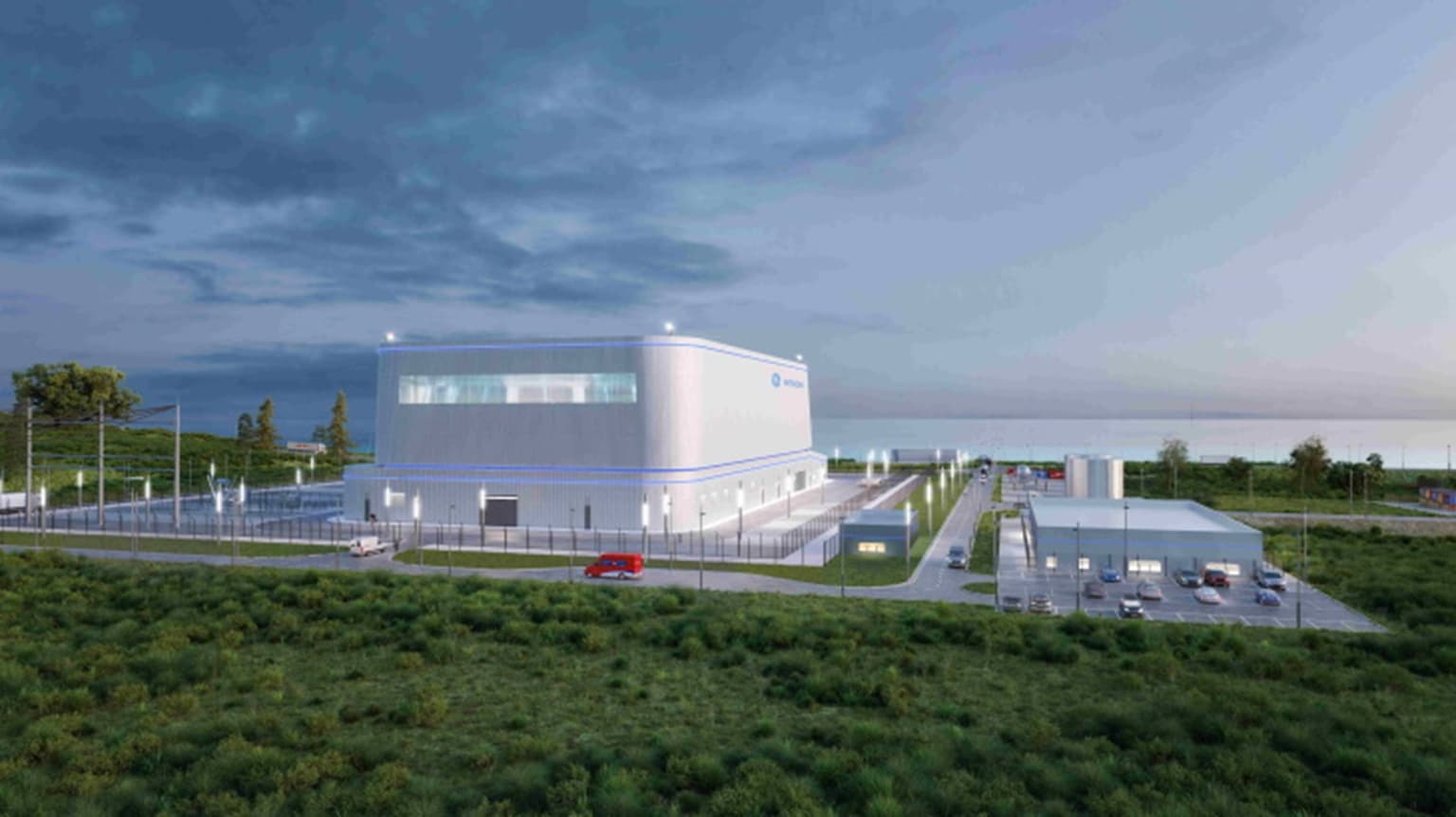
Visualisation of the BWRX-300 small modular reactor (source: GEH).
Advanced small modular reactors under development
In addition to conventional light-water concepts, advanced types of nuclear reactors are also being developed, although their deployment can be expected much later. Some of them are already being commissioned, however. These include the Chinese high-temperature helium-cooled HTR-PM200 reactor. Among those still only on paper, we have already mentioned the Czech EnergyWell and HeFASTo concepts.
At the beginning of 2022, the US nuclear safety authority NRC halted its review of the Aurora reactor. The fast reactor, with an electrical output of 1.5 MWe, is intended to use heat pipes and supercritical carbon dioxide for cooling. It is expected to use HALEU (High-assay Low Enriched Uranium) metal fuel. Oklo Power's wants to build the first reference reactor at INL (Idaho National Laboratory). The justification for the rejection cited missing material information that the applicant should provide. During 2022, the company then took a number of steps to successfully complete the licensing process in the future.
The Xe-100, proposed by start-up X-energy, is also a high-temperature gas-cooled reactor concept. It is a pebble-bed reactor using TRISO fuel, with modules expected to have a thermal output of 200 MWt and an electrical output of 80 MWe. Plants with up to 12 modules should be composed of these. In addition to electricity, they could also supply industrial heat. The ratio between heat and electricity supply would vary according to the needs of the particular project. The first operating facility is planned in Washington state by 2028.
The TerraPower reactor will be delayed by two years. The reactor will therefore not start up before 2030. This is linked to Russia's invasion of Ukraine. It is a sodium-cooled fast reactor with an expected electrical output of 345 MWe. The fuel required for such a reactor must have higher enrichment than that used in conventional reactors. HALEU fuel is therefore envisaged. However, it is not yet produced in the US, so the original plan was to purchase fuel from Rosatom in Russia during the first years. This has now changed. Western fuel of this type will not be available until later. Only at the beginning of February were advanced centrifuge cascades completed that will enable, for now, demonstration production of enriched uranium for this fuel in Piketon. Such fuel is needed by a number of planned fast reactors, not only small modular ones. Japan, which has experience with sodium fast reactors through the construction and operation of the Joyo and Monju reactors, has also begun cooperating on the development of this reactor.
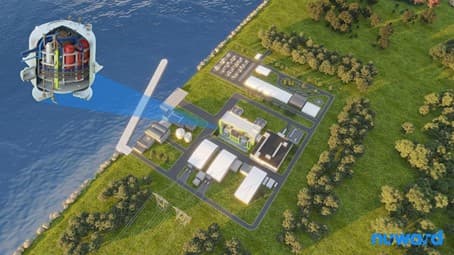
Visualisation of the NUWARD small modular reactor (source: EDF).
TerraPower, which is also backed by Bill Gates, is also working on the MSRI fast small modular reactor using fuel dissolved in liquid salt. The advantage of reactors using liquid salts is that, with suitable configuration, they could enable the efficient use of thorium and spent nuclear fuel. In this case, the intended application is at mining fields and petrochemical plants in the Canadian province of Alberta.
Another interesting liquid-salt concept is the ThorCon TMSR-500 reactor (ThorCon Molten Salt Reactor). In this case, the total electrical output of two modules would be 500 MWe. The US company wants to supply these reactors to Indonesia, including in the form of floating nuclear power plants. Companies from Spain and Norway are involved in cooperation on such floating plants.
There are a number of other projects using liquid salts as coolant or in the form of liquid fuel, including floating nuclear power plants. These include Canadian company Terrestrial Energy's IMSR (Integral Molten Salt Reactor) project, a liquid-salt-cooled reactor with an electrical output of 195 MWe. However, when the first of these will enter operation remains very uncertain.
A large number of microreactors and minireactors with outputs of fractions of, or single-digit, MW are also under development. They are generally economically viable under specific island-mode conditions where lower output is required. Canada is therefore showing strong interest in such reactors for mining and industrial enterprises in the North, as is Russia for similar reasons. One such microreactor is Project Pele, which is developing a high-temperature gas-cooled microreactor with an output between 1 and 3 MWe using HALEU fuel. Another example is the 5 MWe eVinci microreactor using heat pipes. This brings us to reactors in the category being prepared for space, such as Kilopower. With humanity's return to the Moon and expansion to Mars, the intensity of space reactor development has increased significantly. I gave a more detailed lecture on space reactors for the Mars Society in Opava.
Lecture, “Czechia and low-emission energy”, for the Vision for Czechia conference in Tábor.
Translation disclaimer
This article is a machine translation of the Czech original and has not yet been fully reviewed. In case of any doubt, please refer to the Czech version.
Sdílejte článek prostřednictvím:
Topics:Opinion
You might also like
23 October 2026, 11:01
23 October 2026, 06:34