23 October 2026, 14:38
Loading...
Nuclear energy in 2023, part 2: Nuclear renaissance begins in Europe
Vladimír Wagner
20 January 2024, 08:35
Just as in the Czech Republic, a nuclear energy renaissance is also beginning in Europe. A number of European Union countries are therefore continuing efforts to extend the operation of existing nuclear reactors for as long as possible. In Belgium, a final agreement was concluded between French company Engie and the Belgian government to extend the use of the Tihange 3 and Doel 4 units by another ten years. It defines the conditions for preparing them for further long-term operation during the upcoming outage. The operating lives of existing units are being extended in a number of European countries, including the Netherlands, Sweden, Switzerland, Slovenia, Hungary and Slovakia. Let us take a closer look at some interesting examples.
The Finnish Loviisa plant received a licence to operate its two VVER440 units for a total of up to 70 years, until 2050. This is a significant development for us because it has the same reactors as the Dukovany plant. However, they are older, so their example will show us how long they can realistically be operated.
Finland's example also shows that securing Western fuel for Russian VVER1000 and VVER440 nuclear reactors is very important for the European Union. Western fuel is already being offered for VVER1000 reactors. At Ukraine's request, Westinghouse has completed the development of fuel for VVER440 reactors. It is now being tested at the Rivne nuclear power plant. French company Framatome has also begun work on such fuel at Slovakia's request. Western nuclear companies are seeking to create an alliance capable of supplying fuel for Russian reactor types.
France is gradually addressing problems with stress corrosion cracking in welds that emerged at some units in its nuclear fleet. It has also managed to overcome delays caused by the postponement of outages during the COVID-19 pandemic. This year, nuclear electricity generation thus met planned levels and will fall within the target range of 310 to 330 TWh. Last year, it was only 272 TWh. The outlook for the start-up of the EPR reactor, the third unit at Flamanville 3, has not changed. It should start operating in the first half of 2024. At the same time, the entire fleet of French reactors should be in even better condition than it was this year. It can therefore be expected that generation will continue to grow in the coming years.
France has 32 reactors of its oldest type, with an output of 900 MWe, which were commissioned between 1977 and 1988. It plans to extend the use of these units beyond the 40-year threshold, which some of them have already surpassed. So far, licences have been granted for another decade of operation following comprehensive inspection and upgrades. In 2023, comprehensive overarching rules were established for extending operation beyond 40 years. In some cases, the nuclear regulator allowed delays to certain upgrades that could not be completed sufficiently quickly. The first reactor to receive a licence for another ten years of operation under these rules was Tricastin 1, which entered commercial operation in 1980. The standardisation of this licensing is very important for France given the ageing of its reactor fleet.
France is also intensifying preparations for the construction of new units. Preparations for the project for a pair of EPR2 units at the Penly plant have progressed furthest. EDF has begun preparing documentation for approval of the construction of these units and their grid connection. Actual construction work should begin in mid-2024 with site preparation. A second pair should be built at the Gravelines plant, while construction of a third pair at the Bugey plant was approved in 2023. The successes and problems of French nuclear energy were described in detail in a recent article.
Other European countries are also working on the construction of new units. The French company has also dealt with another outstanding issue. Finland's Olkiluoto 3 unit entered commercial operation at the beginning of May 2023, following its start-up in the previous year.
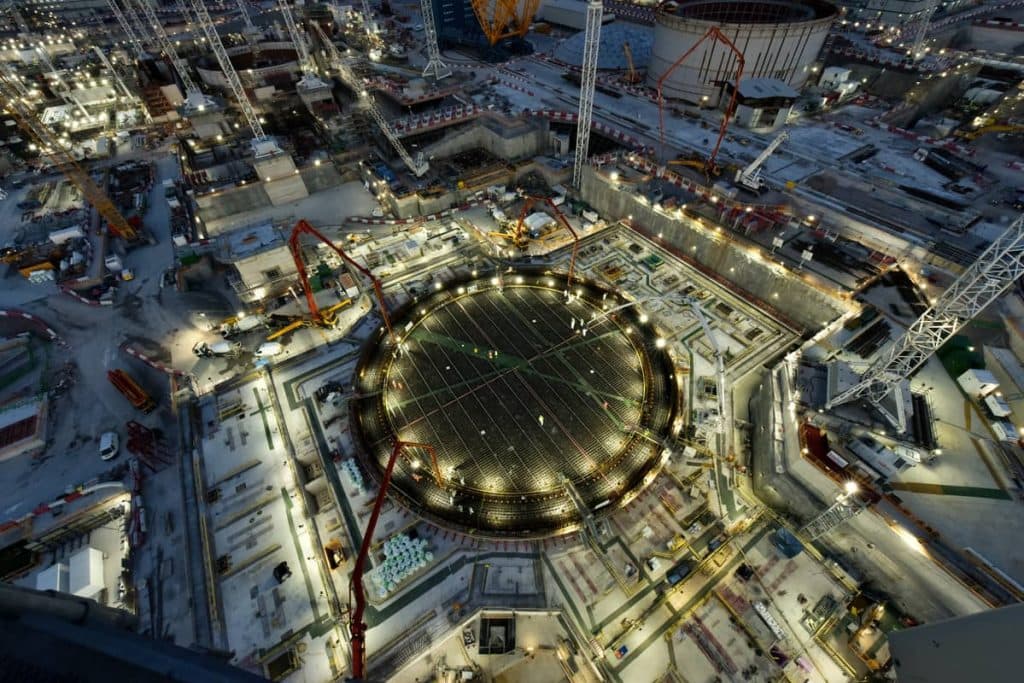
Following completion of the EPR units at Olkiluoto and Flamanville, attention is focused on construction of a pair of these reactors at the UK's Hinkley Point C plant. The key question is whether the problems that emerged during construction of previous EPR units can be avoided and experience from their construction put to use. In April 2023, the central structure housing the reactor and the pool allowing fuel replacement was installed at the plant's first unit. This was one of the key stages in its construction. At the beginning of December, the gantry crane was put in place, and in mid-December 2023 the containment dome was installed using the largest crane, Big Carl. It weighs 245 tonnes, is 14 m high and has a diameter of 47 m. The crane had to lift it to a height of 47 m. At the beginning of August 2023, the last of 116 pylons for the 57 km-long 400 kV transmission line that will carry electricity from the plant was erected. The reactors should start operating in 2027 and 2028.
The Sizewell C project, which is also to feature a pair of EPR reactors, received three important permits concerning environmental impacts. The search for investors and refinement of the financing model are continuing. Preparations for the future construction site are also under way.
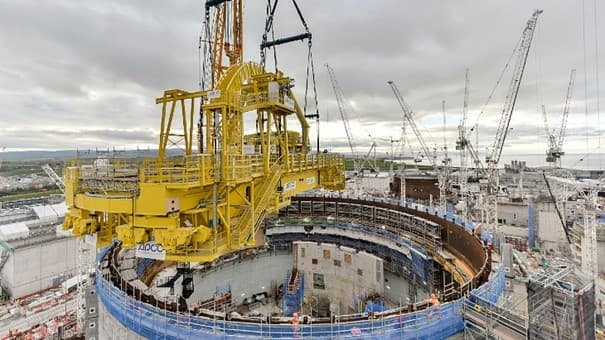
Installation of the gantry crane at the first Hinkley Point C unit (source: EDF)
It was already reported in the previous overview that the Mochovce 3 unit in Slovakia began start-up at the turn of 2022 and 2023. In mid-January 2023, power start-up began following the successful completion of physical start-up. By mid-February, the unit was operating at 35 % of its nominal output, and at the turn of March and April it reached 55 % output. In mid-July, output was increased to 75 % of nominal capacity, by mid-August it was operating at 90 % of nominal output, and it reached nominal output at the end of September. By early November, the reactor had entered commercial operation. Slovakia thus became self-sufficient in electricity generation while also securing a low-emission generation mix. Once the fourth unit is completed, it will also become an exporter of low-emission electricity, at a time when its neighbours will lack it.
Slovakia is also continuing preparations for a new nuclear source at the Jaslovské Bohunice plant. This is being handled by JESS (Jadrová Energetická Spoločnosť Slovenska), in which Slovak company JAVYS holds 51 % and Czech company ČEZ holds 49 %. The new source should replace the ageing VVER440 units. They entered operation in 1985 and are expected to operate for at least 60 years. There is therefore ample time to replace them. In mid-February 2023, the project received a siting permit. An application for a construction permit is planned for 2025, with construction expected to begin in 2031. Another nuclear power plant is also being considered in Slovakia. It would be built at the site of the current Vojany coal-fired power plant or near the village of Kecerovce.
Significant progress was made in 2023 in preparations for nuclear projects in Poland. In the first half of 2023, Polskie Elektrownie Jądrowe (PEJ), Bechtel and Westinghouse signed a contract to prepare the project for the country's first nuclear power plant. At the end of September, Poland's General Directorate for Environmental Protection (GDOS) granted permission to build the plant. It should be located on the coast at Lubiatowo and Kopalino in Pomerania. The project then received a zoning decision from the Pomeranian Voivodeship in autumn. Three AP1000 reactors are to be built. Work on the project could therefore begin, with construction planned to start in 2026 and the first unit to be completed in 2033.
At the same time, ZE PAK, Polska Grupa Energetyczna and South Korean company KHNP signed a memorandum of intent to cooperate on a nuclear power plant project at Patnów in central Poland using at least two South Korean APR1400 reactors. At the end of November 2023, this project also received a GDOS permit.
Poland is also considering the use of small modular reactors. Orlen Synthos Green Energy examined dozens of potential sites. It selected seven of them as optimal locations for GE Hitachi's BWRX-300 reactor. It now plans more detailed geological surveys there. At the end of the year, Poland's Ministry of Environment authorised the construction of 24 small modular reactors at six locations.
A number of Western companies are to participate in the construction of two VVER1200 units in the second phase of the Paks plant. They include France's Framatome and Germany's Siemens AG. Their involvement depends heavily on the status of sanctions against Russia over its invasion of Ukraine. So far, this area has not been subject to sanctions. However, there is greater criticism in Germany of German companies' participation. Should they withdraw, they could be replaced by the French companies. At the end of the year, European Union bodies excluded the Paks II project from the twelfth package of sanctions against Russia. The reason was the importance of the project for both Hungarian and European energy systems. Earthworks were being completed at the construction site, where the excavation reaches depths of up to 26 m in some places, and walls preventing groundwater ingress were being built. Hungary is preparing to extend the operation of its existing four VVER440 units to 70 years.
In Bulgaria, preliminary agreements were signed with Westinghouse to prepare a project for two AP1000 units at the Kozloduy plant. In June 2023, an agreement was then signed with Westinghouse to develop a project for the construction of one or more AP1000 units at Kozloduy.
Romania agreed with KHNP on the refurbishment and upgrade of the first unit at the Cernavodă plant. It has two heavy-water reactors, which Romania wants to keep in operation for as long as possible. The same company will also supply tritium removal equipment, as far more tritium is produced in heavy-water reactors than in light-water reactors. Romania could also use them for tritium production and become a major producer in Europe. It is also preparing to complete two partially built units, for which it plans to cooperate with the US and Canada.
A number of other European Union countries are planning to build new large nuclear units as well as small modular reactors. Sweden and Finland plan to cooperate in this area. Sweden has changed its energy strategy from a path towards a renewable mix to a path towards a low-emission mix, including the use of new nuclear sources. Although it already has a low-emission mix, it needs to maintain it amid the growing electrification of all sectors. Construction of new units will therefore no longer be restricted by number or location, as it has been under Sweden's energy strategy to date.
Construction of new units is planned in the Netherlands. It is considering building two Korean reactors at the Borssele plant. In autumn 2023, an agreement was signed with KHNP to prepare a feasibility study for the project. A similar contract was also signed with EDF for the use of French reactors. Slovenia wants to build a second unit at the Krško plant. In principle, all the bidders known from the Dukovany tender can offer their reactors there.
Europe's focus on nuclear energy is also driven by the fact that it dramatically reduces the European Union's dependence on fossil fuel imports. The need to reduce them is also critical because of the situation created by Russia's invasion of Ukraine. Europe has thus found itself in the shadow of a war in which it has had to live for two years.
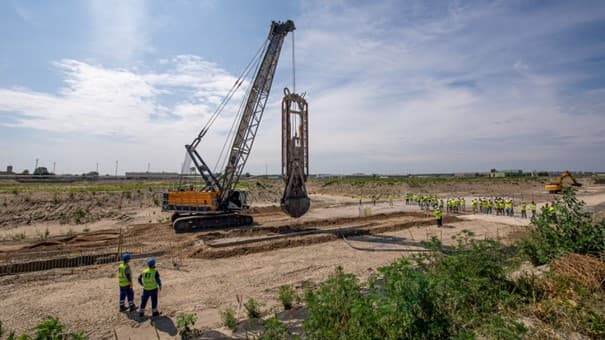
Earthworks at the Paks II plant construction site (source: Paks II).
Nuclear energy in a war zone
We already wrote in last year's overview about the impacts and risks of the war caused by Russia's invasion of Ukraine. It also affects specific nuclear power plants. Ukraine obtains more than 50 % of its electricity from nuclear sources. One of its nuclear power plants, located directly in the war zone, is also Europe's largest. The expulsion of Russian troops from the Chernobyl area and from the vicinity of Kharkiv reduced risks to the decommissioned Chernobyl nuclear power plant and its surroundings, as well as to the Kharkiv neutron source. Although the consequences of the occupation for the Chernobyl site are still being addressed. On 3 January 2024, a new exchange of prisoners of war between Ukraine and Russia took place after a long six-month hiatus. According to released information, the 230 people returning to Ukraine included some abducted members of the Chernobyl site security staff.
Conversely, the situation at the Zaporizhzhia nuclear power plant deteriorated dramatically due to the destruction and draining of the Kakhovka reservoir, the formal annexation of occupied territories by Russia, and the increasing intensity of fighting in its relative vicinity. During the night of 5 to 6 June 2023, the Kakhovka dam was breached, draining the reservoir and flooding extensive areas downstream. The reservoir also served as a source of cooling water for the Zaporizhzhia nuclear power plant. Cooling is a key issue for every thermal power plant, and even more so for a nuclear plant.
VVER1000 reactors have thermal output of roughly 3000 MWt. Even after shutdown, a nuclear unit has residual thermal output arising from the decay of radioactive nuclei, fission products and transuranic elements generated during reactor operation. Radioactivity and thermal output decline exponentially and fairly quickly fall to tens and then single-digit megawatts, but after weeks and months they decline relatively slowly. Spent fuel pools also need cooling. It is therefore necessary to ensure electricity supplies for cooling-system pumps as well as sufficient water. When the plant itself is not generating electricity, it needs supplies from the grid. If these are interrupted, diesel generators are used; they must always be ready and have sufficient fuel. There have already been several such losses of external electricity supply at the Zaporizhzhia nuclear power plant.
Cooling requirements at a plant that has been shut down for a long time are orders of magnitude lower than at an operating plant. The plant was not cooled directly with water from the Kakhovka reservoir, but has a special pond within its site with adequate water reserves. There are also ways to replenish water even with the Kakhovka reservoir drained. These were tested as part of stress tests carried out after the Fukushima I accident. Water can be pumped from a deepened excavation at the site of the plant's cargo port, from the water supply system of the city of Enerhodar, or using mobile pumps and a hose system. To strengthen water supplies, several additional wells were drilled near the pond this year, capable of providing hundreds of cubic metres of water per hour.
The methods described are sufficient for a shut-down plant with very limited thermal output. Returning the Zaporizhzhia nuclear power plant to normal operation is another matter. This cannot be achieved without resolving the issue of what will happen to the Kakhovka reservoir. Until then, the plant will need to be maintained without producing electricity. The main task is to ensure its safety and prevent an accident and the release of radioactivity.
This should also be helped by the IAEA mission, which began work at the Zaporizhzhia nuclear power plant at the beginning of September 2022 during the first visit of Director General Rafael Mariano Grossi. The mission is regularly rotated, and Director General Rafael Mariano Grossi again visited the plant during the summer rotation. The thirteenth rotation took place on 2 November 2023. The mission's task is to monitor the situation at the plant from the perspective of nuclear safety. In carrying out this work, it must overcome a number of problems, including often being denied access to some key locations, such as reactor roofs or turbine halls.
In October 2022, following Russia's declaration of the annexation of occupied territories, the Zaporizhzhia nuclear power plant was taken over by a Russian organisation. Workers were also required to transfer to this organisation and obtain Russian citizenship. This too has led to a relatively strained staffing situation at the plant. It is also compounded by the fact that the plant is not producing electricity, fighting is taking place nearby, and its future is uncertain. The reactors are shut down, and most of them are in cold shutdown. Two reactors have been kept in hot shutdown for longer periods so they can supply steam, which is needed not only for the plant. The reactors alternate in this role; in the autumn of this year, these were units four and five. Under normal operation, the plant had around 11,500 employees; it now has between 3,000 and 3,500. The staffing requirement is lower when units are shut down, but the question is whether the current level is too low. There may also be questions about whether all necessary professions are present and about the workers' physical and psychological condition.
Russia's winter campaign of missile strikes, aimed at destroying Ukraine's energy infrastructure at the turn of 2022 and 2023, also affected Ukraine's other nuclear power plants. Massive missile attacks on energy infrastructure facilities increase the risk that nuclear power plants will also be hit and endangered. Russia does not directly attack nuclear power plants, but the high intensity of attacks increases the risk that a wayward missile will strike one of their sites.
Under normal conditions, Ukraine's nuclear power plants, of which the country has three excluding the occupied Zaporizhzhia nuclear power plant, supplied half or more of its electricity. They therefore play a key role in its power system. This role is further increased by the fact that, as large concentrated sources, they can be better protected by air defences. As already mentioned, the Russians do have reservations about attacking them directly. A number of fossil-fuel and hydropower plants have therefore been destroyed or damaged, while nuclear plants have remained untouched. The problem, naturally, is that Russian missiles target critical points in the electricity grid, such as transformers and substations. In the event of a successful attack, output from a nuclear power plant cannot be transmitted and it also loses the ability to receive power from the grid. After the reactors are shut down, it must therefore rely on diesel generators.
Following the attack of 23 November 2022, attacks on key elements of Ukraine's power grid caused major damage, fragmentation and an overall blackout. The Rivne nuclear power plant switched to emergency mode, while the South Ukraine and Khmelnytskyi plants were disconnected from the grid. Ukraine coped even with such a situation, and Russia did not break Ukrainians' will to defend themselves against the Russian invasion through its winter campaign targeting energy infrastructure, which sought to destroy it by eliminating electricity and heat sources.
It was highly likely that Russia would carry out a similar campaign against Ukraine's energy infrastructure this winter. However, Ukraine's air defences, the grid itself and the nuclear power plants should now be far better prepared for the associated risks than last year.
Russia is probably aware of the different situation this year, while it may also have more depleted stocks of the technologically most advanced missile types used for attacks on infrastructure. The situation is different with drones, whose numbers are also growing on the Russian side. This is also why this year's winter campaign by the Russian army against Ukraine's energy infrastructure was delayed and its impacts have so far been very small compared with last year. Even the attack carried out on 28 December 2023, which was the largest of the Russian invasion to date in terms of the number of missiles and drones launched, affected energy infrastructure only to a very limited extent. We monitored the situation in Ukraine several times over the past year (here and here).
Despite the war situation, Ukraine is seeking to develop its nuclear energy sector. Efforts continue to complete and expand the Khmelnytskyi nuclear power plant in the west of the country. Two VVER1000 units are in operation there and two units are under construction. It is currently assumed that the third unit, which is at a more advanced stage of construction, will be completed as a VVER1000 using components prepared for Bulgaria's Belene plant. Two AP1000 units would also be built at the site. In mid-December 2023, Ukraine and Westinghouse signed an agreement for the supply of AP1000 reactor components for the fifth unit of the Khmelnytskyi nuclear power plant. It should be recalled that Ukraine intends to use AP1000 reactors to gradually replace its ageing units. Westinghouse also supplies fuel for Ukrainian nuclear power plants. VVER440 fuel is being tested at the Rivne nuclear power plant. With the company's assistance, Ukraine is also preparing its own fuel production. It aims to launch it within three years and gradually begin exporting the fuel.
The first Generation III reactor starts up in the US
The entire Western world is returning to nuclear energy. The first Generation III reactor entered operation in the US. At the Vogtle plant, Westinghouse's first AP1000 reactor was commissioned as Vogtle unit 3. Its fission chain reaction began at the start of March 2023 and it started supplying electricity to the grid on 1 April. The reactor reached full output at the end of May and began commercial operation on 31 July 2023.
Hot testing at Vogtle unit 4 was completed in May 2023 and fuel loading began in mid-August. Due to a failure of one of the pumps at the beginning of October 2023, start-up was postponed to the first quarter of 2024.
Nuclear renaissance gains momentum in South Korea
South Korea is successful abroad, and the launch of new nuclear construction projects has also resumed within Korea itself. The third unit at the Barakah plant in the United Arab Emirates entered commercial operation at the end of February 2023. The start-up process for this unit was faster than for the first unit by five months and the second by four months. The fourth reactor is also complete, and fuel was loaded into it at the end of 2023. Its start-up will therefore begin in 2024.
South Korea itself is overcoming the period under its anti-nuclear president. He envisaged a gradual phase-out of nuclear power. Nuclear units were to be shut down after 40 years of operation. Units approaching this threshold therefore did not apply for the necessary permits for continued operation, and the required upgrades and refurbishment were not carried out. It is now possible to operate the units for another decade, but obtaining permission and maintaining the units requires sufficient time. Kori 2 therefore had to be shut down for a period and will not restart until all necessary steps have been completed.
Following the start-up of the first unit at the Sin Hanul plant described in the previous overview, work is under way to complete the plant's second unit. Fuel was loaded into it in mid-September 2023 and, after intensive testing, the fission chain reaction began on 6 December. It then supplied electricity to the grid for the first time on 21 December. It is expected to enter commercial operation in the first half of 2024.
Two identical reactors are already operating at the Saeul plant as its first two units, while two more are being built as Saeul 3 and 4. Their original designation was Sin Kori 3, 4, 5 and 6.
Work also resumed on the halted construction of Sin Hanul units 3 and 4. In 2023, KHNP signed agreements with Doosan for the supply of components required for these units. Groundworks at the site began in July 2023, and their construction will start in 2024. They should be completed between 2032 and 2033.
The development of nuclear energy in South Korea is accelerating overall. Electricity generation from this source was record-high in 2022, reaching 167.5 TWh and accounting for 30.4 % of the total. A detailed analysis of the state of South Korean nuclear energy was provided in a recent article. Having reviewed Western nuclear energy, let us look at countries where the nuclear renaissance has been under way for longer and which have taken the lead in the development of nuclear technologies.
A lecture for future engineers at Brno University of Technology on the present and future:
Translation disclaimer
This article is a machine translation of the Czech original and has not yet been fully reviewed. In case of any doubt, please refer to the Czech version.
Sdílejte článek prostřednictvím:
Topics:Opinion
You might also like
23 October 2026, 11:01
23 October 2026, 06:34