23 October 2026, 14:38
Loading...
Nuclear energy in 2023, part 3: China and Russia lead development
Vladimír Wagner
26 January 2024, 06:27
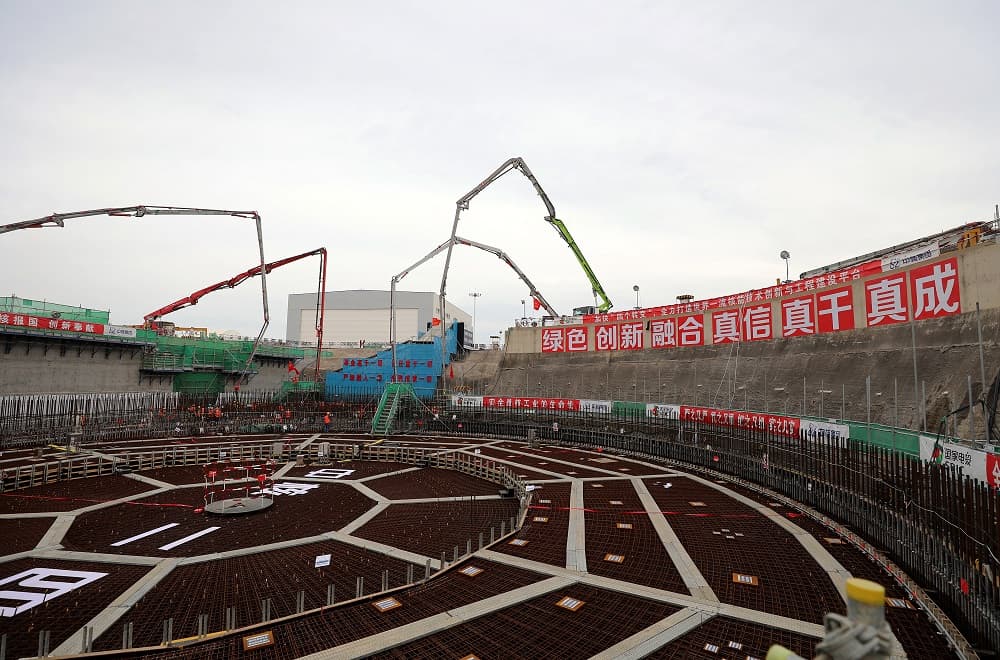
China is approaching the point at which it will have more reactors than France and move ahead of it into second place behind the United States. It currently has 55 reactors in operation, while France has 56. France could bring the Flamanville 3 unit online next year, but China is very likely to commission more than two units.
In mid-2023, China approved the construction of six more units. These were Ningde 5 and 6, which are to be Hualong One reactors; Xudabao 1 and 2, which will use CAP1000 reactors, with construction of the first unit ceremonially launched in mid-November; and Shidaowan 1 and 2, which will again use Hualong One reactors. It should be recalled that four CPR-1000 units are already operating at Ningde, VVER1200 reactors are being built as units 3 and 4 at Xudabao, and the HTR-PM200 high-temperature helium-cooled small modular reactor is already operating at Shidaowan.
Let us now look at progress on units under construction. The second pair of Hualong One units is being completed. It had been delayed. However, Fangchenggang 3 entered commercial operation on 25 March, while hot testing began at unit 4 at the end of September 2023.
Construction is also continuing on other new Hualong One units. At Changjiang 3, the inner steel section of the containment inner dome was installed on 21 February. It has a diameter of 46.8 m, a height of 23.4 m and a total weight of 518 tonnes, which the crane had to handle. The dome had to be lifted to a height of 45 m. First concrete for the nuclear island of this unit was poured in March 2021 and the expected construction period is 60 months. First concrete for the nuclear island of unit 4 at this plant was poured in December 2021.
At Zhangzhou, the steel structure of the outer dome was installed on the first unit at the turn of January and February 2023. Cold testing of this unit was then completed in early November. At the second unit, installation of the containment inner dome was completed on 28 December. Preparation of the financing model and resources for construction of the second phase of the plant, with another pair of Hualong One reactors, was completed.
At Taipingling, a total of six Hualong One units are to be built. The first two are under construction. Cold testing began at the first unit on 22 December. Construction of the third and fourth units was approved by the government on 29 December 2023. Construction of the first two units at the Jinquimen plant was approved at the same time. These too will be Hualong One reactors.
The start of concrete pouring for the nuclear island of Lufeng 5 in September 2022 was covered in the previous overview; concrete pouring for the nuclear island of the plant's sixth unit began on 26 August 2023. These are Hualong One reactors. Both units are expected to connect to the grid in 2028 and 2029.
Two Hualong One units are also being built at Sanaocun. The containment dome was installed at its third unit in early October 2023. Both units are expected to enter operation in 2026 and 2027. Ultimately, the plant is expected to have six units in total.
Let us now look at construction of CAP1000 reactors, which are the Chinese version of the AP1000 design. The start of construction of Sanmen 3 and Haiyang 3 was covered in the previous overview. At Haiyang 3, the 281-tonne reactor pressure vessel was installed in its position on 21 December 2023. Concrete pouring for the nuclear island of Sanmen 4 began at the end of March 2023, and the main and heaviest module of the AP1000 design was installed there in early May. The CA20 module is 20.5 m long, 14.1 m wide, 20.9 m high and weighs 1024 tonnes. Concrete pouring for the nuclear island of Haiyang 4 began in April 2023, and the CA20 module was installed on 14 July. Both new pairs of units at Sanmen and Haiyang are expected to be operating in 2027.
After concrete pouring for the nuclear island of the CAP1000 reactor began in mid-year, construction of the containment started at the first unit of the Lianjiang plant in early October 2023. Construction also began there on the largest cooling tower, which will be 219 m high and have a base diameter of 175 m. The largest CA20 module was installed there at the end of November 2023. There could ultimately be up to six units at the site.
The Chinese are also building Hualong One units abroad. Following the successful completion of this Chinese reactor as Karachi 3 and its entry into commercial operation in 2022, construction of the same reactor began as the fifth unit at the Chashma plant in mid-July 2023.
Nuclear energy development is also accelerating in India
Construction of domestically designed 700 MWe heavy-water reactors is continuing in India. The first such reactor entered commercial operation as Kakrapar 3 at the end of June 2023. Fuel was loaded into Kakrapar 4 at the end of October, and a fission chain reaction began there in mid-December 2023. Two reactors of the same type are being built as Rajasthan 7 and 8. Hot testing took place at Rajasthan 7 at the end of November and it is approaching the start of commissioning. Construction began on the first of four such reactors at the Gorakhpur plant. In addition to the aforementioned units at Gorakhpur, identical reactors are planned as Kaiga 5 and 6 and Mahi Banswara 1 to 4. The site is being prepared for Chutka Madhya Pradesh 1 and 2. A total of sixteen of these reactors are planned in this series.
Russia is progressively building the Kudankulam plant in India using VVER reactors. Two units are currently in operation there and four are under construction. A core catcher was installed at Kudankulam 5 in early July 2023. At the end of 2024, Russia and India signed an agreement to build the seventh and eighth units at the plant. These will be VVER1200 reactors.
Russia leads development in nuclear technologies
Russia leads in the number of reactors being built abroad. The first Generation III VVER1200 reactors began operating in Belarus. In 2023, commissioning took place at the second unit of the Ostrovets nuclear power plant. At the end of March, a fission chain reaction began in this reactor and testing started at the minimum stable power level, which is 1% of nominal output. In early April, output reached a level at which it was possible to move from physical to power commissioning. The turbine began to be tested at 40% of nominal output. The reactor began supplying electricity to the grid in mid-May, with output gradually increased to 50%. Output was then progressively increased in June and different electricity generation modes were tested. On 1 November, the reactor entered commercial operation. Together with the first unit, the two are expected to provide around 40% of Belarusian electricity generation. Belarus is considering building a second nuclear power plant or a third unit at Ostrovets.
Before looking at Rosatom's other overseas projects, let us describe the situation in Russia itself. Components of the reactor vessel internals for the first unit of the advanced VVER-TOI units in the second phase of the Kursk nuclear power plant were completed and have now arrived at the construction site. They were installed and inspected in the second half of 2023. Concrete pouring for the outer part of the first unit's containment dome was completed in August 2023. All four steam generators for the second unit were also delivered to the site and installed in their positions in early December. The containment dome was also placed there in mid-December 2023. Work was also being completed on the cooling tower for these units. At 179 m, it is the second-highest in Russia.
For construction of another pair of VVER1200 units in the second phase of the Novovoronezh nuclear power plant, the site for future construction must be prepared. This requires changing the boundaries of administrative areas so that the entire plant complex falls under one administrative unit. The necessary negotiations and changes are therefore under way so that site preparation can begin next year for the third and fourth units of the plant's second phase.
Transformers to supply electricity to the construction site for the third and fourth units of the second phase of the Leningrad nuclear power plant were delivered at the end of 2023. Site preparation is continuing so that concrete pouring for the nuclear island of the third unit can begin in 2024. Forest clearing, preparation of the construction area and construction of access roads are being completed. Earthworks are beginning for foundation pits for some of the buildings and for the drainage system. Contracts for individual components of the future reactors are also being prepared.
At the second phase of the Smolensk nuclear power plant, three RBMK units need to be progressively replaced with VVER-TOI reactors. In 2023, work was carried out to prepare the project and survey the future construction site. Towards the end of the year, preparations began for a construction workers' camp and the future site.
New reactors are also to be built at the Kola nuclear power plant, where four VVER440 units are currently operating. The first of these entered operation in 1974. It is expected to operate for seventy years. Construction of new VVER-S reactors is being prepared as their replacement.
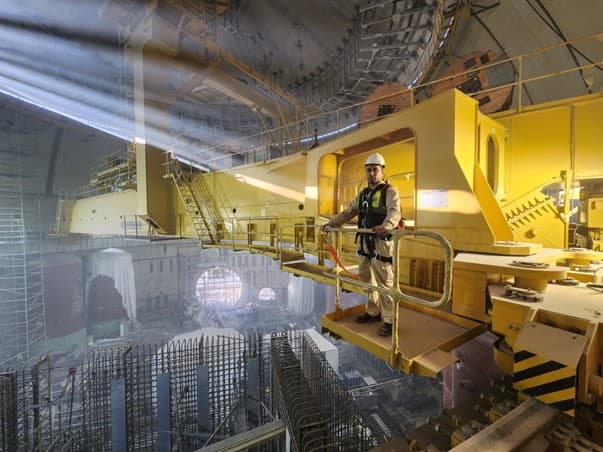
Installation of a gantry crane at Akkuyu 1 (source: Rosatom).
Let us now look at construction of Russian reactors abroad. In February 2023, the Akkuyu plant construction site came through several earthquakes that hit Turkey catastrophically without consequences. This also demonstrates the adequate quality of the plant's design. Near the epicentre, the earthquake on 20 February had a magnitude of 6.4, while at the plant site it was magnitude 2.6. Earthquakes are relatively frequent in Turkey, but the selected site for the Akkuyu plant is among the most stable in this respect. The events of February also demonstrate the soundness of the site's selection for the plant.
Let us look at the main events at this site in 2023. The roof of the turbine hall for the first unit was completed in the first half of March 2023. At the beginning of the year, storage for fresh fuel intended for all four reactors was completed. Fuel for the first unit was therefore delivered to the plant site at the end of April 2023. From that moment, the plant officially acquired nuclear facility status. In October 2023, the gantry crane and fuel handling equipment were commissioned and tested. In the final quarter, the first unit was completed and entered the pre-commissioning testing phase. It received permission for fuel loading in mid-December 2023 and is expected to be commissioned in 2024. The reactor pressure vessel for the third unit was delivered to the site in early November 2023.
Preparation for construction of Turkey's second nuclear power plant, Sinop, is continuing. It is also expected to have four units with capacity of around 1200 MWe. Russia, Korea or China are being considered as suppliers. Turkey is seeking suitable sites for two further nuclear power plants.
The two VVER1200 reactors at Bangladesh's Rooppur nuclear power plant are also approaching completion. The launch of Rooppur's first unit is in sight, although it will be delayed partly due to sanctions against Russia. Bangladeshi ports did not accept some Russian ships subject to sanctions, even though they were carrying components for the plant. The outer containment domes of the first unit were fully completed in mid-March. In the second half of 2023, work was carried out first on the inner dome of the second unit and then on the outer one. Fresh fuel arrived at the plant site in September 2023, making Bangladesh a nuclear state.
Construction of Egypt's El Dabaa nuclear power plant has gathered pace. Concrete pouring for the nuclear island of the third unit began in early May 2023. A jetty that will receive ships carrying components for the plant's reactors was completed. The first of them have already arrived at El Dabaa. They included the core catcher for the first unit, which was installed in October 2023. The core catcher for the second unit was installed at the end of November 2023. Permission to begin construction of the fourth unit was granted at the end of August 2023.
A pair of VVER1200 reactors is being built as the third and fourth units at China's Xudabao nuclear power plant. Installation of the containment dome at the third unit was completed at the end of July, while the steam generators and reactor pressure vessel were delivered to the site at the same time. The Xudabao units are expected to enter operation in 2026 and 2027.
Construction continued at the Tianwan plant on two VVER1200 reactors as Tianwan 7 and 8. At Tianwan 7, the crown of the containment inner dome was installed at the end of June, while the reactor pressure vessel arrived in August and was installed on 16 October.
In Iran, the second unit at the Bushehr plant is being completed; it is a Russian VVER1000 reactor. The third unit at the plant is also expected to be of this type. There are currently around 3,000 workers at the site. In December 2022, site preparation began for construction of the Darkhovin nuclear power plant. It is to use an Iranian 360 MWe reactor.
Lecture for future engineers at Brno University of Technology on the present and future:
Translation disclaimer
This article is a machine translation of the Czech original and has not yet been fully reviewed. In case of any doubt, please refer to the Czech version.
Sdílejte článek prostřednictvím:
Topics:Opinion
You might also like
23 October 2026, 11:01

23 October 2026, 06:34