23 October 2026, 14:38
Loading...
Nuclear energy in 2024, part 2: Renewed interest in nuclear power in Europe and the Western world
Vladimír Wagner
19 January 2025, 08:15
In the second part of our overview, we will first focus on the situation in Europe, where the top priority remains the safe operation of existing units for as long as possible. For countries using Soviet reactor designs with Eastern-type fuel, the transition to Western suppliers is important. The previous overview described how this is succeeding in Czechia. Westinghouse and Framatome are both routinely able to supply fuel for VVER1000 reactors. At the end of May 2024, Westinghouse fuel assemblies were loaded into unit 5 of Bulgaria's Kozloduy nuclear power plant for the first time. Framatome will supply fuel for unit 6.
The situation is worse for VVER440 reactor fuel. Westinghouse has already prepared this fuel and loaded it into unit 2 of Finland's Loviisa nuclear power plant for the first time in early September 2024. Framatome is only now developing this fuel. In 2024, it received a European Union contribution through Euratom for the development of fuel for VVER440 reactors and a new generation of fuel for VVER1000 units.
The European Union's efforts to become more self-sufficient in uranium procurement and fuel production are also reflected in attempts to resume uranium mining. One example is Finnish company Terrafame, which resumed recovering uranium as a by-product of zinc and nickel mining at its Sotkamo mine in Talvivaara in the northeast of the country.
Europe has in recent years been succeeding in completing unfinished projects, namely two VVER440 units at Slovakia's Mochovce plant and two EPR units, one at Finland's Olkiluoto and the other at France's Flamanville. France is effectively the European Union's nuclear powerhouse, thanks to which it has low-emission electricity generation and heating.
In this country, after long delays, Flamanville 3 was finally brought into operation. Fuel loading into the reactor, involving 241 fuel assemblies, was completed on 22 May. A fission chain reaction began on 3 September 2024, and on 21 December the reactor reached 25 % of nominal output and began supplying electricity to the grid. It is an EPR reactor with a net capacity of 1650 MWe. Four reactors of this type are now in operation. Output will increase until summer 2025, when it should reach 100 %. It will also largely replace for France the capacity lost through the shutdown of two units at the Fessenheim plant. France now has 57 reactors with total capacity of 63 GWe. Before the shutdown of the Fessenheim plant on the German border, which occurred largely under pressure from Germany, France had 58 units with total capacity of 63 MWe. Construction began in 2007 and thus took 17 years.
The key issue will be how successfully the experience gained from building this reactor can be used in the construction of subsequent ones. We will see, for example, how construction and commissioning of the pair of units at Hinkley Point C progresses.
France has managed to resolve welding problems and has once again become the largest producer and exporter of electricity. It is again the main pillar of electricity-system stability in the European Union. Nuclear sources generated 277 TWh in 2022, then 318 TWh in 2023 and already 360 TWh in 2024. EDF secured loans for maintenance of its operating nuclear fleet and for extending the operation of individual nuclear units beyond 40 years. The first reactor to exceed 40 years of operation was Tricastin 1 in August 2023.
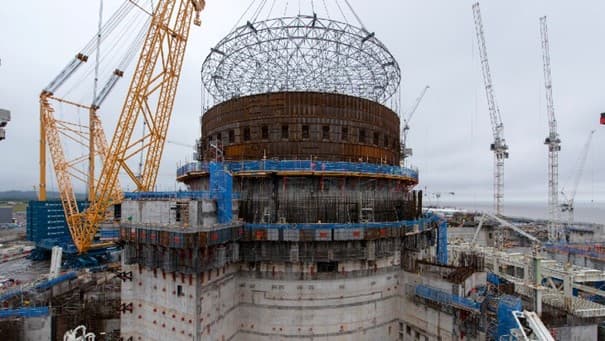
The containment structure of Hinkley Point C's second unit is taking shape (EDF).
French company EDF is also crucial to the development of nuclear energy in the United Kingdom. It decided to invest in extending the operation of its fleet of British gas-cooled AGR reactors. It plans to use the four nuclear power stations Torness, Heysham A and B, and Hartlepool for longer. At least until 2026, British nuclear sources should thus supply around 37 TWh, as they did in 2023. There are efforts to operate the four newer units, Torness 1 and 2 and Heysham B 1 and 2, at least until 2028 and possibly beyond 2030. The operating life of the only operating light-water reactor, Sizewell B, should be extended to 60 years, i.e. until 2055. Under its current energy strategy, the United Kingdom plans to generate around a quarter of its electricity in 2050 from nuclear sources with total capacity of 24 GWe; alongside large plants, small modular reactors should also contribute.
Work is proceeding intensively to complete the two EPR reactors at the UK's Hinkley Point C plant. In January 2024, EDF announced a construction delay, with the plant now expected to enter operation only in 2030. Construction of the plant began in December 2018. The delay was partly caused by the impact of the COVID-19 pandemic, and mainly by the gradual recruitment of qualified staff in a sector that had seen a very long hiatus in the United Kingdom. The experience gained and improving quality of the workforce involved in construction mean that work on the second unit generally takes 20 to 30 % less time than on the first. In May, the first of eight steam generators was delivered to the site. It is 25 m long and weighs 520 tonnes. In November 2024, the turbine generator stator, 12 m long and weighing 450 tonnes, arrived on site. EPR units normally use an Arabelle turbine. In early December, the reactor vessel for the first unit was installed in place. It weighs 500 tonnes and is 13 m high. The delivered steam generators should be installed in 2025. Intensive work is under way on completing the basic containment building structure for the second unit.
The experience gained at Hinkley Point C should be fully reflected in the construction of two identical reactors at Sizewell C. In mid-January 2024, its project received a DCO (Development Consent Order), formally allowing site preparation and construction to begin. The British government also allocated funding to support the necessary infrastructure, including essential roads, railways and power lines. In May 2024, the project then received a nuclear construction licence from the British nuclear safety authority, the ONR. Earthworks were carried out at the site in 2024. Completion is expected in 2034.
Slovakia became an electricity exporter last year and, like France, has low-emission electricity generation thanks to nuclear power. After Mochovce unit 3 was commissioned in 2023, Slovakia focused on completing the plant's fourth unit. In October 2024, both active and passive safety systems passed tests. The first stage of cold hydrostatic testing took place in December 2024, while its second stage began in early January 2025. Cold testing of the reactor is therefore under way. The unit should enter operation this year, and Slovakia will thus export even more electricity.
Slovakia is also seeking to accelerate the start of construction of a new unit at Jaslovské Bohunice. It would like to launch a tender for its supplier in 2025. The reactor should have capacity of around 1200 MWe. It is therefore very likely that the same bidders as in the Dukovany construction tender will participate. The tender should be concluded and the contract signed in 2027, construction should begin five years later, and the unit should be available in 2038.
Preparations are under way for the start of concrete pouring for the nuclear island and the official start of construction of the first unit of the second phase of the Paks plant. Two VVER1200 reactors are planned there. In 2024, intensive work was carried out to complete protection against groundwater ingress. An important task was compacting the soil in the area where the reactors will stand. This is an area of 17 ha, where roughly 75,000 holes must be drilled. A mixture strengthening the subsoil will be injected into them. In early December 2024, the Hungarian nuclear safety authority issued the necessary permit and, subject to the stipulated conditions being met, concrete pouring for the nuclear island should begin in early 2025. In Russia, the core catcher was meanwhile completed and delivered to the site in autumn 2024, while work continued on the reactor vessel. Hungary intends to use experience from Belarus. It is therefore cooperating intensively with Belarusian experts and will seek to involve them in construction of identical units in Hungary.
Preparations for the construction of Poland's first nuclear power plant are also advancing. Three AP1000 reactors should be built on the coast near the towns of Lubiatowo and Kopalino in Pomerania. Companies Polskie Elektrownie Jądrowe (PEJ), Bechtel and Westinghouse will participate in preparing and delivering the project. The previous overview reported that the project had received a location decision from the Pomeranian Voivodeship. In the first half of 2024, permits were issued for deep drilling and detailed geological surveys of the selected site. At the same time, Bechtel began initial work at the future 300 ha construction site. The first phase should cover 45 % of this area. This mainly involves removing vegetation in accordance with seasonal and environmental rules. At the beginning of 2025, the Polish government adopted a draft law on state support for construction of the plant.
Switzerland is working to maintain its nuclear fleet over the long term. Its oldest nuclear power plant, Beznau, entered operation when its first unit was commissioned in 1969. It has now been operating for 55 years. Its operator, Axpo, is now investing in refurbishment and upgrades and plans to operate it until 2033, for a total of 64 years.
Sweden plans to extend the operation of five units at the Forsmark and Ringhals plants from 60 to 80 years, allowing them to be used until 2060.
Bulgaria is preparing to build two AP1000 units at the Kozloduy plant. In the selection of a company to guarantee construction of these units, only South Korean KHNP ultimately remained. The necessary agreements with subcontractors and partner companies are thus being signed gradually.
Romania is preparing to refurbish unit 1 at the Cernavodă plant. It is a Candu heavy-water reactor, and refurbishment should ensure a further 30 years of operation. In total, it could thus supply electricity for 60 years. Work is also under way on the project to complete the unfinished third and fourth units. In mid-2024, the European Commission approved the conditions for their completion. In mid-November 2024, key contracts for engineering work were signed. The reactors could enter operation in the early 2030s.
Ukraine's energy sector survives thanks in part to nuclear power plants
Russia continued its attacks on Ukraine's energy infrastructure in 2024. It focused even more heavily on thermal power plants, hydropower plants and substations. Throughout the year, and especially at the beginning of the current winter season, waves of missile and drone strikes were extremely intense. Despite this, Ukraine has managed to keep its electricity grid operating, although not without restrictions and impacts on people's lives, with planned rolling outages becoming a standard tool. Ukraine has successfully endured two winters since the start of Russia's invasion, but the current one is the greatest challenge. I wrote about the beginning of these efforts in an article in autumn 2022.
Ukraine is increasingly dependent on its three nuclear power plants: South Ukraine, with three VVER1000 reactors; Rivne, with two VVER440 and two VVER1000 reactors; and Khmelnytskyi, with two VVER1000 reactors. It is also critically dependent on the functioning of overloaded transmission lines capable of transporting electricity from west to east. These lines are important not only for transmitting electricity from Ukrainian nuclear power plants, but also for transmitting electricity supplied by the European Union as part of its assistance.
This assistance is another factor helping to keep Ukraine's energy sector afloat. Others include integrating small decentralised flexible sources and repairing damaged grid components as quickly as possible. In this area too, assistance and supplies from the European Union are critical. As the previous overview noted, Ukraine's large share of nuclear generation is a huge advantage. Direct attacks on nuclear facilities remain a red line for Russia. It therefore seeks to destroy grid elements that enable power to be exported from plants and transmitted to consumers. However, these are also important for transporting electricity from the European Union to Ukrainian cities. So far, Ukraine has managed to maintain the grid and use both its nuclear power plants and electricity imports from abroad. This is why Ukraine is working intensively with its foreign partners on grid integration and also seeking to expand its nuclear power sector. The International Atomic Energy Agency (IAEA), led by its Director General Rafael Grossi, has also warned of the danger of attacks on the grid that enables electricity to be exported from and supplied to nuclear power plants. The agency has missions at all Ukrainian nuclear power plants.
The Ukrainian government is working to expand the Khmelnytskyi plant. It wants to add four new units to the two operating ones. The third and fourth reactors should be VVER1000-based, completing units already under construction. The other two should be Westinghouse AP1000s. Westinghouse should oversee all four projects. A number of companies will participate in delivering these projects, including South Korean KHNP.
Ukraine also wants to expand the production of fuel assembly components in cooperation with Westinghouse. Energoatom is preparing construction of a fuel assembly factory in the city of Pivdennoukrainsk. In cooperation with Westinghouse, it would assemble fuel assemblies from Ukrainian and foreign components.
Ukraine is preparing to build an entirely new nuclear power plant near the city of Chyhyryn, on the right bank of the Dnipro roughly halfway between Kyiv and Dnipro. Four units are planned there. A nuclear power plant and the adjacent town of Orbita began to be built at the site in the 1980s. However, the project was halted after the Chernobyl accident. The town and construction site are now abandoned and essentially in ruins. As part of post-war reconstruction, Energoatom wants to revive the project; it has obtained the necessary land and is working on its preparation.
Ukraine's largest plant is Zaporizhzhia, which Russia occupied shortly after the invasion began. It has remained shut down since then and is essentially on the front line. The previous overview described the deterioration of the situation following the breach of the Kakhovka dam. I wrote a more detailed article about the impact of this event. Even without it, cooling of the shut-down reactors can be ensured, but the plant's future cannot be considered without resolving the future of the area. That will only be possible after the war ends. For now, work is limited to improving the ability to pump water into the pond used to cool the reactors. Additional wells are being drilled and the capacity to pump water from the Dnipro is also being improved.
At present, however, shelling and drone activity on both banks of the Dnipro are increasing significantly. This also raises the risk that plant facilities will be hit. IAEA Director General Rafael Grossi has expressed concern about the risk of such a development. The agency's delegation at the site is increasingly hearing explosions from various directions around the power plant. No critical building or technology has yet been affected, but the risks are increasing.
From this perspective too, the presence of IAEA international observers at the Zaporizhzhia nuclear power plant is very important. The drone attack on a vehicle carrying observers as they crossed the front line during their most recent rotation in early December 2024 was therefore highly alarming. The vehicle was damaged, but fortunately the observers were not injured. The rotation of the observer mission was ultimately completed successfully. Both sides in the conflict accuse each other of carrying out the attack. The IAEA mission is extremely important: it is the only international organisation operating in territories occupied by Russia and able to independently monitor the situation at the plant.
In August 2024, the war came close to another nuclear power plant. This time, it was the Kursk nuclear power plant, around 60 km from the Ukrainian border. Two RBMK units are shut down there, two RBMK units are operating, and two VVER-TOI units are under construction. In response to the Russian military invasion in the Kharkiv region in 2024, Ukrainian forces occupied part of the Kursk region around the town of Sudzha. Fighting thus came relatively close to another nuclear site, and drone attacks in particular targeted locations not far from it.
During 2024, especially towards its end, several larger prisoner-of-war exchanges took place. Russia does not want to return prisoners who were captured earliest, particularly defenders of Mariupol, Azovstal and the Chernobyl security contingent. Ukrainians, on the other hand, insist that prisoners of war who have been in captivity the longest should be exchanged first. However, Russia did not want to return them, which was the main reason exchanges had not taken place for a long time. The turning point came with the capture of part of the Kursk region and the Ukrainian army's capture of a larger number of Russian conscripts. Putin could not afford to leave them in captivity. This was the main reason for several larger exchanges in the second half of 2024. Thanks to them, more members of the Chernobyl nuclear power plant security contingent finally returned home.
In 2020, the European Bank for Reconstruction and Development established the International Chernobyl Account, which at Ukraine's request supports work to decommission the destroyed fourth unit of the Chernobyl nuclear power plant. With the help of European donors, the European Bank for Reconstruction and Development financed construction of the new sarcophagus and is now involved in its operation and work inside it. It is very important that work inside the sarcophagus does not stop even during the war, taking advantage of the fact that the Chernobyl site is now in a quiet area less affected by the war. Most importantly, certain unstable sections of the original sarcophagus must be dismantled and disposed of. They risk collapse, which could have very negative consequences. The new sarcophagus would prevent radioactivity from escaping, but this would worsen conditions for decommissioning the destroyed reactor.
The war delayed the project to remove unstable structures of the old sarcophagus, and its completion has therefore been postponed until 2029. I wrote about the course of the occupation and progress in dealing with the consequences of the accident in a special article marking the 35th anniversary of the accident. With foreign funding, damage caused by the occupation also had to be dealt with at the site. Permits for work with radioactive materials had to be renewed at various workplaces in the controlled zone. At the end of 2024, the Ukrainian side met representatives of the European Bank for Reconstruction and Development. They discussed options and conditions for financing projects related to removing unstable structures and commissioning the internal equipment of the new sarcophagus. Work is currently under way to survey the unstable sections and gather materials for preparing the project for their dismantling and disposal.
Ukraine has opened up the possibility of locating small modular reactors in the Chernobyl industrial zone.
Extending the life of nuclear units dominates North America
In the United States and Canada, the main focus is on extending the operation of existing units. Some could remain in operation for as long as 80 years. It is becoming clear that data centres, particularly with the development of artificial intelligence, need ever more stable energy sources. Nuclear power plants are very well suited to this. This is why the United States is considering restarting some nuclear units that have already been shut down. These include Palisades, which Holtec wants to restart and later build two of its small modular reactors at, and unit 1 at the well-known Three Mile Island plant. This was discussed in greater detail in a recent article. NextEra is also considering the possibility of restarting a boiling-water reactor shut down in 2020 at the Iowa nuclear power plant.
Construction of new units is very rare in the United States. We already reported in the previous overview on the commissioning last year of the first AP1000 reactor in the United States, Vogtle 3. In mid-February 2024, a fission chain reaction began in the Vogtle 4 reactor, and on 1 March, after output had increased sufficiently, it could connect to the grid and begin supplying electricity. The unit entered commercial operation at the end of April.
No large Generation III reactors are currently planned in the United States. Under an investor-financed model, they can hardly compete with natural gas, which is available in the United States in large quantities and at low prices. With the support for fossil fuels that can be expected under President Trump, the availability of fracked gas can be expected to improve further.
Alongside maintaining existing reactors, efforts are therefore focused on developing and future deployment of small modular reactors. It will be interesting to see whether, and when, they can be brought into commercial use.
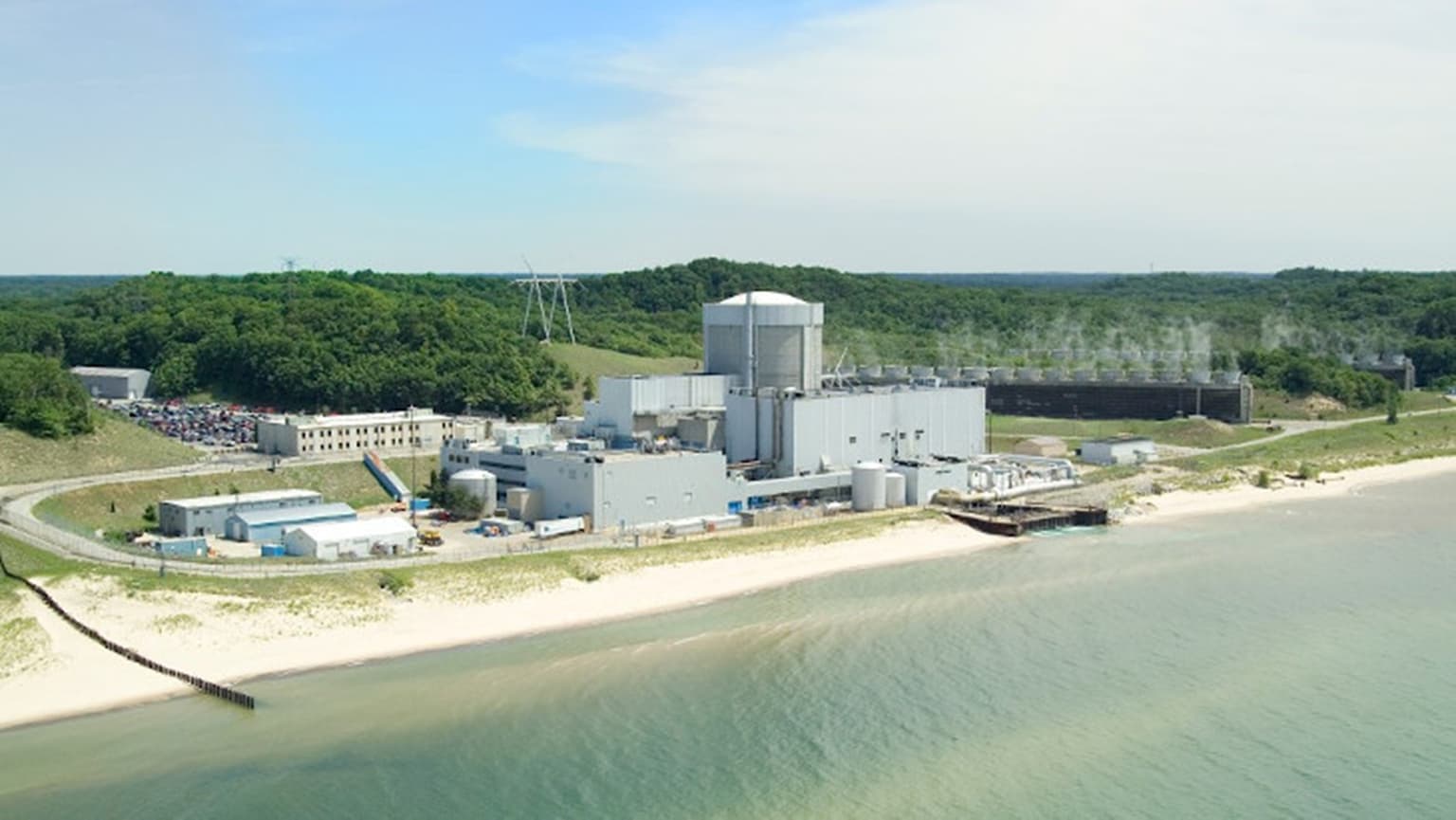
The Palisades reactor could be the first to restart after permanent shutdown (source: Holtec).
In Canada too, ageing units are being shut down, but there is also an effort to keep at least some of them operating safely for as long as possible. Pickering reactors 1 and 4 were shut down in 2024, meaning that all reactors in the first phase of the plant, Pickering A, are now shut down. It entered operation in 1971–73. These four units were shut down in 1997. Units 1 and 4 were refurbished in 2003 to 2005 and returned to operation. For Pickering reactors 5 to 8, i.e. Pickering B, the provincial government has decided to carry out refurbishment. This should begin in 2026 and they should return to operation in the 2030s. Gradual refurbishment of four units at the Darlington plant continues. Refurbishment of unit 2 was completed in 2020, unit 3 in 2023, and unit 1 ahead of schedule in mid-November 2024. Completion of the refurbishment of unit 4 is expected in 2026. Refurbishment will enable the units to operate for another 30 years. It is also important that Candu heavy-water units are used to produce radionuclides for medicine and industry. These include cobalt-60, used to sterilise instruments and materials and to irradiate tumours. Candu reactors supply up to half of global production of this radioisotope. Construction of a BWRX-300 small modular reactor is being prepared at Darlington, but this will be discussed in more detail at the end of the article.
Canada is considering construction of new capacity. In Ontario, a third phase of the Bruce C plant should be built, with AP1000 reactors under consideration. Nuclear sources currently supply more than 50 % of electricity. The share should increase further in the future, with Ontario seeking to use both large and small modular reactors. It also aims to become a centre for the development of nuclear technologies and industry.
Work also continues on developing the 1000 MWe Generation III Candu Monark heavy-water reactor. The project is being developed by Candu Energy Inc. Preparations for pre-licensing assessment of the project began in autumn 2024.
Questions over South Korea's direction
South Korea clearly demonstrates how nuclear power, as a very long-term investment, is heavily dependent on changes in political leadership. The previous president was anti-nuclear and sought to begin South Korea's withdrawal from the use of nuclear sources during his term. He tried to halt construction of Saeul 3 and 4 and stopped preparations for construction of Sin Hanul 3 and 4. The current president, who went mad and politically destroyed himself by attempting to declare martial law, by contrast supported nuclear energy development. There are therefore concerns about the attitude of the next president who replaces him.
However, it must be stressed that reality cannot be entirely denied. South Korea's natural conditions mean that use of renewable sources is very limited there. At the same time, all fossil fuels are imported. The nuclear technology industry is also successful and offers great export potential. This was why the former anti-nuclear president ultimately did not halt construction of Saeul 3 and 4 and, while restricting construction of Korean nuclear units in South Korea itself, supported and promoted their export. I therefore do not think that a political change in South Korea would threaten construction of new units at Dukovany.
In South Korea itself, Sin Hanul 2 entered operation at the turn of 2023 and 2024. At the end of October 2024, earthworks began at the site of the new Sin Hanul 3 and 4 units, while in the first half of September the Korean nuclear safety authority granted permission for their construction. These should also be APR1400 reactors. Sin Hanul 1 entered commercial operation in December 2022, followed by Sin Hanul 2 in April 2024.
The extremely successful overseas project in the United Arab Emirates has been completed. In March 2024, commissioning began for the fourth and final unit at the Barakah plant, which began supplying electricity to the grid on 23 March and entered commercial operation in early September. The United Arab Emirates is considering expanding the plant by a further two units.
Robert Oppenheimer also reflected on how to use nuclear energy for peaceful development while avoiding the risks of nuclear weapons:
https://www.youtube.com/watch?v=U21uEV2YrN8
Translation disclaimer
This article is a machine translation of the Czech original and has not yet been fully reviewed. In case of any doubt, please refer to the Czech version.
Sdílejte článek prostřednictvím:
Topics:Opinion
You might also like
23 October 2026, 11:01
23 October 2026, 06:34