23 October 2026, 14:38
Loading...
Nuclear power at the start of 2017
Vladimír Wagner
5 January 2017, 20:07
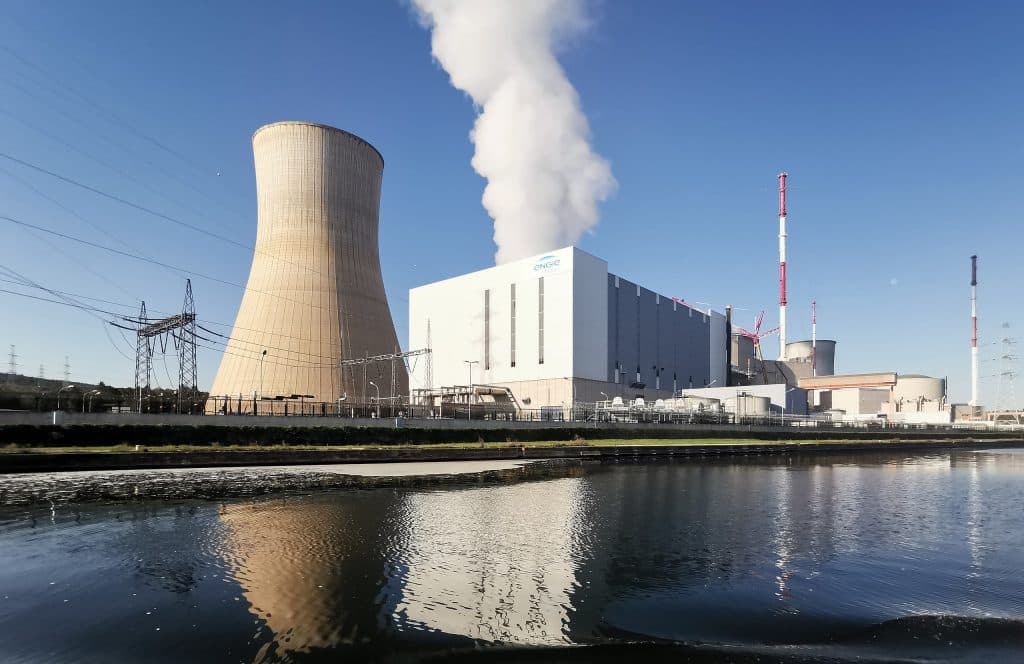
Although the development of nuclear power was not easy this year either, it can be described as very successful. For the second year in a row, ten new units began supplying electricity to the grid, and nuclear power capacity increased by 9 GW. A very positive trend is that, in addition to China, units also began operating in India, Pakistan, South Korea and the US. Several events also took place that are crucial for the further development of the sector.
In South Korea, a Generation III unit was commissioned commercially. It is an APR1400 pressurised water reactor. Further units are under construction in South Korea, but above all four such units are being completed in the United Arab Emirates. Construction there began in 2012 and has so far continued according to plan. There is therefore a strong chance that the first unit will indeed start up this year. South Korea would thus demonstrate that it is capable of building a Generation III unit abroad within five years.
Russia succeeded in starting up Novovoronezh Unit 6. This time, it is undoubtedly a Generation III+ reactor. Several more units of this type are under construction in Russia. This type is also being built abroad. Two reactors have been under construction at the Ostrovets plant since 2013, with completion of the first planned for 2018. A construction site for a unit of this type is being prepared at Hanhikivi in Finland.
If these reactors prove themselves in operation and further Generation III+ units, namely EPR and AP1000 reactors, are also started up in 2017 and 2018, this will be a genuinely real start to the transition to this new generation of reactors. Its success will then be crucial for the future decades of nuclear power development.
Another important milestone is the start of commercial operation of the BN-800 fast sodium reactor. It is only the second unit of this type to operate under the conventional regime of a commercial power plant. The first is the BN-600 at the same plant. Although the chain reaction at BN-800 began as early as 2014 and it was already supplying electricity to the grid in 2015, it only reached full output and entered commercial operation in 2016. It should become a model for the truly commercial BN-1200 reactor and a major step towards Generation IV reactors.
An important step was also the start of commercial operation at Kudankulam Unit 1 in India and the start of electricity production at Kudankulam Unit 2. These are Russian VVER1000 units, whose safety parameters in particular are very close to those of Generation III reactors. Problems did occur during the completion of the first unit, but it is now operating normally. Together, their connection increased India's nuclear capacity from 4.4 GW to 6.2 GW, or by almost 50%. Construction of another pair of units has begun at the same plant, while several other reactors are nearing completion. Nuclear sources, together with renewables, can thus make a significant contribution to reducing emissions from electricity generation in the country.
China commissioned a total of five units, with their construction taking around five years. This confirmed that China is capable of building reactors within five years. It has now moved into third place in the number of nuclear reactors, behind the US, France and Japan, although the situation for nuclear power in Japan remains very open. At present, only the Sendai and Ikata plants are in operation there. China should also start up a number of units next year, with the most anticipated being the Generation III+ AP1000 and EPR reactors. If it maintains the efficiency and speed of unit construction during the transition from Generation II to Generation III, nuclear power, together with wind power, which is expanding at roughly the same pace, could contribute to a dramatic reduction in emissions in the country. Particularly those that are choking Chinese cities.
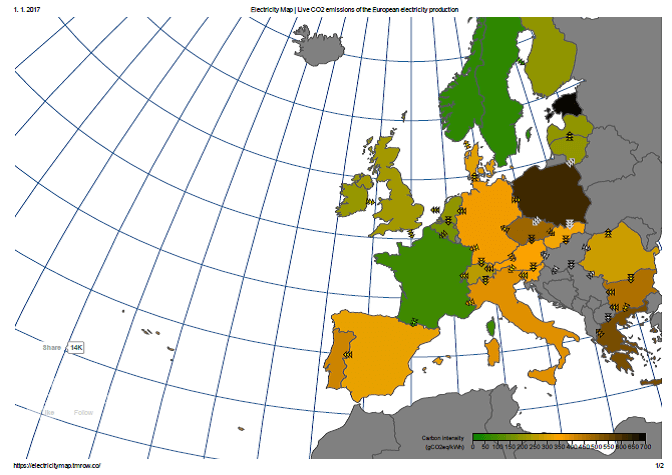
Several very important decisions were made in Europe that will have a major impact on the development of nuclear power. Most concern administrative and preparatory measures rather than actual construction of generating capacity. The UK, Hungary and Finland have embarked on a path towards low-emission electricity systems with the help of nuclear and renewable sources. The UK decided to begin construction of the Hinkley Point C plant, and progress was also made on other plants. In Finland and Hungary, too, site preparation is slowly giving way to actual construction.
In France, some reactors underwent extraordinary outages and inspections in November after concerns that higher carbon content could affect safety. Given that there was also little wind at the time and Europe faced a certain water shortage, this showed where the Energiewende would lead across Europe. Electricity had to be generated by fossil-fuel sources, largely coal-fired ones.
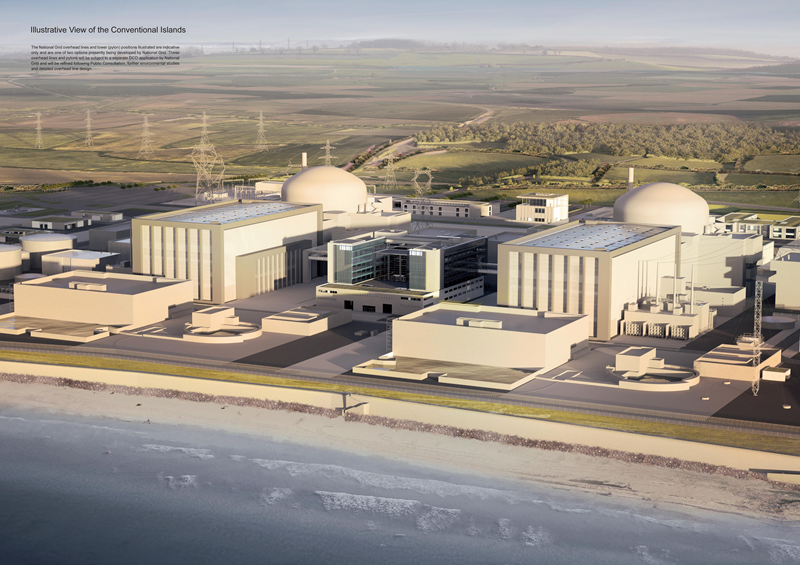
The online map on the Tomorrow project website illustrates carbon dioxide emissions very clearly. It shows that while carbon dioxide emissions in France are currently mostly around 100 gCO2eq/kWh, and in Sweden even only around 50 gCO2eq/kWh, in Germany they are mostly above 400 gCO2eq/kWh. And Germany still has 10 GW of nuclear capacity. France and Sweden are thus entirely green, while Germany is turning a darker brown.
In Germany, following the shutdown of the first large unit in Bavaria, Grafenrheinfeld, in 2015, the decline in nuclear electricity generation continued. While nuclear power plants produced the most electricity before the start of the Energiewende (almost 160 TWh annually), the figure is now around 80 TWh per year, well below generation from fossil sources. Even this year, nuclear power plants still generated more electricity than wind power. This will change this year, when another large unit in Bavaria is shut down. The course of electricity generation from different sources in Germany shows that generation from hydro and biomass has remained unchanged for many years. Germany can therefore use only wind and solar to replace nuclear power. However, it is a question to what extent this can be achieved.
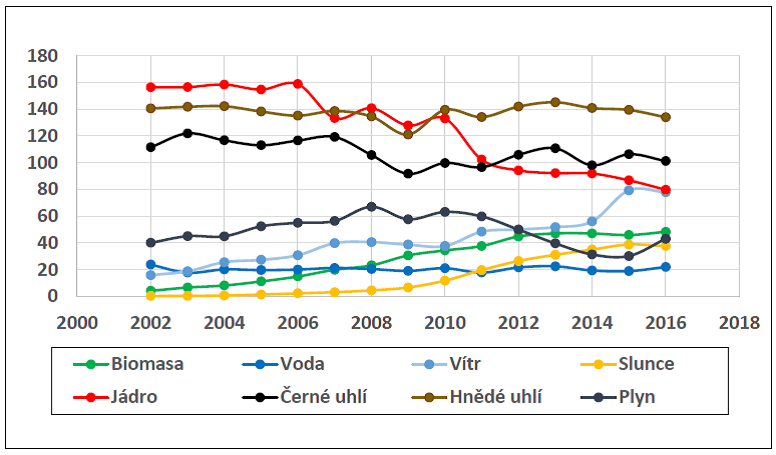
We will see the outcome of the conflicting decisions by different European countries in roughly ten years. By then, all nuclear units in Germany will have been shut down and, hopefully, transmission lines from wind farms in the north to industrial Bavaria in the south will have been built. Nuclear units in the UK, Finland and Hungary should also be completed. It will then be possible to compare the electricity-sector emissions resulting from the nuclear-free path of Germany, Denmark and Austria with the combination of nuclear and renewable sources in France, Hungary, Finland, Slovakia, Sweden and Switzerland. We will see what this map looks like in the aforementioned ten years: whether England, Finland and Hungary will be green like France is now, and what colour Germany will be.
On a global scale, the future of nuclear power depends on the success of Generation III reactors and, in the future, on new Generation IV reactors, including small modular reactors. A detailed analysis of the state of nuclear power, developments not only in the past year, and the outlook for the future is available here.
Translation disclaimer
This article is a machine translation of the Czech original and has not yet been fully reviewed. In case of any doubt, please refer to the Czech version.
Sdílejte článek prostřednictvím:
Topics:Opinion
You might also like
23 October 2026, 11:01
23 October 2026, 06:34