23 October 2026, 14:38
Loading...
Nuclear power in 2025, part 2: Asia’s nuclear renaissance is gathering pace
Vladimír Wagner
16 January 2026, 06:39
In the second part of our overview, we describe the nuclear renaissance already well under way in Asia. China is approaching the point where it will bring ten or more nuclear units online each year. South Korea is also maintaining a high pace, while the situation is improving in India as well. The question is how the war and sanctions will affect the state of nuclear power in Russia.
South Korea remains at the forefront of nuclear power development
It has been confirmed that the new president will also support the Korean nuclear industry, with the government seeking to develop it through offers of low-cost loans for small and medium-sized companies involved in the nuclear equipment supply chain.Saeul 3 and 4 (previously known as Shin Kori 5 and 6) are nearing completion. At the very end of 2025, the Korean nuclear safety authority issued a permit to begin reactor commissioning at Saeul 3. Fuel loading into the reactor will therefore begin in early 2026. This will be the fifth APR1400 unit to enter service in South Korea and the ninth overall.
Construction is also accelerating at Shin Hanul 3 and 4, which are expected to be completed in 2032 and 2033. The successful progress of reactor projects in South Korea is a very positive signal for their construction in Czechia.
South Korea is considering building two further large reactors by 2038 and also expects to construct several small modular reactors. The share of nuclear electricity should reach 35 % by then.
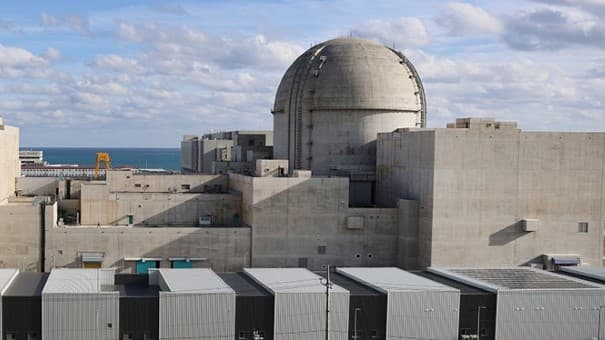
Fuel loading at the Saeul 3 reactor begins (source: KHNP).
China is racing full steam ahead to the forefront of nuclear power nations
China is meeting its plans, and this year the Chinese State Council again approved a total of ten reactors for future construction across five nuclear power plant projects. These are phase III of Fangchenggang, phase III of Sanmen, phase II of Taishan and phase I of Xiapu, all with Hualong One reactors, and phase III of Haiyang with CAP1000 reactors.This year, China also set an interesting national record for the length of uninterrupted operation of a nuclear unit. Such records are held by reactors in which fuel can be replaced during operation. These include heavy-water reactors. One such reactor is the first CANDU-6 unit at the Qinshan plant. It was shut down on 1 May 2025 after 738 days of uninterrupted operation. The world record is held by Canada’s Darlington 1 heavy-water unit, with 1,106 days of uninterrupted operation.
China has almost forty nuclear units under construction. These are predominantly Chinese Generation III Hualong One reactors and Chinese versions of Westinghouse reactors designated CAP1000 or the larger CAP1400 variant. A larger number of Russian VVER1200 reactors are also still being built in China. Let us look in more detail at the Chinese ones; the Russian reactors will be covered in greater detail in the section on Russian nuclear power. Readers not interested in excessive detail can skip ahead to India.
First, let us look at the Hualong One reactors. The previous overview reported on the start of construction work on the first pair of units at the new Jinquimen nuclear power plant. In August 2025, it received a construction permit from the Chinese nuclear safety authority and can proceed with preparations for pouring the nuclear island concrete for the first reactor. The second unit will follow a year later. The site will eventually have six Hualong One reactors.
Testing work continued throughout 2025 at the first unit of the Taipingling plant, and fuel loading began in January 2026, bringing its start-up closer. Hot hydrostatic tests were completed at the plant’s second unit in July, also bringing it close to fuel loading and the commissioning phase. The fission chain reaction could therefore begin at both units of the first phase of this plant in 2026. At the third unit, following the start of nuclear island concrete pouring in June 2025, the foundations and lower containment structures began to be built. The site is ultimately expected to have six Hualong One units.
Hot tests were completed at the first unit of the San'ao plant in mid-June, and fuel loading began in early January 2026. Cold hydrostatic tests were completed at the plant’s second unit at the beginning of October 2025, followed by hot tests. The first pair of six planned Hualong One (HPR1000) reactors is being built there. The units are expected to enter operation in 2026 and 2027.
Hot hydrostatic tests began at Zhangzhou 2 in April and the reactor was started up in November. At Zhangzhou 3, an emergency cooling vessel was installed at the top of the containment in March. Concrete pouring for the fourth unit’s nuclear island began in autumn. The site is to have six Hualong One reactors.
At Changjiang 3, the containment building for this Hualong One reactor was completed in July 2025. Cold tests had already begun in April. Completion of the containment dome concreting allows hot tests to begin, taking the reactor into the commissioning phase. The fourth unit should also be operating in 2027.
In September, agreements were also signed for the construction of another pair of Hualong One reactors approved last year. These are phase I of the Xuwei plant. A later phase is also to include a 600 MWe high-temperature helium-cooled HTRG reactor.
As mentioned, first nuclear island concrete was poured for the second unit of the Shidaowan plant in mid-May 2025, following the same event at the first unit last year. A total of four Hualong One reactors are expected to be built there.
Hualong One units are also being built in Pakistan. At the very beginning of 2025, concreting of the nuclear island began for this reactor, designated Chashma 5.
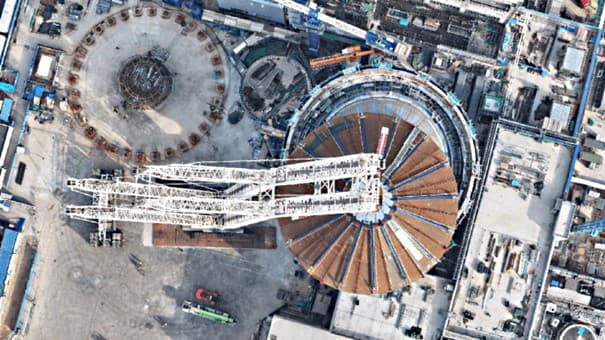
Installation of the outer dome steel structure at Haiyang 3 (source: SPIC)
And now to the Chinese variants of the AP1000 reactor. Two CAP1400 reactors are also being built at the Shidaowan plant; these are enlarged Chinese versions of the AP1000 reactor. The first unit is already operating and the second is nearing start-up in 2026.
The previous overview discussed the installation of the inner part of the containment dome at Sanmen 3 and Haiyang 3. At the end of March 2025, the outer steel structure of the containment dome was installed at Haiyang 3. In August, the final module, the emergency water storage tank, was placed on the containment dome, allowing the entire nuclear island structural work to be completed in October. At the fourth unit, internal reactor vessel structures were installed in June and the upper containment section was installed in early September. Both units are expected to be completed in 2027.
Four CAP1000 reactors are planned at the Lufeng plant. Construction of Lufeng 1 began in February 2025, with the lower containment section installed in April and the 990-tonne CA01 supermodule installed during September. Two Hualong One reactors had already begun construction as units 5 and 6. The inner containment dome was installed at the sixth unit in July 2025.
At the end of September 2025, earthworks began for the second unit of phase I of the Bailong plant. CAP1000 reactors are being built there. It should be recalled that this is a pair of units among the eleven approved last year. This too illustrates how quickly nuclear construction projects are being implemented in China.
In mid-February 2025, the reactor vessel for the first unit arrived at the Liangjiang plant construction site and was subsequently installed. By the end of October, both steam generators had also been installed. Construction of the world’s largest cooling tower was also completed. Two CAP1000 reactors are being built there for phase I. Completion of this unit is expected in 2028. The site is ultimately to have six CAP1000 reactors.
By the end of March 2025, a construction pit 12.2 m deep and with a volume of 66 000 m3 had been excavated for the pair of CAP1000 reactors in phase I of the Bailong plant. A number of contracts were also signed with future suppliers. A later phase of this plant is planned to include four CAP1400 reactors.
As can be seen, construction in China is very intensive and construction times are approaching the target of five years. For a fourth consecutive year, construction of ten new units has been approved annually, and this number is planned to be maintained or increased. China could soon have ten units approved every year, nuclear island concreting started at ten, and ten being commissioned. China’s nuclear renaissance is thus clear, and the country will quickly take the lead in both the number of units and generation from them.
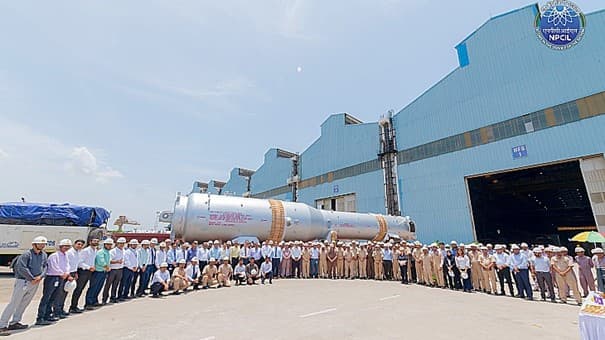
Steam generator for phase II of the Gorakhpur plant (NPCIL)
Note: After writing this overview, Emil Novák alerted me that the second CAP1400 unit is already in operation, although this has not yet appeared in the PRIS database because of the operator’s secrecy. When compiling statistics, I encounter considerable inconsistencies between statistics and information from different sources. Regarding units in operation, the criteria under which a unit is classified as such in a given information source are often not applied entirely consistently. There is also sometimes a reluctance to provide information, as in this case. I at least try to maintain consistency by strictly using WNA and PRIS data throughout my overviews. However, I always have considerable problems arriving at consistent figures, and I am aware of inaccuracies, for which I apologise.
India is working on nuclear power development
As mentioned, the third Indian 700 MWe heavy-water reactor entered commercial operation in 2025. Although the fission chain reaction at Rajasthan 7 began in 2024, it only started supplying electricity to the grid in 2025. Rajasthan 8 should start up in 2026.After long delays, Gorakhpur 1 is approaching nuclear island concreting, with the second unit expected to follow six months later. Completion is expected in 2031. This is a significantly delayed project, as construction of this reactor pair was meant to begin as early as 2018.
India’s nuclear safety authority, the Atomic Energy Regulatory Board (AERB), approved the site for the new Mahi Banswara nuclear power plant near the village of Napla in Banswara province in mid-May 2025, and construction work officially began in September. Four domestic 700 MWe IPHWR heavy-water units are to be built there. Other planned units of the same type are Kaiga 5 and 6, Gorakhpur 3 and 4, and Chutka 1 and 2. Steam generators for these projects were gradually completed in 2025. A total of ten more reactors of this type are to be built at this stage. Upon its completion, India should have a total of 16 such reactors.
Construction is also progressing on four new Russian VVER1000 reactors at the Kudankulam plant, where two such units are already operating. At the beginning of 2025, the reactor vessel for the plant’s sixth unit was delivered to the site. Manufacturing a reactor vessel takes two years. Fuel was delivered to the site for the third unit, and fuel for the other reactors will be delivered gradually. Construction of units 3 and 4 began in 2017, while units 5 and 6 began construction in 2021. Construction of units 7 and 8 is being prepared, with more powerful VVER1200 reactors to be used in this case. India is also preparing to build a second plant using Russian VVER reactors.
India wants to build both domestic and foreign reactors very intensively. Its plans are extremely ambitious. It now has 8.9 GWe of nuclear capacity and wants to have 100 GWe by 2047. This is to be enabled by intensive private-sector involvement and deployment of several domestic models of small modular reactors of different capacities.
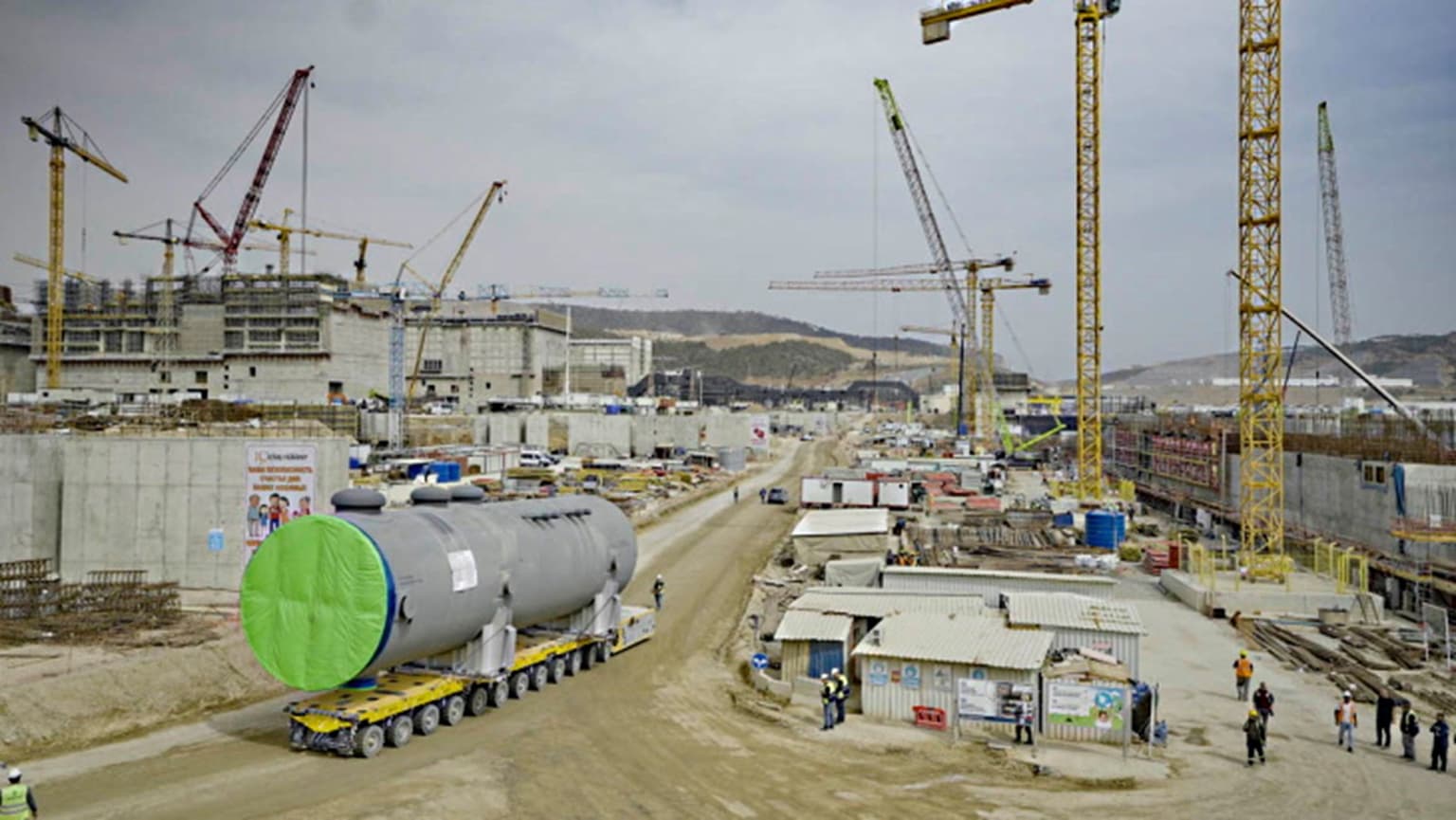
The first heavy components of internal equipment were delivered for unit 3 of Turkey’s Akkuyu plant (source: Akkuyu Nuclear).
Sanctions are beginning to affect Russian nuclear power
Russia is experiencing a dramatic decline across all technological fields. The situation is truly catastrophic in space technology. Nuclear power has held up so far, but the impact of sanctions is now visible there too. Above all, this is leading to delays in reactor projects that Rosatom is building abroad. Sanctions do not yet directly apply to supplies of nuclear technology and fuel, but problems are arising in transferring funds. This resulted in targets not being met in 2025. Projects directly in Russia have probably been affected the least, but the direct impacts of the war are apparent there. This applies particularly to the Kursk plant, where the most significant event of last year for Russian nuclear power nevertheless took place.The plant is located 60 km from the Ukrainian border, and its operation is also heavily affected by the war, particularly during fighting for the nearby town of Sudzha. This is also why the start-up of the first two VVER-TOI units in phase II of the plant has been delayed. For the first unit, this was pushed back to the very end of 2025. The reactor therefore supplied its first electricity to the grid on 31 December 2025. At that time, it was operating at 250 MWe. Output will now be gradually increased while all equipment is carefully checked. The unit will enter commercial operation in the first half of 2026.
At the beginning of March 2025, a permit was issued for preparatory work on the construction of the third unit of phase II of the Kursk plant, followed by the fourth unit in the middle of the same month. These will be VVER-TOI reactors. Completion of all new units is expected in 2034. The new units will replace four RBMK reactors from phase I of the plant, the first of which has already been shut down. Lifetime extensions are planned for units 3 and 4 of that phase.
The third unit at the Leningrad plant received a licence for another five years of operation, until 2030, at the beginning of February 2025. The same operating extension should also be implemented for the fourth unit. These are RBMK1000 reactors, with the third entering operation in 1980. Work is already under way on its replacement. The plant’s first two reactors have already been shut down and replaced by two new VVER1200 units. At unit 7, construction of which began in March 2024, the lower containment sections were built in 2025 and its height was gradually increased. Units 7 and 8 are expected to be completed in 2030 and 2032 to replace the shut-down RBMK reactors.
Work is under way to extend the operation of other RBMK units as well. Smolensk 2 received a five-year extension at the beginning of June 2025 and will thus operate until 2030. The first unit of this plant is licensed until 2027 and the third until 2034. The operation of Kalinin 1 should also be extended. Construction of replacements in the form of modern Generation III units is also being prepared for these reactors.
Russia plans to build an entirely new nuclear power plant on the Pacific coast near its borders with China and North Korea. The Primorskaya nuclear power plant will have two VVER1000 units. Construction is expected to begin in 2027 and completion is anticipated between 2033 and 2035. It is part of plans to intensify development in eastern Asian regions, which have become particularly relevant given Russia’s changing geopolitical orientation in recent years.
The start of operation at Turkey’s Akkuyu plant has also been delayed. Start-up of the first unit has been pushed back to 2026. In February 2025, backup diesel generators were installed and tested there, a necessary condition for beginning cold tests. Each unit will have three such backup systems. At the beginning of April, the first heavy component of internal equipment was delivered to the construction site of the plant’s third unit. It was a 259-tonne emergency water storage tank. Assembly of the reactor vessel for the fourth reactor was completed in August 2025.
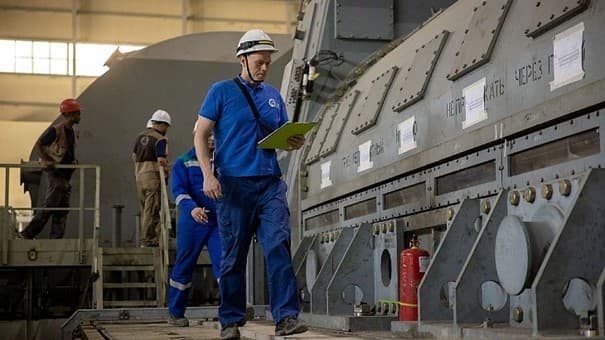
Turbine at Rooppur 1 (Rosatom)
Start-up of the first unit at Bangladesh’s Rooppur plant was planned for 2025. However, it has been postponed, partly due to sanctions. Cold hydrostatic tests at the plant’s first unit were successfully completed in March 2025. These test the leak-tightness of the primary circuit at a pressure of 24.5 MPa and corresponding temperatures. Turbine installation at this unit was completed at the end of March. Containment leak-tightness tests were then carried out during June, and hot testing of the equipment began in July. The fission chain reaction will therefore begin in 2026, with the second unit most likely starting up the following year. Construction of these units began in 2017 and 2018. Bangladesh is beginning to plan another pair of these units.
Assembly of the reactor vessel for the first unit of Egypt’s El Dabaa plant was completed during 2025; it was delivered to the site in November and subsequently installed. At the second unit, the containment walls were slowly rising. A total of four units are being built there. The contract covers not only reactor construction, but also fuel supply throughout operation, personnel training, construction of interim storage facilities and the supply of spent-fuel containers.
Cold hydrostatic tests were completed at Xudabao 3 in mid-December 2025, moving it into the phase preceding start-up. Its commissioning in 2026 or 2027 is thus approaching. At the fourth unit, the final large modules of the passive water tank located at the top of the containment were installed. This unit is likewise nearing completion.
Cold hydrostatic tests took place at Tianwan 7 in July 2025, marking the transition from reactor construction to commissioning, and hot hydrostatic tests began in early January 2026. The unit should enter operation in 2026, with Tianwan 8 expected to follow in 2027.
Delays are also occurring at Iran’s Bushehr plant, where a Russian VVER1000 reactor is being built as the second unit and the containment height increased in 2025. Nuclear island concrete pouring for the third unit was due to begin in 2025. However, it is uncertain whether it will take place even in 2026.
Belarus plans to build a third unit at the Ostrovets plant as well as another new nuclear power plant in the east of the country.
Kazakhstan has also decided to use VVER1200 reactors for its first nuclear power plant. The first Kazakh nuclear plant is to be built near the village of Ulken in the Almaty region. Geological surveys of the potential site began in August 2025. For its second nuclear power plant, it is considering a Chinese supplier. At the same time, it is seeking cooperation with other nuclear vendors.
Russia thus remains at the forefront of global nuclear power, but it remains very much an open question what impact sanctions and war costs will have on the state of this sector and Russia as a whole.
Lecture for Dominikánská 8 on the current state of nuclear power:
https://www.youtube.com/watch?v=IbmlYKj382I
Reflections on how to use nuclear energy and survive in the shadow of nuclear weapons:
Translation disclaimer
This article is a machine translation of the Czech original and has not yet been fully reviewed. In case of any doubt, please refer to the Czech version.
Sdílejte článek prostřednictvím:
Topics:Opinion
You might also like
23 October 2026, 11:01

23 October 2026, 06:34